Uncategorized

Time to change Title IX’s three-prong test

At The Guardian last week, I had a story on Title IX’s history and impact. It also delves into the issues the law — in this case, strictly the sports aspect of what was intended to be about education — will face in the future.

https://www.theguardian.com/sport/2022/jun/23/50-years-of-title-ix-the-us-law-that-attempted-to-make-sports-equal

I’d also recommend some excellent work at USA TODAY, starting with this timeline that is focused on but not limited to sports:

https://www.theguardian.com/sport/2022/jun/23/50-years-of-title-ix-the-us-law-that-attempted-to-make-sports-equal

Other parts of their anniversary investigations are behind a paywall, though if you’re an Apple News subscriber, you can find the stories there:

https://www.theguardian.com/sport/2022/jun/23/50-years-of-title-ix-the-us-law-that-attempted-to-make-sports-equal

It’s great to see my old paper revving up its investigative and analytical work. Almost makes me wish I was still there. Almost.

But enough about me and my career decisions. Let’s talk about how Title IX should be better.

For starters, we’re focusing on the wrong thing. Specifically, the gap between roster spots available for men and roster spots available to women. From one of the USA TODAY stories:

None was larger than the University of North Carolina, though. It would need to add 395 female roster spots, the analysis found.

I’m not predisposed to praise UNC’s sports program. I went to its arch-rival.

But … seriously?

The numbers are correct, I’m sure. But they show how Title IX watchdoggery is really missing the boat.

In the 2021–22 academic year, North Carolina’s women went unbeaten in lacrosse to claim their third national championship. The tennis team reached the NCAA semis after losing a streak of ACC titles going back 2015. The nine-time champion field hockey team fell short of the Final Four for the first time since 2008. The basketball team went 25–7 to return to its usual spot in the Sweet 16. The soccer team lost in the first round and will have to content itself with its 22 national championships (1 AIAW before the NCAA took over). The volleyball team made the NCAA tournament, and the cross-country and swim/dive teams finished in the top 20.

Does this seem like a university that doesn’t emphasize women’s sports?

And like a lot of colleges, North Carolina has several women-only sports: field hockey, gymnastics, rowing, softball and volleyball. Three sports are men-only: baseball, football and wrestling.

So why isn’t North Carolina in compliance?

Because the undergraduate student body in Chapel Hill is 60% women.

The primary intent of Title IX (educational opportunity) has been overwhelmingly successful at UNC. That makes the secondary intent (athletic opportunity) much harder to fulfill.

And that’s typical. A school with 60% women is increasingly the norm these days.
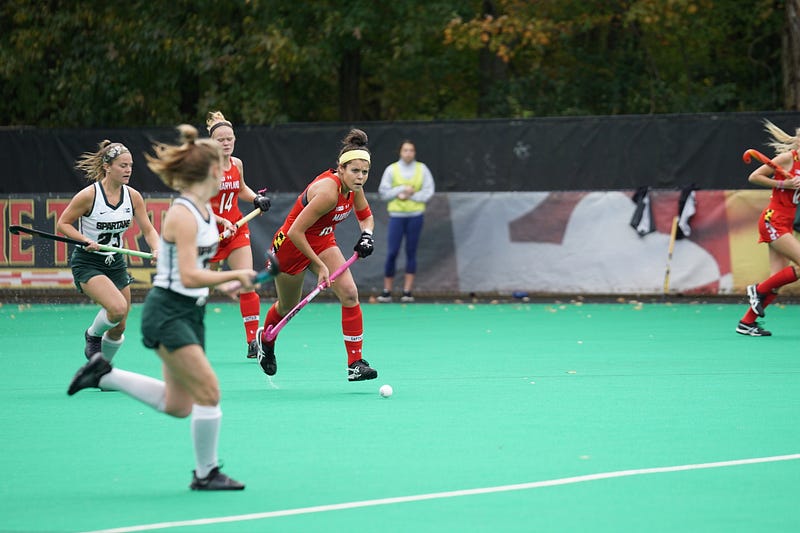
Photo by Jeffrey F Lin on Unsplash

Proportionality is just one of the three “prongs” in Title IX compliance, but it’s the one advocates and journalists are stressing these days. For one thing, it’s easier to quantify than “does the university have a history of expanding its programs for” or “is the university fully accommodating the interests and abilities of” the underrepresented sex.

The latter is archaic. The vast majority of student-athletes enrolled in their college of choice with the intent of playing that sport. Polling students who either chose not to play a sport in college or weren’t good enough to be recruited is nonsensical.

The “history of expanding” its programs quickly hits the problem of having no more reasonable programs to offer. A lot of colleges have added equestrian, a tiny sport whose competitors generally don’t need scholarships to go to college, just to make up the numbers.

For reference of the number of teams in each sport, start with the 2020–21 snapshot from the latest NCAA participation report:

https://www.theguardian.com/sport/2022/jun/23/50-years-of-title-ix-the-us-law-that-attempted-to-make-sports-equal

Field hockey and beach volleyball are for women only. Bowling has only three men’s teams. Women’s teams account for more than 80% of the teams in volleyball, equestrian, gymnastics and rugby, and more than 70% in rowing. (There are 940 men’s baseball teams, though that’s offset by 983 women’s softball teams.)

Would a national survey of students’ interests show us a pent-up demand for 50-woman rowing teams? Or bowling or equestrian? And would it show that men have no interest in gymnastics, rowing or volleyball?

But if you’re a “men’s rights” advocate, it’s time to go back to your cave. Women account for just 10.6% of wrestling teams, and that’s after a surge from 4 to 30 women’s teams since 2019. The NCAA’s overall participant count is still 56% men. The NCAA disburses massive prizes for men’s basketball and nothing for women’s basketball.

And there’s an elephant in the room, represented neatly by Alabama’s mascot. That would be 657 football teams.

Ah, football. The benefactor of all other sports, right?

Well, sometimes. At the very biggest athletics departments. Maybe. See the Knight Commission’s work in conjunction with Syracuse, or see Sportico’s database of big schools.

Mark Ziegler, one of the clearest-eyed columnists on such matters in the country, puts it more bluntly:

The next thing to understand is that women’s sports, with few exceptions, lose money at the intercollegiate level. Lots and lots of it.

Only about 25 of 1,100-odd NCAA athletic departments actually turn a profit, all of them in power conferences with huge TV contracts. Seventy percent of San Diego State’s athletic budget is subsidized by state tax dollars, student fees or booster donations.

And Ziegler’s piece points to a bleak future, in which football teams split off entirely from the university. Sure, lawyers would fight about it for years, but it could be a serious threat.

So what can we do? It’s not my place to rewrite the law, and not just because I’m a middle-aged man. But I have some suggestions …

Take a holistic view …: For some sports, going school-by-school misses the point. Why not go sport-by-sport? Does each sport have enough colleges offering it? Does an accomplished athlete in a given sport have enough places to play?

… especially with Olympic sports: The NCAA participation stats from yesteryear show the occasional archery or badminton team. Why not find a few schools that are capable of hosting such programs? A partnership with the USOPC could lead to small but successful programs that give students more opportunities while also boosting the U.S. teams. And in this holistic view, give exemptions so that a men’s team can exist where a women’s team exists — don’t just have schools add women’s badminton or women’s modern pentathlon for gender numbers. Maybe we can even have some men’s field hockey teams.

For proportionality, go by a 50–50 split, not enrollment: Why punish a school for being so successful at enrolling women? Conversely, why let a school off the hook for being 60% male, still? Encouraging more women to attend a traditionally male engineering school is a win-win, isn’t it? And basing proportionality on enrollment, again, is based on the assumption that students go to a school and then peruse the athletics department’s offerings.

Force football to pay the bills: Football advocates have long argued that their sport pays for all the others. Again, not always. In fact, rarely. The main reason for that is the proliferation of football facilities and staffers. Instead of funding the women’s soccer coaches’ recruiting budget, that money goes to the assistant to the assistant tight ends quality control coach on the football team. Let’s say this — if football-playing schools want an exemption from Title IX’s proportionality prong, they can do so if football really is paying for other sports.

Make sports match the general public’s interest, even if sports aren’t varsity: Remember JVs? They still exist in high school. The only junior varsity I know of in college is North Carolina’s men’s basketball JV. (As much as I defended UNC earlier, adding a women’s JV seems reasonable.) How many more good soccer players are out there? Probably more than we have equestrian athletes or even rowers.

By current accounting, every difference in men’s and women’s numbers is a “lost opportunity” or “lost scholarship.” But what “opportunities” do we want? A spot on a JV soccer team is more attainable to a more diverse group than a spot on a team in equestrian or other sports (rowing, squash) that generally exist only in expensive private high schools. And in terms of “lost scholarships,” there are a lot more athletes who “lose” scholarships in basketball players (men’s and women’s) than in the prep-school sports.

We can make Title IX work. We have to. It’s going to be under attack in the coming decades from people with reasonable (the numbers don’t work) and unreasonable (the recently emboldened patriarchy).

It’s been successful so far. Continued success means continued vigilance and examination.

sports, x marks the pod

X Pod Episode 2: Sports make the rich richer

The insistence upon exalting athletes and selling dreams of everything from Olympic gold to Ivy League college admission is turning sports into a miserable experience, especially for us parents and our kids. Also, Bull Durham is one of the best movies ever. Also, how do you explain 9/11 to a second-grader?

This episode has some audio glitches that I hope to squash in future episodes. At one point, I think I picked up some extraterrestrial communications. If the aliens invade, episode 3 of this podcast might take a while.

Links from this episode:

journalism

How not to do social media (or, why Stephen A. Smith is not a role model)

A brief history of U.S. media: 

1950s: Calm, maybe a bit boring. Newspapers and TV news don’t have much competition, and they usually don’t want to rock the boat. 

1980: CNN launches. They strive to be taken seriously as a news-gathering organization to this day — a 2016 report shows they had a whopping 31 international bureaus. 

1996: Rupert Murdoch’s global empire, which loves to do things on the cheap and tawdry (I actually did a grad-school paper on this in the late 90s), launched Fox News Channel. They take the worst aspect of CNN — talking heads yelling at each other — and go all-in with that. In that same 2016 report, they have only three foreign bureaus. It’s just easier to prop up someone in front of a camera to yell a one-sided take on things for an hour before handing off to the next person who does the same thing.

2001-02: ESPN launches Pardon the Interruption, turning the newsroom conversations of Washington Post columnists Tony Kornheiser and Michael Wilbon into a rigidly formatted show, and Around the Horn, a panel discussion of “competitive banter.”

2006: Twitter is launched. 

2012: ESPN goes all-in on “debate” by re-hiring Stephen A. Smith, who had gained fame and infamy in his previous work. 

Today: LEBRON JAMES IS THE NO SHUT UP BERNIE BROS SOCCER STINKS EXCEPT RAPINOE AMERICAN FLAG LIBTARD! 

Or something like that. 

Over the past few weeks, Stephen A. Smith has been facing some of the worst backlash of his career. It’s generally not a great idea for anyone to claim a beloved hard-working fighter quit in a fight, especially when you haven’t established any credentials for knowing what you’re talking about, but that’s exactly what Stephen A. did in talking about Cowboy Cerrone after Conor McGregor smashed him in the first and only minute of their recent UFC fight. 

To get some sense of how this commentary has been received in the circles of people who know the sport and followed Cerrone’s career, including his five absurdly difficult fights compressed into one year, check this podcast excerpt from Luke Thomas’ SiriusXM show. (Start at 37-minute mark for the Smith content.)

To an extent, Thomas is also in the “hot takes” business (he used to do a segment called “Hot Takes Tuesday,” challenging listeners to come up with occasionally outlandish opinions), but he does his research and listens. So when Smith’s ever-shifting defense of his ignorant Cerrone turned to “I’m just trying to start a conversation,” Thomas correctly paraphrased that as “I’m going to fart in a room and then leave.” 

It’s easy to get suckered into the “hot takes” frenzy. I know this because … I’ve done it. 

I was a relatively early Twitter adopter because I was USA TODAY’s new media guinea pig for a while. When I went to the 2008 Olympics, I was asked to join Twitter and share observations as I ran around China. I got maybe 4,000 followers, a pretty good number in those days. 

Over the years, I’ve shared my candid thoughts, especially on soccer. Sometimes people like that, and it’s easy to get a big head when a lot of people agree. 

It’s also easy to piss off a lot of people.

The sport I’ve covered the most in the decade since I left USA TODAY for the novel concept of “seeing my family on weekends” is women’s soccer. Even before leaving, I did a lot in the sport. I did feature stories on women continuing to play without a pro league in the doldrums of the mid-2000s, then covered the sport in the 2008 Olympics, site of the U.S. women’s least-expected win. Then I spent a year freelancing for ESPN, covering the early rounds of the 2011 Women’s World Cup and the demise of Women’s Professional Soccer. 

My WoSo cred started to go downhill in 2013 when I wrote a book following the Washington Spirit through their first year of existence. Over the course of a woeful season, a vocal group of women’s soccer fans and media (at the time, the fan media was gaining a much louder voice than in any other sport I can think of) grew angry and angrier with the team’s management. Some were certainly hoping for some great investigation of how management ruined everything, but I simply didn’t have anything along those lines, and I defended them against some of the less substantial criticism. 

Over the years, I’ve staked out some unpopular positions. I questioned whether Megan Rapinoe’s kneeling during the national anthem was the most effective political protest, pointing out that she wasn’t having much success articulating a message behind the protest. (She has since grown into that role, much to her credit.) I called out Marta for diving. And at some point, I surely offered a mild criticism of someone’s favorite player. 

Case in point — a former women’s national team player was so angered by my take that Crystal Dunn had some shaky moments defensively for the U.S. women’s team that she said I should count her “the long list of people that don’t respect you and have cut you off.” That was after I pointed out that I respect Dunn so much that I told my soccer-playing son to watch her specifically when we went to Washington Spirit games.

And over the next few years, I’ve learned a lot about how NOT to engage on social media. Not many people can say they argued about the works of Ayn Rand with longtime U.S. goalkeeper Hope Solo, and a lot of the discussions I’ve had over the years have been enlightening. 

But some of my interactions have given me some hard lessons. 

Such as … 

Don’t be too flippant 

Even if you intend to be on someone’s side, it’s far too easy for a Tweet to be misinterpreted. 

And that’s why Landon Donovan, a soccer player with whom I’ve spoken frequently and of whom I’ve written glowing tributes, blocked me. 

I meant it as satire of the current discourse. And I tried to make sure Donovan took it as satire with a follow-up tweet. 

That didn’t do it. I’m blocked to this day.

But that was one person. When I was watching and tweeting about an NWSL playoff game, I said the following about Alex Morgan, who was out injured in that game: 

And Morgan did the equivalent of releasing the hounds:

I watched Twitter responses spin through so fast I thought my computer would explode. One person offered to buy my Spirit book and smack me in the face with it. One person offered to kill me twice. No, not two messages saying he would kill me. This would apparently be a double murder, with me as the victim each time. Not sure how that works. 

How did I get in this mess? With another mistake …

Don’t assume people know the context 

The Morgan tweet came in the midst of a discussion about national team players getting a lot of breaks from referees in the then-new NWSL. Out of context, it looks worse than it was, but that’s my fault. 

The Donovan tweet was similar. If he could’ve read my mind, he wouldn’t have been offended. 

Twitter is not a medium for telepathy.

You’d think these lessons would sink in, but oops, I did it again, and it brings up another thing not to do …

Don’t give a gut reaction 

In covering women’s soccer and U.S. soccer politics as long as I have, I’ve found a couple of things … 

1. The “equal pay” dispute is far more complicated than people think. Australia and Norway have alleged “equal pay” deals that would not satisfy the U.S. women’s team because the sticking point is World Cup bonuses, which are drawn from international prize money that is heavily weighted toward men.

2. The marketing around the U.S. women’s team is that they inspire little girls to be what they want to be. Some people take it literally and think every youth soccer player is on the field hoping to go pro, and I can tell you from a decade of coaching that they’re wrong. But some believe images of powerful women are helpful, and I can’t argue with that. 

3. U.S. Soccer is a deeply flawed federation. But its mandate is clear. It’s supposed to grow the game for all — both genders, able-bodied and Paralympian, youth and adult, etc. It’s a nonprofit organization that has planned to spend a big pile of assets, gathered up through a decade of improved sponsorship deals and hosting the wildly successful Copa America Centenario in 2016, for the betterment of soccer as a whole. 

So when the U.S. women file a motion for summary judgment in their 3½-year legal wrangling that tosses around a number of $66 million, a good bit more than the $42 million U.S. Soccer plans to have after its five-year plan, I see alarm bells. 

I start to question whether the women (and men, who recently presented a suggestion that the women’s pay should be tripled, surely with a corresponding raise for themselves) are trying to take away money earmarked for future generations.   

I got the notice about that court filing late at night. Here’s my response … 

Then I brought up some context from my reporting … 

But then came the tweet that drew the backlash … 

And the people who responded didn’t know what I meant. 

The biggest issue: People thought I was telling the U.S. women their role is to “inspire little girls.” I thought people would understand that I was referring to their public perception, not some mansplained assertion of what they should be doing. I was clearly wrong.

If I had stopped to think about it a little more, maybe I would’ve realized I wasn’t completely clear. Maybe I should’ve waited until the next morning and wrote a blog post so I could establish the context. 

In the frenzy that followed, I forgot another lesson.

Don’t engage with everyone

Some people, you just can’t reach. 

I tried to be selective in my responses, picking out people who had a significant number of followers. Two people who attacked me were journalists who followed me at USA TODAY, and I tried to contact them off Twitter. To my dismay, neither one has responded. 

It’s a natural instinct to defend yourself when you’re misunderstood, and every once in a while, you’ll have a productive conversation. But you can’t appear to have a thin skin. 

Flame ways generally have no winners, with the exception of the rare occasions in which truly horrible people try to engage with people who have an audience and a brain: 

Perhaps the lesson here is that if you commit to remorseless unexamined shouting, as Stephen A. Smith has done, you can make a career out of being a bad guy to many and a truth-speaker to a small cult. That just seems like a terrible way to live. 

So I’m giving up Twitter discussion for Lent. When I come back, maybe these lessons will finally take hold.

Or I can just take Smith’s job.