Just sending this out to anyone who still subscribes to Mostly Modern Media on WordPress — check out the new version on Substack:
Author: Beau Dure
The guy who wrote a bunch of soccer books and now runs a Gen X-themed podcast while substitute teaching and continuing to write freelance stuff.
A reminder of relevant NASL lawsuit material after seven years
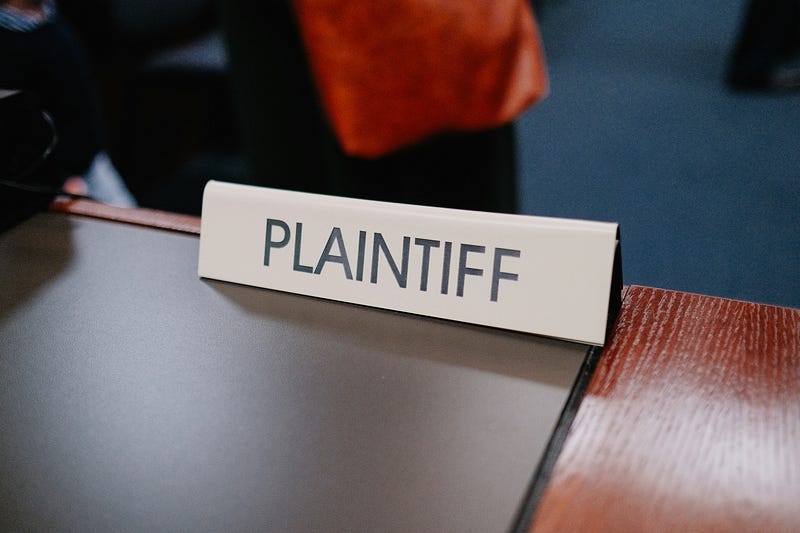
Why is the NASL still suing US Soccer?
A cynic would say it’s because their chief legal representative in the case, Jeff Kessler, is still seeking his first win in court against the federation after a series of losses. (The fact that he and his legal team made several million from the settlement of the women’s team’s lawsuit shouldn’t erase the fact that, in the only legal decision in the case, he lost — which was not a surprise to lawyers who looked into it and spotted the problems that were obvious to a judge and would’ve been obvious to the appellate courts.)
https://www.theguardian.com/football/2022/dec/16/uswnt-equal-pay-settlement-case
Another cynic would say it’s because the people who ran the NASL, especially firebrand New York Cosmos owner Rocco Commisso (who, by way of disclaimer, is the man who answered one of my questions on a media conference call by asking if I was the idiot who said all those stupid things on Twitter — I think the best counter would be that I can’t possibly be the only idiot on Twitter), still want to extract a pound of flesh from the federation for failing to do their bidding and let them build a league that would directly compete against Major League Soccer, which had spent 20 years building a market for professional soccer that had collapsed when the NASL’s namesake quickly withered and died in the mid-80s after a spectacular but brief run.
A less cynical person would say … probably nothing. Because if you can’t say anything nice …
I say that with great care because I know a lot of good people worked in the NASL and with its teams, hoping to combine the glitz of the disco-era Cosmos with a traditional promotion/relegation league with clubs that aren’t as strictly limited as they are in MLS. Whether they were pursuing those specific goals are just trying to broaden the reach of professional soccer in this country, they were trying to accomplish something positive. Having a league system in this country outside MLS could be a lot of fun as long as it’s set up in a way that doesn’t make both leagues collapse, as happened in indoor soccer. And yes, maybe at some point, if we don’t have traditional promotion/relegation, we could have more competitions open to clubs outside MLS — or at the very least, the US Open Cup could get more interesting.
But the best gauges of the merits of the case are these:
- In 2017, Judge Margo K. Brodie denied the NASL a preliminary injunction to maintain Division 2 status. If you followed the proceedings in court, that ruling was hardly a surprise. After that, the NASL appealed, as is customary for a Kessler client no matter what chances they actually have. They lost in 2018, and the league hasn’t played since.
- This month, Judge Brian M. Cogan kicked the guts out of the lawsuit but allowed part of it to continue. I’ll need to let Steven Bank, the UCLA law professor who has long been the go-to expert for analyzing all the cases the federation has heard over the years, explain, even though it means I’ve had to go back on the platform formerly known as Twitter (Professor, please switch to Threads!):
https://x.com/ProfBank/status/1801296697018159575
Losing part of the case to summary judgment while keeping a weaker part intact will be familiar to those who remember when Kessler led MLS players in a lawsuit against the league in its embryonic stages in the late-90s. I spoke with many players from that time for (plug alert) Long-Range Goals, my league history that was published in 2010, and it’s safe to say there’s a bit of regret that they pursued legal action rather than collective bargaining. By the time Kessler got to court in 2000, three things had happened:
- League attendance had plummeted after its initial boom, and its viability would remain a hot topic well into the 2000s, which effectively undercut the credibility of the sports economists who flocked to the case to argue that so-and-so would be making two or three times as much money if the league didn’t have such tight controls. The fact that the league struggled to attract investors to a structure that minimized risk didn’t speak well to the league’s prospects for attracting investors to one that maximized it.
- US players were getting more opportunities overseas, undercutting the notion that MLS had any sort of monopoly power.
- Judge George O’Toole granted summary judgment against the most substantive parts of the case, including an argument over the validity of the “single-entity” league structure as a defense against antitrust laws — a decision lawyers continue to debate even after the appellate court left it alone in 2002.
Here’s a cartoon explaining the latter:
If you’re a lawyer or law student with an interest in antitrust matters, you’ll seize upon this from the appellate decision for future briefs and law review articles:
In all events, we conclude that the single entity problem need not be answered definitively in this case.
But from a practical perspective on this case’s own merits, the sentences before that one show that the appellate judges understood full well why the plaintiffs were doomed from the start — essentially, that MLS did what it had to do to get professional soccer going in this country.
(T)he fact that MLS was structured with the aim of achieving results that might not otherwise be possible does not automatically condemn it. …
Indeed, the best arguments for upholding MLS’s restrictions-that it is a new and risky venture, constrained in some (perhaps great) measure by foreign and domestic competition for players, that unquestionably creates a new enterprise without combining existing competitors-have little to do with its structure.
So Kessler was arguing with one hand tied behind his back. That didn’t stop him from attempting the legal gymnastics of arguing that England had two “first divisions,” a claim that forced the players bringing the suit to take the witness stand and feign ignorance about the existence of promotion and relegation.
To bring it back to the NASL, one of the many layers of irony is that the league put itself forward as the banner-carrier of the promotion-relegation movement, though it never had a concrete plan for doing so and adopted the branding (both “NASL” and “Cosmos”) of a league and a marquee team that scoffed at tradition, breaking ties with 1-on-1 “shootouts” and passing on the US Open Cup and CONCACAF (North American) regional tournaments. The only aspect of the old NASL that the new NASL carried forward was a lack of central league control. The old league expanded and spent wildly, creating a boom that was more of a bubble. Its collapse was precisely what MLS (and US Soccer, which gave the league its blessing as the country’s only “Division 1” league) wanted to avoid from the outset, even if it meant people like Kessler would cry foul.
From what I’ve seen in the media, Kessler seems quite pleased that he’ll finally get his day in court. But that day in court didn’t go well for him 24 years ago, and there’s little reason to think it’ll go any better this time — in court or out of it — for a handful of reasons.
- MLS and US Soccer have established quite well that through their cautious, controlled approach, they were able to do what no other entity has done — build a successful pro soccer league in the United States. Courts and juries have already found that MLS can’t be faulted for an approach that yielded full-scale professional soccer where there had been none.
- MLS now pays pretty well and is able to sign a lot of the best young players in the Americas, along with global superstars like Beckham and Messi, even while US players finally get their due in Europe and have even more job opportunities — thereby once again undercutting the Kessler case of anticompetitive behavior.
- A faceless, dormant soccer league is a less sympathetic plaintiff than MLS players, let alone the US women’s players who got a generous settlement due to the court of public opinion, not the court of law.
- At the time the suit was filed, US Soccer was perceived as a bit arrogant under the leadership of longtime president Sunil Gulati and longtime CEO Dan Flynn. (It has to be said, though, that US Soccer grew from about $14m in assets to about $162m in less than 20 years with Gulati and Flynn playing prominent roles, which I believe outpaces inflation by quite some distance.) After some tumult, the federation has found its groove under Cindy Cone, a Hall of Fame player. The biggest complaint to be found against Cone is that she has favored the vastly overpaid (by comparison with their peers) US women’s and men’s teams while granting fewer resources and paying less attention to grassroots development, but it’s safe to say that beyond nerds like me, that complaint gains little traction in a media landscape that will favor players over “the establishment,” even if the establishment is a nonprofit organization responsible for all levels of soccer in this country rather than a billionaire team owner.
When I analyzed the case in September 2017, I argued that both sides bore a bit of the blame.
https://www.theguardian.com/football/2022/dec/16/uswnt-equal-pay-settlement-case
But US Soccer helped keep second-division soccer in this country alive, stepping in to administer a stopgap league when owners were breaking away from the long-standing USL. No good deed goes unpunished, apparently.
While the suit was fresh, I also wrote a timeline, constructed from court documents and a few outside reports.
https://www.theguardian.com/football/2022/dec/16/uswnt-equal-pay-settlement-case
Take note especially of Traffic Sports, which in 2012 owned a lot of teams in the league and was the subject of a lot of indictments in 2015. Kessler and the NASL argued to seal the league’s settlement with Traffic, but Judge Cogan disagreed.
And upon re-reading the timeline now, I’m remembering so many colorful scenes such as the time a team’s minority owner literally took half of the team’s field. (Updated link to The Oklahoman’s story.)
The healthiest NASL clubs — Indy Eleven, North Carolina FC and Miami FC — eventually moved to the rival USL. The Jacksonville Armada will relaunch next year in the new rival to the USL, MLS Next Pro. The San Francisco Deltas were already collapsing when the league lost its injunction battle, FC Edmonton played in the Canadian Premier League before going defunct, and Puerto Rico FC unfortunately followed every other effort to establish a professional presence on the island.
That leaves the Cosmos, whom Commisso bought from the scrap heap just in time for them to play in that final NASL season in 2017, eked out appearances in a short-lived NPSL pro division and in NISA before going dark again.
A victory on what’s left of this case probably isn’t going to bring the Cosmos back to life, though the brand has been written off and returned several times in the past. It’s even less likely to spin them a league in which they can fulfill their notions of reviving the glory days of the mid-2010s, let alone the late 1970s.
A victory won’t create a lot more professional opportunities for soccer players in the USA. These days, the bigger concern driving soccer investment is the NWSL, anyway, and women’s soccer is also — perhaps ironically, given all the wrangling over “Division 1” status in men’s soccer — getting a second Division 1 league in the USL Super League, which kicks off in August and will play primarily in the months the NWSL is idle.
But there’s a fundamental question at stake here:
Who stands to benefit from this case?
Let me know — because I’ve come up empty.
Kessler actually has a much better case against the federation in a different suit, representing a promoter called Relevent Sports, mostly because FIFA has decided there’s more money to be made in backing international club games in countries like the United States that fighting them. The case was dismissed in 2021 and revived last year. But with FIFA reaching an agreement with Relevent, it seems little will now stand in the way of Premier League and La Liga games being played in the United States — another slap in the face of the traditional league structures a lot of MLS critics and NASL backers claim to support but will forget about if they can bask in the glory of Barcelona and Manchester City for a couple of hours.
No one really wants those games to take place. But they’ll surely be such hot tickets that only the lawyers can afford tickets.
What was Leon Dure up to?
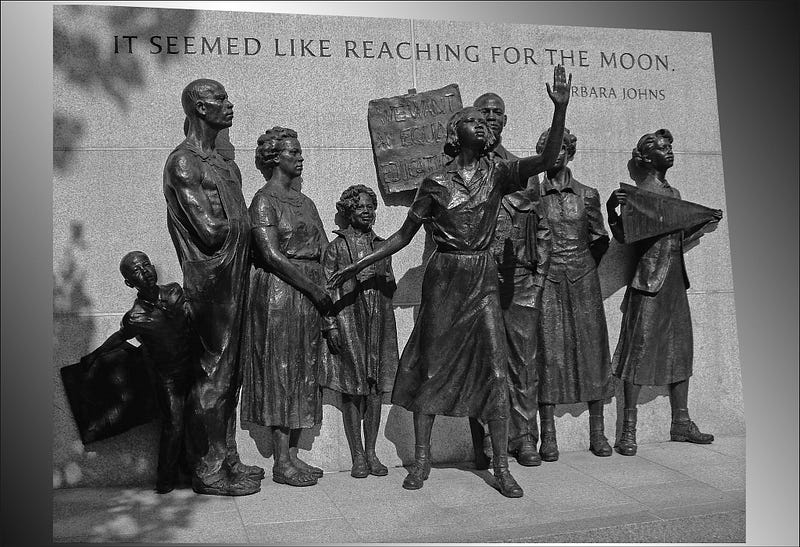
Well, first, we have to be more specific. There are at least five Leon Dures in a line that branched out from Macon, Ga., to parts of the world not yet determined.
But in this case, I’m talking about Leon Dure Jr., who led a fascinating life. He graduated from the University of Georgia, and by his own admission, that might have been generous. He was not the most dedicated of students. He was, though, a dedicated reader, and that undoubtedly served him well as a journalist and his distinguished service in WWII, about which I know only that it involved some sort of intelligence work and the unfortunate acquisition of some chronic gastrointestinal issues. I regret that I know so little about the former, but I know all I need to know about the latter.
He retired from journalism to become a gentleman farmer, seeing himself as a latter-day Thomas Jefferson, equally adept at raising crops and writing influential letters and articles from the rolling landscape around Charlottesville.
Unfortunately, the cause for which he’s best known was, like the cause of many of his ancestors, regarded today as being on the wrong side of history. That cause was school segregation.
No, Leon Dure Jr. wasn’t one of the lowlife scumbags who assaulted the Freedom Riders. He was far more erudite than that. But he was also more complex. He wasn’t a cartoon villain like Steve Bannon or a Fox Infotainment Channel anchor. He would’ve been appalled by the rally in Charlottesville where people chanted “Jews will not replace us” and Heather Heyer died, and he surely would’ve had no patience with any cult-leader politicians who said there were “fine people” on “both sides.”
A well-written biography at Encyclopedia Virginia captures an intellectual life that doesn’t fit neatly in one box. While still in Georgia at the Macon Telegraph, he led the way to give Black people courtesy titles such as “Mr.” and “Miss,” a symbolic but important sign of respect. He also told North Carolina colleges that they would accept a female sportswriter, the legendary Mary Garber, whether they liked it or not.
On the other hand, there’s no denying that he wrote letters and journal articles suggesting a way for white parents to ensure that their kids never had to associate with Black kids. He used a clever argument — if the Constitution granted us a freedom of association, it must also have granted us the freedom not to associate.
You may have guessed by now why I have such an interest here. Leon Dure Jr. was my grandfather. You’ll also find Leon Dure III and Leon Dure IV in scholarly journals, but they’re scientists, and I’d need considerable help deciphering their work or any work that cites them. I was once interested in being an engineer, but I never had any desire to be a biochemist or neurologist. I’m a journalist like my grandfather. Like many inherited maladies, journalism apparently skips generations.
And there are other strands woven together in this web of Southern political trivia. The school that was told to accommodate Mary Garber in its pressbox was Duke, which happens to be my alma mater. And Duke appears in this story again because some historians have accused a Duke professor, Nancy MacLean, of neglecting my grandfather’s work in her book Democracy in Chains: The Deep History of the Radical Right’s Stealth Plan for America.
I have no desire to wade into an academic argument over James Buchanan — not the president accused of bungling pre-Civil War tensions but a Nobel laureate accused of being too sympathetic to segregationists. That argument is being contested mostly by members of libertarian-leaning think tanks, and like my favorite band Rush, I outgrew libertarianism in my young adulthood. Maybe I’d have more sympathy to libertarians if Reason magazine and its commenters would put up a more forceful resistance to the least libertarian president in American history, Donald Trump, but alas, I’ve found all too many people in my life who reach for Atlas Shrugged as cover for their unwillingness to admit that a lot of people in this world suffer misfortunes that are not of their own doing, and any sensible form of morality would say we should help such people directly rather than misreading Adam Smith and thinking “the invisible hand” will lift them all. While I was at Duke, the libertarians were the ones who wanted to defend their right to urinate out their dorm windows.
Where was I? Oh, right …
Despite my inclination to believe a Duke professor over a gaggle of people funded by the Koch family (speaking of people who’ve put up a comically ineffectual resistant to forces bent on stripping away our liberties, thereby showing their true colors), I’m indebted to Phillip Magness, Art Carden and Vincent Geloso for reporting something I did not know — my grandfather’s work was seen as too accommodating by the hardcore segregationists of the day:
Shortly after the initial publication of his tuition grant plan in January 1958, Dure began receiving anonymous personal threats by mail on a regular basis, including pieces intimating they originated from the Ku Klux Klan.
Imagine if they’d known he gave courtesy titles to Black people in Macon!
Magness took the debate to a blog post on Democracy in Chains by Ben Alpers, and my grandfather’s name was invoked once again. The context would take a while to explain, but I believe Magness is attempting to claim that people like Buchanan who shared my grandfather’s views on school choice weren’t really mean old segregationists.
Alpers responds by re-establishing the context that a paper by Nutter and Buchanan (A) directly challenges the Brown vs. Board of Education decision and (B) draws upon my grandfather’s clever argument:
First, it states as axiomatic that substantive education decisions should rest entirely with state and local governments. This, in effect, assumes the illegitimacy of Brown. Just as crucially, it presents as the attractive “middle option” between the wholly public and wholly private extremes “the plan associated in Virginia with Mr. Leon Dure.” Dure, a prominent journalist, was the creator and chief advocate of “freedom of choice of association” as a way that the South could successfully resist federal demands to integrate schools. (Alpers then links to Encyclopedia Virginia.) So, in short, despite not discussing race (much) directly, Nutter and Buchanan’s paper is an argument for what was, in 1959, the cutting-edge segregationist position in Virginia state educational debates.
My grandfather died when I was in my early 20s. I can’t say I had the opportunity to have many meaningful conversations with him, sadly. He was tickled that I went into newspaper journalism as he did. He thought news should be based in objectivity, which I still generally uphold as well. At the same time, he thought I needed to write something about the greatness of Margaret Thatcher, to which I just nodded politely and changed the subject to the putting greens at his retirement complex in Florida.

(I found another paper I need to read now.)
But there’s no surprise here. Alpers is right. Whether my grandfather or Buchanan ever expressed any outright prejudice is irrelevant. The system they wanted to instill was not good for Black people, and it was naive to ever believe otherwise.
My grandfather wasn’t one to bear animosity. The Klan guessed correctly that he wasn’t one of them. I believe he genuinely believed that his plan was the best for everyone involved, including Black people. But that belief is rooted in what we might call “white privilege” today, though I’m wary of that term.
Magness responded to Alpers:
The particulars of the 1959 paper are certainly interesting and certainly open to criticism. For example, I suspect it is more a case of naivety with what Dure was up to, or more broadly a case of underestimating the depth of the problem with the segregationists, than the more malicious motives depicted by MacLean.
My guess is the opposite. Granddad was probably a bit naive about the effects of his school choice plan on Black people, not fully recognizing that “separate but equal” doesn’t work in practice. People who are closer to the halls of political power are typically less naive. As we see today, they may not share the racism of the rabble, but they’re more than happy to exploit it. Granddad would’ve been horrified to see that.
This tangled web has another ironic thread. Throughout the South, there was an explosion of private schools as public schools were desegregated. My school, Athens Academy, came into being during that time. I have no desire to slander its founders, though, and I can report that less than two decades after it was founded, my school had far more diversity of thought and diversity in its student body than a lot of the “Christian” indoctrination chambers that dot the Georgia landscape. These days, all the more so. Whether any founders harbored ill intent isn’t something we can discern. The ones I met all had good hearts. Most important, the school puts forth a few dozen well-educated kids each year.
Today, I devote a lot of my working life to schools. I’ve been in schools that are predominantly wealthy — not necessarily white, because we have a lot of international families — and in less homogeneous schools that are full of first-generation Americans whose primary at-home language is not English. I think the students who race up to give me a hug before plowing through their schoolwork prove that Granddad’s concerns about “not associating” were overblown. But I’d like to think he’d be happy to hear that. It’s nice to be wrong every once in a while.
X Marks the Pod parodies 60 Songs That Explain the 90s
I love the podcast 60 Songs That Explain the 90s, by The Ringer’s Rob Harvilla. It’s now inaccurately named, having gone beyond 60 songs.
Rob goes on entertaining personal digressions. He has a unique style.
Which, of course, I have felt compelled to parody, like Weird Al doing Eat It or Ridin’ Dirty.
So this is also full of personal digressions that I hope are entertaining. Either that or you’re going to come out of it saying you now know way too much about me.
Enjoy.
A social contract (updated for 2022)
Most of us don’t want a civil war.
Most of us want politicians who are smart enough to understand the issues and humble enough to know when they need outside expertise.
Most of us want drivers at a four-way stop sign to go in the order of when they arrived at the intersection.
And yet the media insist we’re divided. …
Consider poll numbers right after Jan. 6. (The one in 2021, not the year in which you’re reading this.) A Reuters/Ipsos poll released two days after the Capitol assault found:
- 57% of Americans wanted Trump out. Immediately. Not Jan. 20.
- 72% strongly opposed the assailants’ actions. 9% somewhat opposed.
- 79% described the assailants as either “criminals” or “fools.”
- 55% strongly disapproved of Trump’s actions on Jan. 6. 7% somewhat disapproved. 6% “lean toward” disapproval. Only 16% “strongly approved.” (Again, this was 18 months before the hearings on the matter.)
- 57% said lawmakers trying to block certification of the election were “criminals” or “fools,” while another 16% didn’t know.
The purpose here isn’t to put forth some sort of Milquetoast Moderatism. There’s no middle ground between “the left” and the people who ran into the Capitol alongside people bearing Confederate flags and anti-Semitic slogans. The people on the “left” who commit political violence are swiftly denounced and hold no real power; the people on the “right” who do so are given political cover by a party that refuses to participate in an investigation of an assault on democracy.
But there’s no reason We the Common People Who Have Things in Common can’t rise above all of the hatred, all of the ignorance and all of the fundamental disrespect that manifests itself everywhere from political protests to merge lanes on the interstate. We have more in common that we think, and we need to demonstrate that in a show of strength to disarm the haters.
And we agree on a lot more than simply denouncing the Proud Boys, “antifa” or the misinformation miscreants who have taken over cable “news” in prime time. We generally agree on guns, abortion and immigration. Agreement, though, makes poor prime-time ratings.
The social contract I’m proposing here has three stages:
- Stop the Republican Party now. Apologies to old-school Republicans, but given the evolution of the two-party system, the GOP mainstream has become driven by a desire to “own the libs” and limit our freedoms to do so. The Democrats are the lesser of two evils, or in some cases, a bit better than that.
- Get rid of the two-party system.
- Just be nicer. Period.
In doing so, we’ll have better tools for building on the things on which most of us agree. Maybe the good feelings will even trickle down to four-way stops. Or at least stop people in a backup on the interstate from pulling into the shoulder and passing five cars before merging back in.
Through a lot of American history, we’ve agreed on what we wanted to do but disagreed on the specifics. The sooner we can get back to disagreeing on things like “the role of private corporations in health care” instead of things like “the use of misinformation to enable violent hatred” or “whether it’s OK to threaten health officials,” the better.
So the following is a list of common goals. We can debate the specifics while the white supremacists go back to playing soldier in the woods, “antifa” goes back to the drum circles, and Putin’s apologists fight their Twitter bans.
Here goes …
The basics
1. Amplify experts, not “alternative facts”
We should be debating how to address climate change, not whether it exists. We shouldn’t be able to lie about crime statistics to demonize immigrants or people of color. We shouldn’t spread fatal deceptions about COVID-19. And we shouldn’t be stirring up violent mobs with fanciful tales of election fraud that have been rejected by every possible adjudicating body. (Also, we did indeed land on the moon, and the Earth is not flat.)
An epidemiologist might know more about COVID-19 than your “liberal”-bashing pastor. Climate scientists might know more about climate than economists. If you don’t believe that, let your doctor fix your plumbing and vice versa.

A journalist spends more time researching the issues than the majority of people do. They’re human, and they’re subject to biases — most of them not partisan but economic. For some reason, we’ve decided to exalt talk-show hosts who don’t do any homework or even admit that their shows aren’t good sources of fact. And we’re getting medical info from Gwyneth Paltrow rather than medical experts. We’re falling for dangerous conspiracy theories.
It’s too easy for progressives to think this is simply a right-wing problem or limited to Joe Rogan’s podcast. The fact is that a lot of today’s bullshit stems from the postmodern relativism incubated in academia. You can’t peddle theories about science being nothing more than a hegemonic patriarchal social construct and then expect people to show up at a climate change rally. This anti-expert bias has, of course, moved into the media.
You don’t have to assume someone’s right just because someone has initials after their names. We have plenty of quack doctors shilling for bullshit products, after all. But if an overwhelming number of biologists see evolution as the fundamental backbone of biology, you might want to use some skepticism when you step into that creationist museum.
2. Respect empathy — and each other
The USA is built in part around a belief in the “rugged individual.” And to some extent, that’s not a bad thing. Nothing wrong with self-reliance. The problem is when we think we owe nothing to each other, and that’s a problem that’s growing.
If World War II happened today, would we have the national resolve to sacrifice everything from our material comfort to our lives to turn back fascism? Back then, people ran unprotected at machine-gun nests to help their fellow human being. At the height of COVID, a lot of people wouldn’t even get a shot or wear a mask in an effort to protect other people from getting a disease that could kill them, hospitalize them or give them long-term problems. “It’s my choice whether I want to protect myself,” the argument went. The arguer showed no capacity to consider the impact of letting a disease run rampant, putting a lot of other people — or even themselves — into overtaxed hospitals.
A bit of hostility isn’t new. We had an actual Civil War. We’ve always had bumper stickers venting hostility. But it’s becoming more mainstream, with public servants (please note the word “servant”) no longer trying to stay above the fray. It’s bad enough when someone puts a “Let’s Go Brandon” sticker on a car. It’s worse when Florida’s governor alludes to that juvenile slogan while signing an order against COVID vaccine mandates.
We’ve turned empathy into a weakness. Donald Trump Jr. in particular loves to gloat about people feeling “triggered.” The people he’s trying to bully are far more courageous than he is because they’re brave enough to care. We need that bravery.
3. No more violent or destructive protests
Yes, this applies to the downtown Portland occupation and other left-wing protests as well. Leaders who matter, like Joe Biden and Atlanta mayor Keisha Lance Bottoms, denounced the looting and the attempts to bait police into responding.
It applies to showing up at Josh Hawley’s house (near mine, incidentally) or Brett Kavanaugh’s house.
This isn’t a case of “bothsidesism.” It’s just recognition that this is a reasonable conversation:
“Jan. 6 was abhorrent.”
“Would you say the same about the protest in East Urbanville in which someone was killed?”
“Yes.”
Well, that was simple.
So no more destruction of property. Public or private. Doesn’t matter. The people who suffer from this destruction — the shopowners, the sanitation workers, the taxpayers, the Capitol Police — are never the people you’re trying to hold accountable.
No more death threats toward election officials trying to oversee a fair vote or school board members trying to keep schools safe. Nor more assaulting college professors who bring conservative-ish speakers to campus. And “Antifa”? You’ve given anti-fascism a bad name.
Again, no “bothsidesism” or “whataboutism” here. One “side” is more dangerous than the other when you look at the number of armed groups rehearsing for war and the willingness to stampede past the police into the Capitol, and they still have apologists in Congress. Doesn’t matter. You can denounce murder while also denouncing sucker-punching someone in the street.
4. Listening, not lecturing
Speaking of counterproductive measures — “cancel culture” and “woke” excesses are clearly turning people against progressives. Rushing to judgment inevitably leads to hypocrisy.
To give an example for Millennials and younger generations: A lot of people over 35 didn’t grow up knowing how to be allies or anti-racist. If you’re under 35 and learned such things, congratulations. If you’d rather pass judgment on older people (and dismiss their life experience/expertise), isn’t that a little ageist?
If you won’t listen to other people, why would they listen to you?
We need to fight racism. Obviously. But that means unifying people against racism, not making them feel they can never help. Condemning other people only hardens your alleged enemies’ minds. We need persuasion.
5. Listening, not labeling
Canadian politician Michael Ignatieff wrote the following:
“For democracies to work, politicians need to respect the difference between an enemy and an adversary. An adversary is someone you want to defeat. An enemy is someone you have to destroy. With adversaries, compromise is honorable: Today’s adversary could be tomorrow’s ally. With enemies, on the other hand, compromise is appeasement.”
On a more basic level, we equate listening with weakness. Trump rose to power because he seemed less willing to compromise than the Bush family and their peers. And he didn’t listen to anybody. Not even his intelligence briefing, according to those radicals at the CIA.
Listening will help to get rid of the labels. A “progressive” is simply someone who wants progress, which should apply to all of us. A “liberal” should be someone who loves anything that liberates. A “Christian” should be someone who welcomes other people with humility and compassion in the name of Christ, reserving judgment to higher powers. A “Southerner” is someone who lives in or was born in the South, not necessarily an uneducated racist.
Joe Biden isn’t a communist. He’s not even socialist. And in this country, we hardly know what “socialist” means, anyway. We certainly don’t know what “conservative” means — the Venn diagram between Ronald Reagan’s ideology and Donald Trump’s is nearly two separate circles. There’s also a considerable amount of diversity within the Democratic Party, plus third parties such as the Libertarians, Greens, actual Socialists, and the American Solidarity (Christian Democrat) Party.
When we see multiple perspectives rather than two “sides,” we can stop the knee-jerk opposition. Put country above party. Stop whataboutism. Be skeptical, but not cynical.
What we need
6. Work toward economic security
Trump preyed on those who felt they were being left behind in Obama’s strong economic recovery. We can debate the solutions he offered and the sincerity with which he offered them, but we can see that people wanted to feel like they were heard and that someone was going to take care of them. Democrats should make the argument that a strong safety net and opportunities to switch careers are the best path forward, and Republicans should certainly have a say in how to do that.
7. Let no one go uninsured
Obamacare, single-payer, Medicare for all or most, or a public-private partnership we haven’t considered — debate the options all you want, but recognize that the model of having employers foot the bill has fallen apart because it’s an albatross on small businesses and the “gig economy” leaves people stranded. Also, consider the economic argument that someone is paying for emergency treatment for the uninsured, and that’s hardly the most efficient system.
Another advantage of #6 and #7 here: If your basic needs are met, you’re free to innovate. You can take risks. A safety net with insurance is stereotyped as a benefit for leeches, lazy people who refuse to work. If you’d like to build in safeguards, go ahead. But bear in mind that this isn’t a strictly socialist idea. Universal basic income, after all, has long had conservative backers. (Not that we’re keeping labels.)
The reforms
8. Rein in presidential power.
We shouldn’t have to spend the last days of a president’s term worrying that he’s going to pardon everyone who has inflicted damage on our country. And both parties have complained over the decades about the expanding power of the executive branch.
9. Rein in the major parties.
“The alternate domination of one faction over another, sharpened by the spirit of revenge, natural to party dissension, which in different ages and countries has perpetrated the most horrid enormities, is itself a frightful despotism. But this leads at length to a more formal and permanent despotism.” – George Washington
“There is nothing which I dread so much as a division of the republic into two great parties, each arranged under its leader, and concerting measures in opposition to each other. This, in my humble apprehension, is to be dreaded as the greatest political evil under our Constitution.” – John Adams
They warned us of a cycle of retribution between two warring parties who put their own interests ahead of the country’s. They anticipated a future in which “owning the libs” (or “cons”) passes as ideology.
The point of elections isn’t to put a specific “party” in office. It’s to hold people accountable for their misdeeds. And mistruths.
10. Reconsider our election process.
The Electoral College disenfranchises people who aren’t in “swing” states, and it can easily give us presidents who didn’t win a majority of votes. Tying yourself in legal pretzels to try to invalidate or suppress votes is anti-democratic.
We can also get rid of the “lesser or two evils” phenomenon with voting systems that give third parties a chance. Yeah, some of them are a little “out there,” but plenty of them deserve to be heard. The problem today is that a candidate can win a Senate seat or electoral votes with less than a majority. Major Party A gets 49% of the vote in a state, Major Party B gets 48%, and Major Party B asks the other 3% why they wasted their votes or ruined Hillary Clinton’s chances of stopping Donald Trump. Consider a “ranked-choice” system or approval voting, and we should at least have a winner the majority of us can live with.
Maybe even get rid of presidential primaries, which give the first few states and states with “caucuses” far too much of a say.
11. Focus on solutions
It’s all well and good to put forth an idea like getting rid of prisons. But you have to follow up with details on how that’s supposed to work — in this case, without rapists and murderers roaming the streets.
And let’s not pretend problems just magically go away. From Y2K to polluted rivers, we human beings have solved a lot of issues.

Common-ground issues
Polls find that we agree on a lot of things:
- A wealth tax
- Minor tweaks to Obamacare — or allowing people to buy into Medicare. Anything that will keep people from going bankrupt because of an illness.
- On guns: background checks and assault-weapon bans
- Some legal abortion — at least, not a total ban
- Legal immigration, which has been severely inhibited by some of the same people trying to stop illegal immigration
We can agree on a few more.
- Job training. We’ll work with educators to prepare you for jobs of the 2020s, not the 1920s.
- Education without crippling debt. We’ll work with colleges to get you in the door. If you can only afford to spend two years in college now, we’ll work to create a two-year degree that means something. You’ll be an informed citizen with job skills. And whenever you’re ready to complete a four-year degree, online or in-person, you can pick right back up where you left off.
How will we pay for all this? Simple. We’ll make the wealthiest people in the country pay a sum approaching what they paid back in the old days when America really was great, when we rebuilt the world after World War II and became the shining light of freedom and prosperity.
And in those days, the gap between rich and poor was smaller.
We surely also agree on rebuilding infrastructure — I don’t know of a “let us fall through a crumbling bridge” lobby. And improving education, even if the approaches vary wildly.
“Conservatives” can help to solve those problems when they don’t deny they exist.
“Progressives” can help to solve those problems when they’re not taking every question of viability as an ignorant attack by a worthless person.
“Centrists” can help to solve those problems when they’re following the facts and not simply trying to please everyone’s ill-supported whims.
“Libertarians” can help … somehow. Maybe?
Fascists and communists can move out of the way. Preferably to an as-yet-unpopulated part of the Sahara or Siberia.
And most of us don’t need these labels. We need to see past them.
Also, if you’re merging when an interstate drops one lane, wait your turn and do a zipper merge. Not because it’s the law, but because it’s the right bloody thing to do.
Deal?
A letter to the person leaving the FUCK BIDEN stickers at Starbucks
Dear Sir,
(I think it’s safe to assume “Sir.” I hate to stereotype, and a lot of women have risen to prominence with confrontational tactics recently, but it seems more likely that a man did this. Maybe you’re the person I once saw in this Starbucks who was telling his daughter the government had implemented “social justice scores” and then got mad at me when I Googled it, saying you didn’t ask to fact-checked. Or maybe not.)
I’m not going to try to convince you to vote for Biden in 2024. I’m not even going to try to convince you to vote for Democrats in 2022.
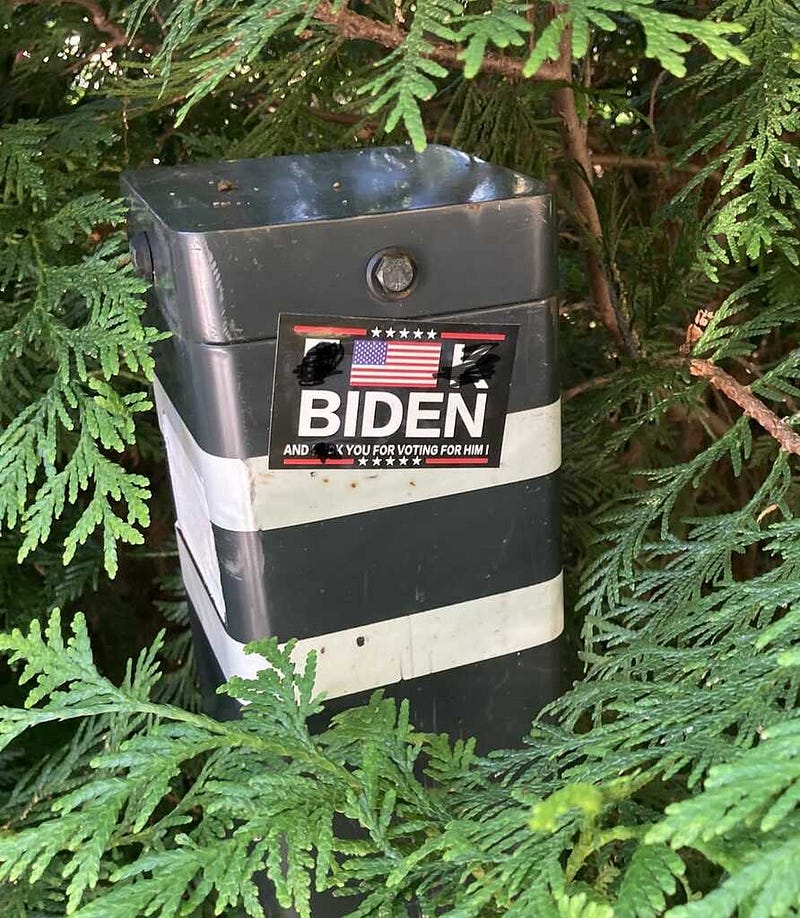
After all, you’re not trying to convince anyone to vote a certain way, either. “FUCK BIDEN AND FUCK YOU FOR VOTING FOR HIM” isn’t an argument, per se. It’s simply unfocused anger.
I’m guessing you’re posting this sticker on the Starbucks drive-thru bollard — for the third time, as of this morning — because you feel that you’ve been left out of the political power structure. You’re a minority — nationally, and certainly here in Northern Virginia. Biden’s approval ratings are low, but that’s a measure of the public’s disappointment in him, not their hatred.
And perhaps you feel compelled to do this after your candidate, the former president, has been publicly shamed and disgraced. He was twice impeached. It’s becoming clearer and clearer that his vanity, lack of empathy, and lack of intellectual curiosity led to a disastrous presidency and then a violent attempt to slash the heart of democracy. Perhaps you think he’s been unfairly accused. Perhaps you regret supporting him.
So you’re upset that people hate Donald Trump. A majority of people. A substantial majority of people.
But here’s a surprise for you:
We don’t hate you.
I’m making a few assumptions here. I assume you’re not a Proud Boy or an Oath Keeper or a white supremacist. I assume you don’t wish violence upon gay people. Perhaps I’m wrong, but I don’t see these stickers as a sign of blind hatred.
I think you feel lost.
Maybe it’s difficult for you to wrap your head around the way society is changing. It’s more diverse, and even if you’re OK with people of color or LGBTQ+ people in the abstract, you no longer feel culturally at ease with everyone around you. It’s OK. That’s normal. I’ve attended basketball games in which I was one of maybe five white people in the gym. I’ve been at a dinner table in which the majority of people at the table were lesbians. No matter how well-intended you are, it’s an adjustment. It takes time. I grew up as a conservative Christian who feared diversity. I’ve learned that it’s a wonderful feeling to embrace it.
Maybe you’re concerned about inflation. That’s also OK. Paying more for groceries and gas is inconvenient for some but forces a lot of people to make difficult decisions with their money. It eats into their savings. All I can tell you is that inflation is complicated, and the world’s top economists have a lot of different takes on why it’s happening and how to stop it. It’s nothing Joe Biden is doing intentionally to hurt you. If he could snap his fingers and stop it, he would.
Now here’s the flip side. We are scared. Donald Trump could’ve snapped his fingers and stopped a riot that caused some people to die and caused many more to be injured and traumatized. He didn’t. The people who walked the streets of Charlottesville chanting, “Jews will not replace us,” before one of their own drove a car into a crowd and killed someone could’ve snapped their fingers and stopped the violence. They didn’t. The people placing refugees in cases and separating them from their families could snap their fingers and stop it.
They didn’t. They aren’t.
Sometime in the past couple of decades, the people who do these things stopped trying to persuade us that they were right. Instead, they shout down their neighbors at school board meetings. They gloat about “triggering” people.
Well, yes. We’re “triggered.”
Because we care. Because we have the *courage* to care.
Consider the location of this Starbucks. It’s in Fairfax County, Va., in an area where most of us are white and affluent. As long as we’re not gay and we’re old enough to die before the bills fall due for climate change and all manner of debts, we have absolutely nothing to fear personally from a bunch of Republicans. Even if abortion law gets more stringent, we have the means to take a little “vacation” somewhere — even if it’s Ireland or France — where we can “take care” of things, no matter our religious or political views.
Maybe that’ll make you stop and think for a minute. “Wait a minute,” you think. “The people I’m mocking and bullying here — they’re not consumed by hate. They’re not even voting for their own self-interests.”
For the most part, no, we’re not.
Because we don’t hate.
We don’t even hate you.
We hate that our political landscape is so toxic, so dominated by the merchants of fear who have taken over the media, that you feel powerless. That you feel the only way you can participate is to sneak a sticker onto an otherwise useless bollard that partially obscured by nature.
We hope it changes.
But even more than that — we invite you to help us change it.
Yes, you.
We can talk about how to address inflation. We can talk about the best path forward in Ukraine. We can talk about how to deal with climate change — do we take stringent action to cut emissions, or do we work on adaptations, or some mix thereof? We can even talk about the specifics of when it’s OK to have an abortion — how late in the pregnancy, what kind of circumstances, etc.
But we can’t talk on a bollard. We can scratch away the sticker, you can replace it, we can scratch it away again, and what’s that getting us?
So let’s talk.
Leave a comment here. Go on social media and try to engage with someone who seems willing to have a conversation. Find out why people feel the way they do.
You’ll find that it’s not because anyone wants to oppress you. No one wants to shut down your church — though I’d imagine your pastor might want a word with you upon seeing what you’re sticking on this bollard. No one wants to take your job — unless it’s a progressive-leaning job that appeals to the Millennials and Zoomers who are specifically seeking those, but, no offense, I don’t think that’s the job you have. No one wants to groom your daughter to be gay — just be warned that she might be, anyway, and your neighbors will be there to support her either way.
You’ll find that we voted for Joe Biden and will do what we can to stop Donald Trump because we care. That’s not going to change because you said, “FUCK YOU FOR VOTING FOR HIM.” If anything, it’ll stiffen our resolve to go out there and make sure the Democrats win the midterms. (The Senate map at the moment actually looks pretty good for the Blues.)
Because we care.
We even care about you.
Enjoy the rest of your summer.
 Mostly Modern Media