
Need a little pick-me-up now?
After ripping Spotify’s current top 20 — which is full of lazy beats, misogyny and narcissism — it’s time to go the other direction and prove that good music is indeed being released this century.
This playlist is limited to music released from 2000 to 2020, and each artist is limited to three songs. It spans several genres and several levels of popularity, from ubiquitous pop artists to local bands who deserve a wide audience.
(Yes, the 21st century began in 2000, not 2001. If we were counting the years from a specific event, then yes, we could insist upon starting the century at 2001. But our system of counting years is arbitrary. It’s pegged to the birth of Jesus, but we didn’t exactly have birth certificates 2,019 or 2,026 years ago. Just as “the 90s” includes the years 1990 to 1999, there’s nothing to prevent us from calling the 100-year stretch from 2000 to 2099 the “21st century.” Take that, pedants!)
Enjoy …
Aimee Mann, Lost in Space (2002)
The titletrack of Mann’s best album, criminally underrated by many critics, makes drifting away from reality sound so cool and makes apathy sound friendly.
If you ever have a chance to see Mann live, go. She often surrounds herself with comics who help her laugh about a generally downbeat catalog of songs.
Alanis Morissette, Everything (2004)
The queen of Gen X romantic rage and attempted irony takes a dramatically different turn here, marveling at her partner’s willingness to take the good and bad she offers. The juxtaposition with her back catalog of revenge against her ex-lovers makes this sweet tune that much more powerful. If you’re looking for something unconventional to play at a wedding, you could do worse.
Angela Perley and the Howlin’ Moons, Athens (2014)
It’s a pity we don’t have a radio format for crossovers between indie rock and country. Music critics think that space is exclusively reserved for Wilco, which has never released anything as evocative as this wistful song about her college town — I still wish it was my childhood home in Georgia rather than the one in Ohio — and the hold it will have on her heart even as she travels onward with her adult life. She’s also one of the sweetest people you could ever meet.
Anna Nalick, Shine (2011)
You may know Nalick from Breathe (2 a.m.), which was in Grey’s Anatomy and a few other shows and movies. Kudos to various producers for their good taste, but this song is even better, building to an uplifting chorus in which Nalick’s voice simply soars.
Belly, Shiny One (2018)
Yes, this is the same Belly that had the MTV hit Feed the Tree, made it to the cover of Rolling Stone for their second album, then broke up. A couple of decades later, they reunited with the same lineup, including bassist and cancer survivor Gail Greenwood, and Tanya Donelly’s musings on parenthood are a nice sequel to the mystical landscapes she conjured in the 90s.
Bloc Party, This Modern Love (2005)
From the band’s debut album Silent Alarm, a smash in the U.K., this lovely song of yearning is a masterclass in wringing emotion from dynamic contrast built around simple guitar lines. The band continued to churn out quality songs, from 2007’s I Still Remember to 2015’s The Love Within. The rhythm section changed in the 2010s, adding drummer Louise Bartle, who was a preteen when Silent Alarm was released and 20 when she joined the band.
Soon after Bartle and American bassist Justin Harris joined, the band did a beautiful live performance for the BBC with a small choir.
Blondie, Fun (2017)
You don’t see many 1970s-80s New Wave/punk bands hitting №1 on the dance charts in the 2010s, but Debbie Harry and company pulled it off, with drummer Clem Burke still providing irresistible beats.
The Cardigans, I Need Some Fine Wine, and You, You Need to Be Nicer (2005)
The eclectic Swedish band, best known in the USA for the Romeo + Juliet soundtrack song Lovefool, delved into quirky power pop here with some propulsive guitars and the classic line, “Baby, you’re foul in clear conditions, but you’re handsome in the fog.” And cowbell.
Todd in the Shadows summed up their career, lamenting their one-hit status, in an entertaining roundup.
Chris Stapleton, Midnight Train to Memphis (2017)
This song has such a classic country-blues vibe that it’s hard to believe it was written in the 21st century. Stapleton’s powerful voice captures the bitterness of an imprisoned man.
Deap Vally, Smile More (2016)
Never tell a woman to smile more. Don’t do it. Or you might find this guitar/drum duo, a bit like The White Stripes with a more versatile drummer and a feminist growl, calling you out.
Death Cab for Cutie, Cath … (2008)
Not many songs combine 90s alt-rock riffs and a reference to Wuthering Heights. (The book, not the Kate Bush song.) An inventive drum part from Jason McGerr, a stately bass line from Nick Harmer and an intricate guitar part provide a hook-laden backdrop for the tale of a woman settling for Mr. You-Might-Do. (Reference stolen from a comedian from maybe 30 years ago.)
The Derek Trucks Band, Already Free (2009)
The great Southern blues guitarist shines on this song about standing defiant in the face of depressing circumstances. The final solo in particular is a searing statement of resilience.
Drive-By Truckers, Thoughts and Prayers (2020)
The alt-country band from my hometown of Athens, Ga., once employed country sensation Jason Isbell. Just in time for the election, they released this biting take on that phrase we hear from politicians who could actually do something more. They’re happy to tell you where to stick it.
Dropkick Murphys, The Green Fields of France (2005)
The Bostonians who typically turn up the volume on Celtic punk turn it down here for a plaintive reading of an anti-war ballad, alternately called No Man’s Land, written in the 70s by Scotsman Eric Bogle. It’s addressed to a young man killed in World War I whose grave the narrator has just found.
Electric Six, Danger! High Voltage (2003)
Let’s have some fun. Here’s a bouncy mix of funk guitar, disco bass and power chords.
Enter the Haggis, Year of the Rat (2013)
Another Celtic-inspired band, this one from Canada, even though it plays in Northern Virginia so often it’s as if they’re from Fairfax. This one sounds mostly like an indie-rock waltz but with pipes instead of guitars in the solo. This album, The Modest Revolution, is a concept album of sorts, with the band taking Toronto’s Globe and Mail newspaper on March 30, 2012, and writing songs inspired by the stories therein. I can’t find the reference now, but I believe this one is a meditation on financial advisors in a tower facing imminent arrest.
Evanescence, Bring Me To Life (2003)
One of the few legit rock songs to reach the heights of the Top 40 this century, this song somehow incorporates a lot of touches from the oft-derided nu metal genre without drifting in Limp Bizkit territory.
Foo Fighters, All My Life (2002)
Hard to believe this timeless alt-rocker was released in this century. The riffs are as powerful as any classic rock tune, and the drums add some rhythmic twists.
Foo Fighters, Rope (2011)
Another strong set of riffs and inspired drum fills, this song paints a picture of a flailing person at the end of his, well, rope.
Green Day, Jesus of Suburbia (2004)
The punk concept album doesn’t hang together that well on the whole, but it produced several solid songs, most notably this epic that races through a variety of sonic landscapes as adeptly as Yes did in the early 70s. (And much better than Yes did after that.)
Live? There’s a reason this video has nearly 15 million views.
Guster, Amsterdam (2003)
As they evolved from their early days as a trio with two guitarists/bassists and one guy who beat the bejeezus out of everything with his hands, Guster hit the sweet spot of college rock, expanding their instrumentation while continuing their steady stream of sharp hooks and lyrics.
Jack White, Lazaretto (2014)
No one does more with less than the former White Stripes frontman.
Jonatha Brooke, Linger (2001)
The sprightly hooks in this one inject a measure of defiance into this tale of a dysfunctional relationship.
The Joy Formidable, Whirring (2011)
There’s nothing subtle about many of this Welsh power trio’s songs, and this one builds up from its brash choruses to a massive wave of noise.
The Joy Formidable, Cradle (2011)
A short blast of powerful guitar rock from a short, powerful guitarist, paired nicely with a video set almost entirely on a see-saw. Another great song and video: This Ladder Is Ours.
July Talk, Summer Dress (2012)
This Canadian group made the best videos of the 2010s, building on the theatrical interplay of Peter Dreimanis and Leah Fay as a couple of people trying to figure out what the other wants. Summer Dress is the best song, a playful blues-rock tale of a prodigal man. Guns + Ammunition is a little spookier, featuring a video that twists and loops like a Mobius strip. Picturing Love, built on a stately electric piano riff, treads the line between reality and porn fantasy. The best of these compelling videos is Beck and Call, in which Dreimanis and Fay act out their conflict over whether they want more than their hookups.
The Killers, Somebody Told Me (2004)
The soaring vocals and bouncy bass line are a strong combination.
Macklemore & Ryan Lewis (feat. Ray Dalton), Can’t Hold Us (2012)
More hip-hop should feature percussive piano and a melodic vocal hook in the chorus.
Mark Ronson and Bruno Mars, Uptown Funk (2014)
If you don’t like this song, there might be something wrong with you. Mars’ super-smooth vocals, a no-nonsense funk guitar riff and a killer bass line are irresistible. Besides, what else could’ve been the soundtrack for a video of the U.S. cross-county ski team dancing all over Europe?
The Mars Volta, Cotopaxi (2009)
Not too many songs with wailing vocals, abstruse lyrics, aggressive guitars, 11/8 verses and a 9/4 bridge are this catchy.
Metric, Gimme Sympathy (2009)
As perfect a piece of dreampop as you’ll ever find.
Metric, Love You Back (2018)
A heavy industrial guitar riff leads nicely to Emily Haines’ yearning vocals. The video is a fun mix of fan videos interspersed seamlessly with shots of the band. (You have to know the band members to pick them out.)
Metric, Now or Never Now (2018)
We’re getting serious now. This is the soundtrack for anyone over 40, a sort of carpe diem for people who have the added stakes of not being 20 any more. Emily Haines’ lyrics and typically gorgeous vocals mix a sense of resignation with a strong claim of agency, and Jimmy Shaw’s guitar blasts are as pleasant a kick up the backside as you’ll ever find.
Minipop, Ask Me A Question (2007)
Shoegaze music doesn’t get any dreamier than this.
Muse, Stockholm Syndrome (2003)
The power trio’s third album, Absolution, features two showcases for its rhythm section’s dexterity. Hysteria is built on a complex, propulsive Chris Wolstenholme bass line. Stockholm Syndrome features an inventive, powerful performance by drummer Dominic Howard.
Muse, Knights of Cydonia (2006)
A great review said if U2 weren’t full of shit, they wouldn’t be as great as they frequently are. Same goes for Muse. Some of their operatic numbers are downright unlistenable, with Matt Bellamy’s vocals screeching into self-parody. But when it comes together, it works, even in an oddly constructed song that roars through several genres, from spaghetti Westerns to space rock to flat-out power guitar rock. And Bellamy’s a damn good guitarist, as shown on this astounding performance at Wembley Stadium:
Muse, Panic Station (2013)
Muse also excels when they strip things down and throw a curveball such as the old-school R&B infusion in the guitar and bass here.
Nicole Atkins, Maybe Tonight (2007)
The Jersey singer’s voice is a national treasure, and no song puts it to better use than this timeless-sounding tune that wouldn’t sound out of place if recorded by a 1960s girl group. And the video is a dazzling single-shot (not really) stroll through a fun cast of characters in some sort of vaudevillian touring company.
Nicole Atkins, Girl You Look Amazing (2013)
Atkins veers a little closer to indie pop with this playful song and hilarious video.
Paramore, Hard Times (2017)
Misery Business is the more famous song, thanks to layers upon layers of guitar hooks and dazzling drums underneath a breathtaking vocal performance by the then-teenaged Hayley Williams. But they won’t play that one any more because the “Mean Girls” aesthetic no longer suits Williams, who shows a more mature side with this fun take on dealing with difficulty.
Phoebe Bridgers, I Know The End (2020)
This tour of various genres starts out as a simple singer-songwriter piece with Bridgers’ wispy, wistful voice singing about travel and longing. Then it veers into more of an indie rock feel and shifts gears into a wry take on an apocalypse. By the end, it’s a giant cascade of sound. She explains it all in a fun video for Genius.com.
The Pretty Reckless, Take Me Down (2016)
If rock is dead, why would Taylor Momsen give up acting to lead this gritty band through a retelling of the old Crossroads tale with evocative vocals, agile bass, massive drum fills and some gospel singers? (I’m playing bass on a cover version.)
Queens of the Stone Age, No One Knows (2002)
Speaking of rock not being dead, here’s a romp through some quirky chords (C minor, G … B??) fueled by Dave Grohl’s over-the-top drumming.
Rachael Yamagata, Reason Why (2004)
The Queen of the Breakup Song infuses this piano ballad with a quiet dignity, reflecting on what could’ve been but moving on without malice or regret. (If you want a more frightening Yamagata breakup song, try the haunting Elephants.)
R.E.M., Leaving New York (2004)
My fellow Athenians wrapped up their career with two albums straight out of the garage, in the best possible sense. Before that, they recorded this lovely song with spare, dissonant verses and a majestic chorus that makes the inherent self-loathing sound beautiful somehow.
Rilo Kiley, Wires And Waves (2001)
The Californians struck it big a few years later when Portions for Foxes was featured on the first episode of the long-gone medical drama Grey’s Anat- … what? it’s still on??!! Anyway, Portions for Foxes and several other songs from their too-brief four-album career are worth checking out, but this one noses out Science vs. Romance as my favorite.
Rina Sawayama, XS (2020)
The theme alone makes this intriguing. In an era of consumption-obsessed pop music, Sawayama issues a brilliant critique with pop hooks punctuated with guitar blasts that serve a purpose, as she describes in her Genius take:
Rush, Headlong Flight (2012)
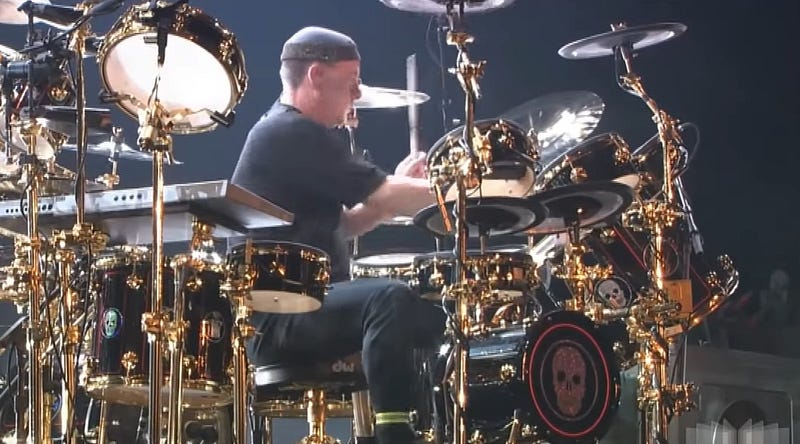
I could’ve picked just about anything from Clockwork Angels, their fantastic finale, along with 3–4 songs from each of the preceding albums since Neil Peart returned from his hiatus after the death of his wife and daughter. This one distills a lot of what’s great about latter-period Rush into one strong succession of riffs and fills.
Sara Bareilles, Love Song (2007)
The record company wanted a love song. She delivered, sort of. But she also delivered with a catchy piano line and her Broadway-ready voice.
Sara Bareilles, King of Anything (2010)
Another blast of sarcasm sweetened with Bareilles’ beautiful voice.
Silversun Pickups, Panic Switch (2009)
A contender for best bass line of the century in alt-rock, and it serves a purpose — the discombobulated rhythm of the verses giving way to a steady succession of eighth notes, as if the protagonist has moved from unsettled sleep to a pounding headache. It’s perfectly orchestrated drama. And it sounds cool.
The Sounds, No One Sleeps When I’m Awake (2009)
If you’re looking for inner strength through adversity, listen to this upbeat song with powerful vocals.
Sunhead, Orbit (2020)
Who? OK, you probably haven’t heard of them unless you went to a high school near me or have kids at School of Rock. But this song with quirky chords, sounding a bit like fellow DMVers Velocity Girl, wouldn’t sound at all out of place on WHFS if it still existed as it used to.
Taylor Swift, cardigan (2020)
So sue me. I also like Shake It Off, which I often dial up before or after reffing a soccer game. This one has a sophisticated arrangement, a melody that pleasantly works its way into your brain, and memorable lyrics. (“Peter losing Wendy” is my favorite.)
Trio 111, No Surprise (2020)
Who? OK, you probably haven’t heard of them unless you went to a high school near me or have kids at School of Rock. But this song, built on a Zeppelin-esque blues-rock riff doubled in the guitar and bass, wouldn’t sound at all out of place on 98 Rock, which still existed as it used to.
Walk the Moon, Shut Up and Dance (2014)
I’ll do neither, but this is pure pop candy of the best kind.
Wolfmother, Joker and the Thief (2005)
If you go to hockey games, you may have heard this without realizing it. It’s a power-trio romp with a dizzying central riff and anthemic organ and drums.
So rock isn’t dead. And pop is sometimes OK.
Happy to take more suggestions. I can’t listen to yacht rock 12 hours a day forever.
 Mostly Modern Media