That’s a controversial statement that opens either a can of worms or a contentious set of discourses — the latter being academicese for “can of worms.” If you’d like to read more about hip-hop history and the uneasiness some people — in my experience, mostly Black people — have with letting hip-hop stand as the primary representation of Black culture, read these …
For the UK’s Academy of Music and Sound, academic/journalist Isobel Trott untangles the complex history and sociology of hip-hop, from parties to protests to problematic violence and misogyny. But she sees more good — and more complexity — than most observers, and she points a finger for hip-hop’s muddled reputation at white audiences embracing its worst aspects: “Once hip-hop entered the mainstream it became increasingly commoditised and increasingly consumed by white audiences. The ‘gangsta image’ was seized on in pop culture, and in this became a popular and essentialist way to view this generation of Black youth.”
In City Journal, Black academic John H. McWhorter is strongly dismissive, even of “harmless” pioneers such as the Sugar Hill Gang, and he takes aim at Pennsylvania professor Michael Eric Dyson, whom I vividly remember giving a graduation speech at North Carolina in which he made incorrect references to his alleged field of pop culture. (No, Alanis Morissette was not talking about the back seat of a car.) At times, it’s tempting to reply “OK, Boomer,” but it’s hard not to empathize with his concern that the best-selling violent/misogynist rap songs, bought and lauded by a lot of white people, paint an ugly picture of Black people in America.
Journalist Juwan Lee insists that the focus on material things represent aspiration to rise above poverty and that violent lyrics are meant to deter violence, not celebrate it. (It’s safe to say I’m skeptical that the violence in hip-hop deters violence, and I’m personally a fan of Rina Sawayama’s skewering of capitalist overreach in the song xS. Whether hip-hop has played a role in the unwise money-management that has led many athletes — certainly not just Black athletes, but the hip-hop audience isn’t just Black — would be an interesting academic study.)
?uestlove, the drummer for the Roots and therefore a steady presence on The Tonight Show with Jimmy Fallon, points to a paradox — as hip-hop has become ubiquitous and therefore synonymous with Black culture, it becomes meaningless: “Once hip-hop culture is ubiquitous, it is also invisible. Once it’s everywhere, it is nowhere.”
On the other hand, ?uestlove has defended hip-hop against cultural appropriation on Saturday Night Live, smacking around some white posers. But it seems to me his point is that there’s more to Black culture than hip-hop, particularly the misogynist sex (no wonder Cardi B and Megan Thee Stallion got such attention for pushing back with the filthy WAP), weed and commercialism that dominates the charts.
Back in the late ’80s, when I graduated high school, you could count the number of black musical artists that weren’t in hip-hop on two hands — maybe. You had folksingers like Tracy Chapman, rock bands like Living Colour, pop acts like Lionel Richie, many kinds of soul singers — and that doesn’t even contend with megastars like Michael Jackson and Prince, who thwarted any easy categorization.
If you know anything at all about the history of American music, you know that the contributions of Black musicians didn’t start with a couple of turntables in New York. Nearly every genre that has been on the charts since 1960 or so was built on the foundations of what Black musicians did.
So for Black History Month, let’s celebrate those who prove Black culture isn’t limited to hip-hop, and Black musicians aren’t limited to whatever “beats” are belched out by a few synth loops and an 808 drum machine. I’ll stick to people who are still alive, with apologies to Prince, Michael Jackson and Jimi Hendrix.
Some of the musicians incorporate aspects of hip-hop, which just proves the point that no one should be placing any limits on any musicians.
Living Colour
Since ?uestlove mentioned them, let’s start here. You might know Cult of Personality, an appropriate song for the Trump era. They also ripped through some sociopolitics on songs like Open Letter (To A Landlord) and Type, propelled by a tight, blazing power trio of guitarist Vernon Reid, bassist Muzz Skillings (later Doug Wimbish) and drummer Will Calhoun, backing the powerhouse vocals of Corey Glover, who has dabbled in film (Platoon) and stage (Judas in Jesus Christ Superstar, one of the best roles a singer can take).
The song that blows me away is This Is The Life, which builds quickly to a thunderous Calhoun fill and then Glover singing two verses that empathize with a downtrodden person (“in another life, you might have been a genius”) before turning the tables with a verse urging that person to look on the bright side (“in another life, you’re always lonely”) and a carpe diem pre-chorus (“in your real life, treat it like it’s special”).
Fishbone
I’m not qualified to say how much the album The Reality of My Surroundings is representative of Black peoples’ lives. But it’s certainly a vivid tour of someone’s life, from despairing over violence (Fight the Youth), scoffing at junkies (Junkies Prayer starts as a Lord’s Prayer parody beginning with “My pusher, who are in the crack house / hallowed be thy bitches and hos”), daily chores (Housework) and sex (the weakest part of the album and perhaps a tinge homophobic).
The closer is the brilliant Sunless Saturday, which they tore through on Saturday Night Live and have continued to use as an anthem through several personnel changes around bassist John Norwood Fisher and frontman Angelo Moore, who opens this performance in Bordeaux with a long jump into the crowd, perhaps taking the “trust fall” to new heights. Or lengths.
Mark White, Spin Doctors
Before dismissing Spin Doctors as a white jam band, listen to the way Mark White’s bass funks up the band to this day.
Josh Winstead, Metric
Before dismissing Metric as a white Canadian band, listen to the way Josh Winstead’s bass anchors the dreamy Gimme Sympathy.
60% of the Dave Matthews Band
Before dismissing the Dave Matthews Band as a white jam band … wait, were you seriously dismissing DMB as a white jam band?
Carter Beauford’s drum kit looks like it’d fit right home in a prog-rock band.
Darius Rucker / Hootie and the Blowfish
I’m not wading into the country charts to see what sort of impact Darius Rucker has had as a solo artist, though it’s clear the CMA voters love him, but you might remember his pop-rock band.
Kele Okereke, Bloc Party
One of the more intriguing alt-rock bands to emerge from Britain is fronted by the son of Nigerian immigrants.
George Benson
Maybe “smooth jazz” isn’t your thing, but he has recorded a few songs that are difficult to resist.
Branford Marsalis
Other styles of jazz may not be your thing, but rather than point toward Sting’s multiracial band from his early solo days, I’m going to go with a fun album with bassist Milt “The Judge” Hinton, who was pushing 80 at the time.
Tracy Wormworth, bass
Also played with Sting at one time and has toured with the B-52s, but let’s check out this iconic bass line you’ve all heard many a winter. (Sadly, I can’t find a performance video, but this will do.)
And finally …
Stevie Wonder
The opening hi-hat (played by Stevie himself) on Superstition says more than most songs of the 21st century.
You get the idea. And this list is just a sampling to show the diversity of Black musicians worth celebrating. In Black History Month, it’s worth going back in time to see how Black musicians inspired every genre we have today (yes, even country, which has some roots in what was called “blues” in the early 20th century), but Black musicians aren’t limited to one time period or one genre.
After ripping Spotify’s current top 20 — which is full of lazy beats, misogyny and narcissism — it’s time to go the other direction and prove that good music is indeed being released this century.
This playlist is limited to music released from 2000 to 2020, and each artist is limited to three songs. It spans several genres and several levels of popularity, from ubiquitous pop artists to local bands who deserve a wide audience.
(Yes, the 21st century began in 2000, not 2001. If we were counting the years from a specific event, then yes, we could insist upon starting the century at 2001. But our system of counting years is arbitrary. It’s pegged to the birth of Jesus, but we didn’t exactly have birth certificates 2,019 or 2,026 years ago. Just as “the 90s” includes the years 1990 to 1999, there’s nothing to prevent us from calling the 100-year stretch from 2000 to 2099 the “21st century.” Take that, pedants!)
Enjoy …
Aimee Mann, Lost in Space (2002)
The titletrack of Mann’s best album, criminally underrated by many critics, makes drifting away from reality sound so cool and makes apathy sound friendly.
If you ever have a chance to see Mann live, go. She often surrounds herself with comics who help her laugh about a generally downbeat catalog of songs.
Alanis Morissette, Everything (2004)
The queen of Gen X romantic rage and attempted irony takes a dramatically different turn here, marveling at her partner’s willingness to take the good and bad she offers. The juxtaposition with her back catalog of revenge against her ex-lovers makes this sweet tune that much more powerful. If you’re looking for something unconventional to play at a wedding, you could do worse.
Angela Perley and the Howlin’ Moons, Athens (2014)
It’s a pity we don’t have a radio format for crossovers between indie rock and country. Music critics think that space is exclusively reserved for Wilco, which has never released anything as evocative as this wistful song about her college town — I still wish it was my childhood home in Georgia rather than the one in Ohio — and the hold it will have on her heart even as she travels onward with her adult life. She’s also one of the sweetest people you could ever meet.
Anna Nalick, Shine (2011)
You may know Nalick from Breathe (2 a.m.), which was in Grey’s Anatomy and a few other shows and movies. Kudos to various producers for their good taste, but this song is even better, building to an uplifting chorus in which Nalick’s voice simply soars.
Belly, Shiny One (2018)
Yes, this is the same Belly that had the MTV hit Feed the Tree, made it to the cover of Rolling Stone for their second album, then broke up. A couple of decades later, they reunited with the same lineup, including bassist and cancer survivor Gail Greenwood, and Tanya Donelly’s musings on parenthood are a nice sequel to the mystical landscapes she conjured in the 90s.
Bloc Party, This Modern Love (2005)
From the band’s debut album Silent Alarm, a smash in the U.K., this lovely song of yearning is a masterclass in wringing emotion from dynamic contrast built around simple guitar lines. The band continued to churn out quality songs, from 2007’s I Still Remember to 2015’s The Love Within. The rhythm section changed in the 2010s, adding drummer Louise Bartle, who was a preteen when Silent Alarm was released and 20 when she joined the band.
Soon after Bartle and American bassist Justin Harris joined, the band did a beautiful live performance for the BBC with a small choir.
Blondie, Fun (2017)
You don’t see many 1970s-80s New Wave/punk bands hitting №1 on the dance charts in the 2010s, but Debbie Harry and company pulled it off, with drummer Clem Burke still providing irresistible beats.
The Cardigans, I Need Some Fine Wine, and You, You Need to Be Nicer (2005)
The eclectic Swedish band, best known in the USA for the Romeo + Juliet soundtrack song Lovefool, delved into quirky power pop here with some propulsive guitars and the classic line, “Baby, you’re foul in clear conditions, but you’re handsome in the fog.” And cowbell.
Todd in the Shadows summed up their career, lamenting their one-hit status, in an entertaining roundup.
Chris Stapleton, Midnight Train to Memphis (2017)
This song has such a classic country-blues vibe that it’s hard to believe it was written in the 21st century. Stapleton’s powerful voice captures the bitterness of an imprisoned man.
Deap Vally, Smile More (2016)
Never tell a woman to smile more. Don’t do it. Or you might find this guitar/drum duo, a bit like The White Stripes with a more versatile drummer and a feminist growl, calling you out.
Death Cab for Cutie, Cath … (2008)
Not many songs combine 90s alt-rock riffs and a reference to Wuthering Heights. (The book, not the Kate Bush song.) An inventive drum part from Jason McGerr, a stately bass line from Nick Harmer and an intricate guitar part provide a hook-laden backdrop for the tale of a woman settling for Mr. You-Might-Do. (Reference stolen from a comedian from maybe 30 years ago.)
The Derek Trucks Band, Already Free (2009)
The great Southern blues guitarist shines on this song about standing defiant in the face of depressing circumstances. The final solo in particular is a searing statement of resilience.
Drive-By Truckers, Thoughts and Prayers (2020)
The alt-country band from my hometown of Athens, Ga., once employed country sensation Jason Isbell. Just in time for the election, they released this biting take on that phrase we hear from politicians who could actually do something more. They’re happy to tell you where to stick it.
Dropkick Murphys, The Green Fields of France (2005)
The Bostonians who typically turn up the volume on Celtic punk turn it down here for a plaintive reading of an anti-war ballad, alternately called No Man’s Land, written in the 70s by Scotsman Eric Bogle. It’s addressed to a young man killed in World War I whose grave the narrator has just found.
Electric Six, Danger! High Voltage (2003)
Let’s have some fun. Here’s a bouncy mix of funk guitar, disco bass and power chords.
Enter the Haggis, Year of the Rat (2013)
Another Celtic-inspired band, this one from Canada, even though it plays in Northern Virginia so often it’s as if they’re from Fairfax. This one sounds mostly like an indie-rock waltz but with pipes instead of guitars in the solo. This album, The Modest Revolution, is a concept album of sorts, with the band taking Toronto’s Globe and Mail newspaper on March 30, 2012, and writing songs inspired by the stories therein. I can’t find the reference now, but I believe this one is a meditation on financial advisors in a tower facing imminent arrest.
Evanescence, Bring Me To Life (2003)
One of the few legit rock songs to reach the heights of the Top 40 this century, this song somehow incorporates a lot of touches from the oft-derided nu metal genre without drifting in Limp Bizkit territory.
Foo Fighters, All My Life (2002)
Hard to believe this timeless alt-rocker was released in this century. The riffs are as powerful as any classic rock tune, and the drums add some rhythmic twists.
Foo Fighters, Rope (2011)
Another strong set of riffs and inspired drum fills, this song paints a picture of a flailing person at the end of his, well, rope.
Green Day, Jesus of Suburbia (2004)
The punk concept album doesn’t hang together that well on the whole, but it produced several solid songs, most notably this epic that races through a variety of sonic landscapes as adeptly as Yes did in the early 70s. (And much better than Yes did after that.)
Live? There’s a reason this video has nearly 15 million views.
Guster, Amsterdam (2003)
As they evolved from their early days as a trio with two guitarists/bassists and one guy who beat the bejeezus out of everything with his hands, Guster hit the sweet spot of college rock, expanding their instrumentation while continuing their steady stream of sharp hooks and lyrics.
Jack White, Lazaretto (2014)
No one does more with less than the former White Stripes frontman.
Jonatha Brooke, Linger (2001)
The sprightly hooks in this one inject a measure of defiance into this tale of a dysfunctional relationship.
The Joy Formidable, Whirring (2011)
There’s nothing subtle about many of this Welsh power trio’s songs, and this one builds up from its brash choruses to a massive wave of noise.
The Joy Formidable, Cradle (2011)
A short blast of powerful guitar rock from a short, powerful guitarist, paired nicely with a video set almost entirely on a see-saw. Another great song and video: This Ladder Is Ours.
July Talk, Summer Dress (2012)
This Canadian group made the best videos of the 2010s, building on the theatrical interplay of Peter Dreimanis and Leah Fay as a couple of people trying to figure out what the other wants. Summer Dressis the best song, a playful blues-rock tale of a prodigal man. Guns + Ammunition is a little spookier, featuring a video that twists and loops like a Mobius strip. Picturing Love, built on a stately electric piano riff, treads the line between reality and porn fantasy. The best of these compelling videos is Beck and Call, in which Dreimanis and Fay act out their conflict over whether they want more than their hookups.
The Killers, Somebody Told Me (2004)
The soaring vocals and bouncy bass line are a strong combination.
Macklemore & Ryan Lewis (feat. Ray Dalton), Can’t Hold Us (2012)
More hip-hop should feature percussive piano and a melodic vocal hook in the chorus.
Mark Ronson and Bruno Mars, Uptown Funk (2014)
If you don’t like this song, there might be something wrong with you. Mars’ super-smooth vocals, a no-nonsense funk guitar riff and a killer bass line are irresistible. Besides, what else could’ve been the soundtrack for a video of the U.S. cross-county ski team dancing all over Europe?
The Mars Volta, Cotopaxi (2009)
Not too many songs with wailing vocals, abstruse lyrics, aggressive guitars, 11/8 verses and a 9/4 bridge are this catchy.
Metric, Gimme Sympathy (2009)
As perfect a piece of dreampop as you’ll ever find.
Metric, Love You Back (2018)
A heavy industrial guitar riff leads nicely to Emily Haines’ yearning vocals. The video is a fun mix of fan videos interspersed seamlessly with shots of the band. (You have to know the band members to pick them out.)
Metric, Now or Never Now (2018)
We’re getting serious now. This is the soundtrack for anyone over 40, a sort of carpe diem for people who have the added stakes of not being 20 any more. Emily Haines’ lyrics and typically gorgeous vocals mix a sense of resignation with a strong claim of agency, and Jimmy Shaw’s guitar blasts are as pleasant a kick up the backside as you’ll ever find.
Minipop, Ask Me A Question (2007)
Shoegaze music doesn’t get any dreamier than this.
Muse, Stockholm Syndrome (2003)
The power trio’s third album, Absolution, features two showcases for its rhythm section’s dexterity. Hysteria is built on a complex, propulsive Chris Wolstenholme bass line. Stockholm Syndrome features an inventive, powerful performance by drummer Dominic Howard.
Muse, Knights of Cydonia (2006)
A great review said if U2 weren’t full of shit, they wouldn’t be as great as they frequently are. Same goes for Muse. Some of their operatic numbers are downright unlistenable, with Matt Bellamy’s vocals screeching into self-parody. But when it comes together, it works, even in an oddly constructed song that roars through several genres, from spaghetti Westerns to space rock to flat-out power guitar rock. And Bellamy’s a damn good guitarist, as shown on this astounding performance at Wembley Stadium:
Muse, Panic Station (2013)
Muse also excels when they strip things down and throw a curveball such as the old-school R&B infusion in the guitar and bass here.
Nicole Atkins, Maybe Tonight (2007)
The Jersey singer’s voice is a national treasure, and no song puts it to better use than this timeless-sounding tune that wouldn’t sound out of place if recorded by a 1960s girl group. And the video is a dazzling single-shot (not really) stroll through a fun cast of characters in some sort of vaudevillian touring company.
Nicole Atkins, Girl You Look Amazing (2013)
Atkins veers a little closer to indie pop with this playful song and hilarious video.
Paramore, Hard Times (2017)
Misery Business is the more famous song, thanks to layers upon layers of guitar hooks and dazzling drums underneath a breathtaking vocal performance by the then-teenaged Hayley Williams. But they won’t play that one any more because the “Mean Girls” aesthetic no longer suits Williams, who shows a more mature side with this fun take on dealing with difficulty.
Phoebe Bridgers, I Know The End (2020)
This tour of various genres starts out as a simple singer-songwriter piece with Bridgers’ wispy, wistful voice singing about travel and longing. Then it veers into more of an indie rock feel and shifts gears into a wry take on an apocalypse. By the end, it’s a giant cascade of sound. She explains it all in a fun video for Genius.com.
The Pretty Reckless, Take Me Down (2016)
If rock is dead, why would Taylor Momsen give up acting to lead this gritty band through a retelling of the old Crossroads tale with evocative vocals, agile bass, massive drum fills and some gospel singers? (I’m playing bass on a cover version.)
Queens of the Stone Age, No One Knows (2002)
Speaking of rock not being dead, here’s a romp through some quirky chords (C minor, G … B??) fueled by Dave Grohl’s over-the-top drumming.
Rachael Yamagata, Reason Why (2004)
The Queen of the Breakup Song infuses this piano ballad with a quiet dignity, reflecting on what could’ve been but moving on without malice or regret. (If you want a more frightening Yamagata breakup song, try the haunting Elephants.)
R.E.M., Leaving New York (2004)
My fellow Athenians wrapped up their career with two albums straight out of the garage, in the best possible sense. Before that, they recorded this lovely song with spare, dissonant verses and a majestic chorus that makes the inherent self-loathing sound beautiful somehow.
Rilo Kiley, Wires And Waves (2001)
The Californians struck it big a few years later when Portions for Foxes was featured on the first episode of the long-gone medical drama Grey’s Anat- … what? it’s still on??!! Anyway, Portions for Foxes and several other songs from their too-brief four-album career are worth checking out, but this one noses out Science vs. Romance as my favorite.
Rina Sawayama, XS (2020)
The theme alone makes this intriguing. In an era of consumption-obsessed pop music, Sawayama issues a brilliant critique with pop hooks punctuated with guitar blasts that serve a purpose, as she describes in her Genius take:
Rush, Headlong Flight (2012)
I could’ve picked just about anything from Clockwork Angels, their fantastic finale, along with 3–4 songs from each of the preceding albums since Neil Peart returned from his hiatus after the death of his wife and daughter. This one distills a lot of what’s great about latter-period Rush into one strong succession of riffs and fills.
Sara Bareilles, Love Song (2007)
The record company wanted a love song. She delivered, sort of. But she also delivered with a catchy piano line and her Broadway-ready voice.
Sara Bareilles, King of Anything (2010)
Another blast of sarcasm sweetened with Bareilles’ beautiful voice.
Silversun Pickups, Panic Switch (2009)
A contender for best bass line of the century in alt-rock, and it serves a purpose — the discombobulated rhythm of the verses giving way to a steady succession of eighth notes, as if the protagonist has moved from unsettled sleep to a pounding headache. It’s perfectly orchestrated drama. And it sounds cool.
The Sounds, No One Sleeps When I’m Awake (2009)
If you’re looking for inner strength through adversity, listen to this upbeat song with powerful vocals.
Sunhead, Orbit (2020)
Who? OK, you probably haven’t heard of them unless you went to a high school near me or have kids at School of Rock. But this song with quirky chords, sounding a bit like fellow DMVers Velocity Girl, wouldn’t sound at all out of place on WHFS if it still existed as it used to.
Taylor Swift, cardigan (2020)
So sue me. I also like Shake It Off, which I often dial up before or after reffing a soccer game. This one has a sophisticated arrangement, a melody that pleasantly works its way into your brain, and memorable lyrics. (“Peter losing Wendy” is my favorite.)
Trio 111, No Surprise (2020)
Who? OK, you probably haven’t heard of them unless you went to a high school near me or have kids at School of Rock. But this song, built on a Zeppelin-esque blues-rock riff doubled in the guitar and bass, wouldn’t sound at all out of place on 98 Rock, which still existed as it used to.
Walk the Moon, Shut Up and Dance (2014)
I’ll do neither, but this is pure pop candy of the best kind.
Wolfmother, Joker and the Thief (2005)
If you go to hockey games, you may have heard this without realizing it. It’s a power-trio romp with a dizzying central riff and anthemic organ and drums.
So rock isn’t dead. And pop is sometimes OK.
Happy to take more suggestions. I can’t listen to yacht rock 12 hours a day forever.
It was one of the most glorious moments of serendipity in television history.
Country singer Morgan Wallen was uninvited as Saturday Night Live’s musical guest after they discovered Wallen had been partying sans mask. To his credit, Wallen handled the decision gracefully.
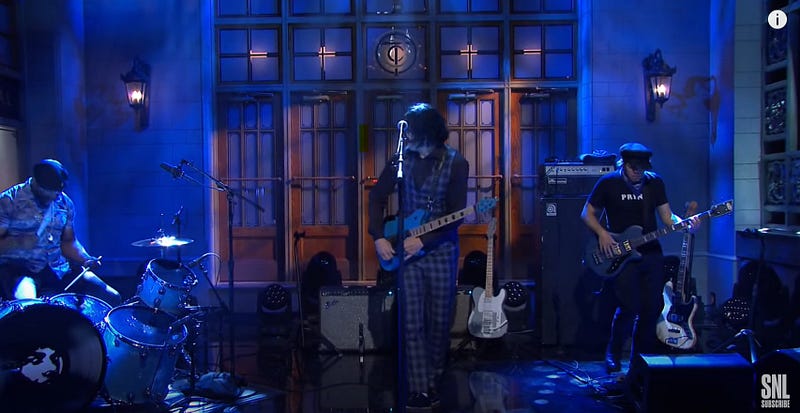
Left with a short-notice vacancy, SNL put called in Jack White, a proven veteran of the Studio 8-H stage.
And he tore … it … up.
Pity Wallen, who wound up being thanked for torpedoing his own performance so that White could take his spot.
His opening medley stitched together a song he did with Beyoncé, a White Stripes song and a gospel blues song by Blind Willie Johnson, who died in 1945. He later performed his solo tune Lazaretto on a custom guitar Eddie Van Halen had helped to design for him, and he tossed in a bit of two-handed tapping as another salute to the rock guitar pioneer who recently passed away.
Guitar World also took a peek at White’s fuzz-heavy pedalboard, giving him a cornucopia of distinctive guitar tones at the touch of a foot.
But the handful of pedals that can be lifted with one hand is nothing compared with the extravagant shows SNL performers have put together in recent years. Last year, Billie Eilish performed on a set that rotated vertically, creating the illusion that she was walking on the ceiling.
Last week, Megan Thee Stallion showed she isn’t just the person who joined Cardi B for the in-your-face sexuality of WAP, with political statements projected on the wall behind her to reinforce the notion of respecting Black women.
There’s nothing wrong with those performances. Megan Thee Stallion made a powerful, timely statement. But White, armed only with a pedalboard, a few lights, a bassist and a drummer with a unique drum kit that faced away from him, more than held his own alongside the multimedia extravaganzas musicians have done on SNL.
In doing so, White proved a basic point.
Rock isn’t dead.
The Billboard charts might say otherwise. But when people want to see a show, there’s nothing quite like the power that some drums and guitars can conjure. (And, in some cases, keyboards.)
The great VH1 series Behind the Music often glossed over a few detours in each band’s history.
To give one egregious example: The Fleetwood Mac episode skips over the period in which a succession of musicians — Billy Burnette, Rick Vito, Bekka Bramlett and former Traffic member Dave Mason — tried to fill the void left first by Lindsey Buckingham and then by Stevie Nicks. Buckingham and Nicks leave, yadda yadda yadda, everyone’s back together again!
The episode on Styx is a little more complete, introducing every new member in the relevant part of the band’s history.
Let’s see the quick overview:
1972–74: Dennis DeYoung, James Young, John Curulewski and the Panozzo brothers (Chuck and John) release four eclectic albums on the small label Wooden Nickel. They’re kind of a prog-rock band, debuting with a suite called Movement for the Common Man that includes Aaron Copland’s Fanfare for the Common Man. That’s Emerson, Lake and Palmer territory. Styx II featured a reworked Bach fugue along with a song to remember, Lady, that got a belated boost from a Chicago DJ to become a hit.
1975: Curulewski stays for their A&M debut, Equinox, but then leaves and is replaced by Tommy Shaw, a Southern guitarist who earns his way into this Chicago band by hitting the high note on Lady’s challenging backup vocal line. Shaw’s full debut is Crystal Ball.
1977–1981: The Golden Era. Well, the Platinum Era. The Grand Illusion has Come Sail Away and Fooling Yourself. Next, Pieces of Eight enters Renegade and Blue Collar Man into the rock canon. Cornerstone is known mostly for Babe, and put a pin in that. Then Paradise Theatre (The Best of Times, Too Much Time On My Hands) continues the hot streak.
The album actually sold pretty well. But the tour extended the concept, an absurd, patronizing rock opera about a land in which rock and roll is banned and DeYoung’s protagonist (Kilroy) disguises himself as a robot to save the day with the help of a young crusader played by Tommy … look, it’s all a bit silly. Rush did the “banned rock and roll” dystopian thing a lot better with 2112, and as big a Rush fan as I am, I have to admit 2112 is a little silly, too. Kilroy adds the extra layer of doing all this as an overblown response to Bible Belters touting their periodic conspiracy theory of “backward masking.”
Behind the Music tells the story pretty well, and YouTuber Todd in the Shadows goes into more detail in his “Trainwreckords” series. Mr. Roboto was catchy, and Don’t Let It End was another DeYoung power ballad hit, but none of it made any sense. Mr. Roboto was supposed to be the story of Kilroy revealing himself to Jonathan Chance (Shaw), but then why is he thanking the roboto? Why is one verse about the excesses of technology, even as the music sounds like something from Epcot Center? Shaw gritted his teeth and “self-medicated” through the subsequent tour, which at one time sent festival-goers flocking to the exits.
That was the final wedge between DeYoung and Shaw, at least for the next 10 years. They had clashed for years over their contrasting visions — Shaw was an arena-rocker who wasn’t thrilled with ballads like Babe, which he would later ridicule in his time with Damn Yankees. (Ironically, or maybe hypocritically, Damn Yankees’ best-known song is a power ballad called High Enough, co-written by Shaw.) And with the declining health and passing of drummer John Panozzo, it was the last time the classic lineup would …
Time out. We’re forgetting something.
Before Shaw’s departure toppled the house of cards that was the band’s membership, Styx actually released one more song, tossed onto the live album Caught in the Act. And it’s not at all what you’d expect from a band that just gone around the country preaching a humorless rock gospel that one of the band’s two main creative forces couldn’t stand.
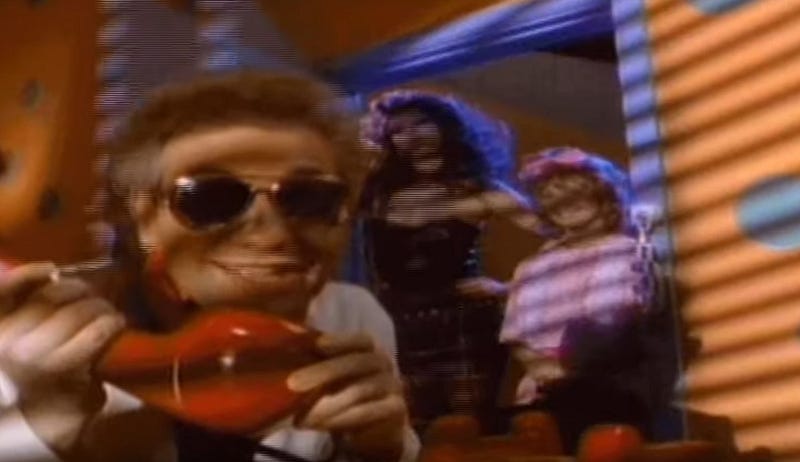
Behold the off-the-wall, occasionally juvenile Music Time.
It wasn’t as if Styx had always been a dour purveyor of power ballads and post-apocalyptic morality tales. The video for Too Much Time On My Handsis full of slapstick comedy, even from DeYoung. John Panozzo is the scene-stealer, trying to brag about his appearance in Billboard to a disinterested older woman while pouring a pitcher of beer into an overflowing glass.
But Music Time takes the comedy to uncomfortable places.
Sure, the sight gags are fun. The video looks like an animated comic strip, with a slow frame rate producing a herky-jerky effect as the action proceeds through a lot of primary colors and oversized items. DeYoung is adept at mugging for the camera, and the Panozzos and James Young seem to be having fun popping their heads up through a dinner table.
But the sight of DeYoung, the family man who wrote ballads for his wife, popping his eyes at buxom women on TV and panting on his knees in a dog costume for the benefit of “fast girls”? That’s more than we needed to see.
Shaw didn’t like this, either, even with some party-animal fun, some solid rock hooks and his own blazing guitar solo in the mix. He appears once in the video, separated from the other band members but pretending to wave as if they’re just off camera. His total camera time is about two seconds. Shaw later admitted it was the whole thing was a little childish.
And that would be the end of Styx’s classic lineup. Shaw was already on the way out, and it was a moot point. The band broke up.
Like most bands, there would be a reunion. In fact, all five band members would record and tour with Styx again. Just not at the same time.
The first reunion proceeded without Shaw, who was busy with Damn Yankees, and Glen Burtnik filled his position. But Shaw got back on board when the band cleverly did an end run around its old record label, Wooden Nickel. A&M Records wanted to put together a greatest-hits compilation, but they couldn’t get the rights to Lady. The band simply re-recorded the song, with Shaw in the fold, and the good feelings continued long enough for a couple of tours and one album, 1999’s Brave New World.
Unfortunately, drummer John Panozzo couldn’t join them for any of that. After years of heavy drinking, Panozzo wasn’t well. Enter Todd Sucherman. (Coincidentally, I worked with Sucherman’s brother, who chose a different career path.) Panozzo passed away a year later.
So the last song to feature the five members of Styx who recorded all their classic albums — basically, everything you’ve heard aside from Lady— was this fun but flimsy tune with a goofy video that walks a fine line behind amusing and uncomfortable.
After Brave New World, DeYoung wound up out of the band. He was ill at the time, but the rest of the band didn’t seem inclined to leave the door open for him to come back. That door remains shut. Lawrence Gowan replaced DeYoung, and the band hasn’t looked back.
(The band also has shuffled bass players under sad and yet inspirational circumstances — Chuck Panozzo was diagnosed with HIV and no longer participates on a permanent basis, but he has stepped forward to speak for gay men such as himself, and he plays with the band on occasion. Burtnik moved from guitar to bass when Shaw returned, but he later stepped aside, and the band brought in Ricky Phillips. Still, Styx is more stable than a lot of bands — including Panozzo, they have two original members, Shaw was part of the classic lineup, and Sucherman and Gowan have been around for a couple of decades. Phillips is the newest band member, but he’s been there for 17 years.)
The material from DeYoung’s long tenure with the band is still the bulk of the Styx setlist, which we’ll examine with the detailed if not fully verified stats at setlist.fm.
On the North American tour that ended when we were all told to confine ourselves to our homes (and the grocery store and the liquor store), they drew upon their entire timeline, heavily focused on the 1975–81 heyday. They went all the way back for Lady, of course. At the other end of the timeline, they rotated through six songs from their 2017 album The Mission. Lawrence Gowan, who has taken over DeYoung’s keyboard/vocal role for two decades, did a lovely piano version of the Rush song Limelight as a tribute to the recently departed Neil Peart, just as they did Mary Jane’s Last Dance a few times after Tom Petty’s death. They do a Damn Yankees song for some reason, and oddly enough, they revived Mr. Robotoin 2018.
You won’t hear Babe. According to setlist.fm data, Styx has played Babe three times since DeYoung’s last performance with the band at a Children’s Miracle Network telethon (seriously, and apparently without either Panozzo), most recently in 2007. If you want to hear Babe, go see DeYoung, who was also touring earlier this year and most certainly played the song that’s near and dear to his heart.
How about Music Time?
Let’s see … Movement for the Common Man (not since 1972), Mr. Roboto, various Mr. Roboto medleys, Never Come Back …
Wait … never? They’ve never played it live at all?
Granted, Styx wasn’t performing when that song was fresh. Caught in the Act was released in 1984. Setlist.fm has no data from that year. Or 1985, when the band started its hiatus. Or 1986, 1987, 1988 or 1989. They list one show in 1990, but they don’t list the songs.
In 1991, on tour to promote the reunion (minus Shaw) album Edge of the Century, they played the new stuff and the classics. No Music Time. Setlist.fm lists three shows in 1993, which seems like a glitch, and they don’t list any songs anyway.
The great reunion in 1996 was mostly the classics, with Show Me the Way the only carry-over from Edge of the Century. By 2006, they had basically ditched everything from Kilroy Was Here onward, with the exception of One With Everything from the 2003 album Cyclorama. (We’re not counting the cover songs they recorded on 2005’s Big Bang Theory and then played live for a couple of years.)
So Music Time occupies a strange place in the Styx timeline. It bears little resemblance to anything else Styx ever did. It’s hardly acknowledged since then. Mr. Roboto is kind of campy, and it was released when the band was still at or near its peak popularity. Music Time simply doesn’t have a place in the band’s canon.
But what’s the harm in playing it? Why go through Crystal Ball for the (checks setlist.fm) 782nd time (at least) when Music Time is still out there waiting for its live debut?


 Mostly Modern Media