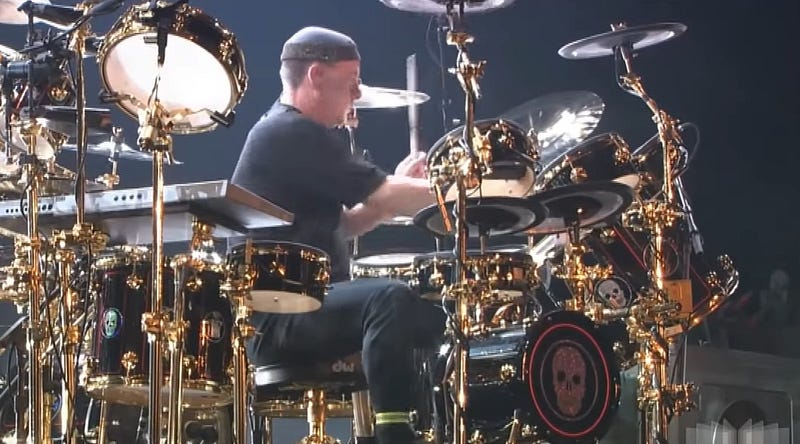
When Rush drummer Neil Peart’s death was announced, three days after it actually happened, social media and mainstream media raced to express shock and to pay tribute. Boomers and Gen Xers broke out their old T-shirts — as I write, a white-haired man across from me is wearing a Peart shirt.
Why? Would we have the same reaction if an accomplished drummer of a similar age passed away? What made Peart so beloved?
It’s not just that he was a virtuoso. The world is full of drummers who have taken the art to another level.
- Before Peart, Bill Bruford brought frenetic fundamentals (his legendary part on Heart of the Sunrise is driven by something called a paradiddle-diddle) and a jazz influence to Yes and King Crimson.
- Former Frank Zappa and Missing Persons drummer Terry Bozzio is on some sort of quest to place the maximum number of percussion objects within the wingspan of an average-sized human being.
- Mike Mangini is a speed demon who, before joining flashy prog-metal band Dream Theater, played creative and even comical solos while working with guitar legend Steve Vai.
But something set Peart apart. He launched legions of air drummers who could play Peart’s iconic parts on Tom Sawyer and YYZ — if only they had a drum set and world-class stick control. Even a first-rate drummer like Josh Freese joined the air-drumming movement.
Well into his 50s and 60s, his drum solos grew even more creative, incorporating electronic drums and samples ranging from African percussion to a full-fledged big band.
In a sense, the music world had already mourned Peart’s loss. He last performed on Aug. 1, 2015, not fully revealing until after the tour that the physical toll drumming took on his body was worse than we imagined. Even if his ailments weren’t so devastating, Peart the perfectionist wouldn’t have accepted playing at anything less than his best. He literally played at the highest level until his body gave out.
But there was more to Peart than what he could do with a pair of sticks, a drum kit whose evolution from cheap starter drums to a high-tech hodgepodge of instruments has been lovingly chronicled online, and his prodigious imagination.
He spoke to and for outcasts
Peart joined Rush for its second album — the only personnel change the band ever had — and quickly took over as their lyricist. He could harness the volumes of books that he read into thoughtful lyrics.
Some of those lyrics didn’t age well. He all but disavowed his Ayn Rand phase, to the point of an unusually blistering comment on Rand Paul when the pseudo-libertarian candidate played Rush songs at his rallies.
But the song that spoke to so many people still does. It’s Subdivisions, from the 1982 album Signals.
Whether studious or stoned, high school outcasts everywhere related to this song, featuring some of Peart’s most direct lyrics. Conform or be cast out.
So Peart let the high school daydreamer know he or she (to be honest, mostly “he”) know that he wasn’t alone.
And the path from Peart’s Ayn Rand phase to Subdivisions wasn’t completely muddled. Peart was drawn not to Rand’s selfishness, aside from the unfortunate dismissal of “begging hands and bleeding hearts” in the early song Anthem, but to the power of the individual.
The young outcasts have grown up to be creators and innovators. But we all still remember what high school was like when we weren’t among the “cool kids.”
Years later, Peart had a viable claim to be one of those “cool kids.” But that wasn’t his nature.
(H)e was so clearly not a rock star, but a bookish, shy chap, who happened to possess extraordinary dexterity on drums. — Michael Hann, The Guardian
Rush fans’ loyalty has been vindicated
For many years, being a Rush fan wasn’t cool. Critics hated the band for many reasons — Geddy Lee’s shrieking voice, the Ayn Rand stuff, and the idea that punk was more authentic than prog.
Over the years, Lee’s shriek and the Rand influence toned down. Punk burned out. And new waves of musicians all cited Rush as an influence that couldn’t be denied.
Rush made the Hall of Fame. Even better, they had the blessing of Jason Segel and Paul Rudd.
And South Park.
And Futurama and Archer and Family Guy — the latter at least three times.
Peart had rebuilt his life
In 1997, Peart’s daughter died in a car accident. He then watched his common-law wife pass away — officially due to cancer but attributed by him to “slow suicide by apathy.”
Peart got on his motorcycle and rode for more than a year, like Forrest Gump on wheels, and wrote about the experience in a book called Ghost Rider: Travels on the Healing Road.
In the book, he revealed that he had told bandmates Geddy Lee and Alex Lifeson to “consider me retired.” But Lee and Lifeson always held the door open. Sure enough, Peart eventually came back.
Appropriately, the band’s comeback album opened with One Little Victory, a triumphant song that starts with a sonic salvo from Peart.
He also found a new family, remarrying and having a daughter who is far too young to lose her father. At least she got to see her father play with “Uncle Alex and Uncle Geddy” and will have a memory of seeing them perform while thousands cheered.
Few people knew he was sick
Peart was always active, known for a love of hiking, cross-country skiing and cycling. Aside from the ailments that sent him into retirement, he seemed perfectly fit. If the news had told us Peart had died in a motorcycle or bicycle accident, that would have been less of a shock than hearing the actual cause of death — brain cancer that had battled for more than three years.
It was typical Peart to keep such news private. He wrote of his own reticence to be the center of attention in the song Limelight. By all accounts, he was a stereotypically affable Canadian, but aside from the rare interview, he was limited his public interaction to what he could control — his lyrics, his writing, his drumming.
We didn’t even hear of his death until three days after it happened. He died Jan. 7. The news broke Jan. 10.
So we weren’t prepared. News organizations rolled out remembrances over the weekend because they didn’t have anything ready to go. If the reportedly ailing Eddie Van Halen passes away sometime soon, even though he would also be leaving us too early, the pre-written obituaries, photo galleries and listicles will be unleashed all at once.
Peart’s fellow musicians scrambled to pay tribute. Styx’s Lawrence Gowan threw a solo piano rendition of Limelight into their Jan. 10 show. Others turned to social media, some clearly as stunned and saddened as the rest of us.
Taylor Hawkins of Foo Fighters, the band that inducted Rush into the Hall of Fame, came up with the most succinct take: “Neil Peart had the hands of God. End of story.”
It all seems so unfair. This man who had come back from tragedy to heal himself and give the world another couple of decades of terrific music surely deserved more time to be a happily retired father and enjoy the respect of his peers and friends. Maybe he’d write another book. Maybe he, like Bruford, would become someone who writes about drumming rather than doing it himself.
If there’s any consolation to Peart’s family, including “Uncle Alex and Uncle Geddy,” it’s the knowledge that his work meant so much to so many.
Such accolades never seemed to mean much to him. But maybe they’ll mean something to those around him.

 Mostly Modern Media