That’s a controversial statement that opens either a can of worms or a contentious set of discourses — the latter being academicese for “can of worms.” If you’d like to read more about hip-hop history and the uneasiness some people — in my experience, mostly Black people — have with letting hip-hop stand as the primary representation of Black culture, read these …
For the UK’s Academy of Music and Sound, academic/journalist Isobel Trott untangles the complex history and sociology of hip-hop, from parties to protests to problematic violence and misogyny. But she sees more good — and more complexity — than most observers, and she points a finger for hip-hop’s muddled reputation at white audiences embracing its worst aspects: “Once hip-hop entered the mainstream it became increasingly commoditised and increasingly consumed by white audiences. The ‘gangsta image’ was seized on in pop culture, and in this became a popular and essentialist way to view this generation of Black youth.”
In City Journal, Black academic John H. McWhorter is strongly dismissive, even of “harmless” pioneers such as the Sugar Hill Gang, and he takes aim at Pennsylvania professor Michael Eric Dyson, whom I vividly remember giving a graduation speech at North Carolina in which he made incorrect references to his alleged field of pop culture. (No, Alanis Morissette was not talking about the back seat of a car.) At times, it’s tempting to reply “OK, Boomer,” but it’s hard not to empathize with his concern that the best-selling violent/misogynist rap songs, bought and lauded by a lot of white people, paint an ugly picture of Black people in America.
Journalist Juwan Lee insists that the focus on material things represent aspiration to rise above poverty and that violent lyrics are meant to deter violence, not celebrate it. (It’s safe to say I’m skeptical that the violence in hip-hop deters violence, and I’m personally a fan of Rina Sawayama’s skewering of capitalist overreach in the song xS. Whether hip-hop has played a role in the unwise money-management that has led many athletes — certainly not just Black athletes, but the hip-hop audience isn’t just Black — would be an interesting academic study.)
?uestlove, the drummer for the Roots and therefore a steady presence on The Tonight Show with Jimmy Fallon, points to a paradox — as hip-hop has become ubiquitous and therefore synonymous with Black culture, it becomes meaningless: “Once hip-hop culture is ubiquitous, it is also invisible. Once it’s everywhere, it is nowhere.”
On the other hand, ?uestlove has defended hip-hop against cultural appropriation on Saturday Night Live, smacking around some white posers. But it seems to me his point is that there’s more to Black culture than hip-hop, particularly the misogynist sex (no wonder Cardi B and Megan Thee Stallion got such attention for pushing back with the filthy WAP), weed and commercialism that dominates the charts.
Back in the late ’80s, when I graduated high school, you could count the number of black musical artists that weren’t in hip-hop on two hands — maybe. You had folksingers like Tracy Chapman, rock bands like Living Colour, pop acts like Lionel Richie, many kinds of soul singers — and that doesn’t even contend with megastars like Michael Jackson and Prince, who thwarted any easy categorization.
If you know anything at all about the history of American music, you know that the contributions of Black musicians didn’t start with a couple of turntables in New York. Nearly every genre that has been on the charts since 1960 or so was built on the foundations of what Black musicians did.
So for Black History Month, let’s celebrate those who prove Black culture isn’t limited to hip-hop, and Black musicians aren’t limited to whatever “beats” are belched out by a few synth loops and an 808 drum machine. I’ll stick to people who are still alive, with apologies to Prince, Michael Jackson and Jimi Hendrix.
Some of the musicians incorporate aspects of hip-hop, which just proves the point that no one should be placing any limits on any musicians.
Living Colour
Since ?uestlove mentioned them, let’s start here. You might know Cult of Personality, an appropriate song for the Trump era. They also ripped through some sociopolitics on songs like Open Letter (To A Landlord) and Type, propelled by a tight, blazing power trio of guitarist Vernon Reid, bassist Muzz Skillings (later Doug Wimbish) and drummer Will Calhoun, backing the powerhouse vocals of Corey Glover, who has dabbled in film (Platoon) and stage (Judas in Jesus Christ Superstar, one of the best roles a singer can take).
The song that blows me away is This Is The Life, which builds quickly to a thunderous Calhoun fill and then Glover singing two verses that empathize with a downtrodden person (“in another life, you might have been a genius”) before turning the tables with a verse urging that person to look on the bright side (“in another life, you’re always lonely”) and a carpe diem pre-chorus (“in your real life, treat it like it’s special”).
Fishbone
I’m not qualified to say how much the album The Reality of My Surroundings is representative of Black peoples’ lives. But it’s certainly a vivid tour of someone’s life, from despairing over violence (Fight the Youth), scoffing at junkies (Junkies Prayer starts as a Lord’s Prayer parody beginning with “My pusher, who are in the crack house / hallowed be thy bitches and hos”), daily chores (Housework) and sex (the weakest part of the album and perhaps a tinge homophobic).
The closer is the brilliant Sunless Saturday, which they tore through on Saturday Night Live and have continued to use as an anthem through several personnel changes around bassist John Norwood Fisher and frontman Angelo Moore, who opens this performance in Bordeaux with a long jump into the crowd, perhaps taking the “trust fall” to new heights. Or lengths.
Mark White, Spin Doctors
Before dismissing Spin Doctors as a white jam band, listen to the way Mark White’s bass funks up the band to this day.
Josh Winstead, Metric
Before dismissing Metric as a white Canadian band, listen to the way Josh Winstead’s bass anchors the dreamy Gimme Sympathy.
60% of the Dave Matthews Band
Before dismissing the Dave Matthews Band as a white jam band … wait, were you seriously dismissing DMB as a white jam band?
Carter Beauford’s drum kit looks like it’d fit right home in a prog-rock band.
Darius Rucker / Hootie and the Blowfish
I’m not wading into the country charts to see what sort of impact Darius Rucker has had as a solo artist, though it’s clear the CMA voters love him, but you might remember his pop-rock band.
Kele Okereke, Bloc Party
One of the more intriguing alt-rock bands to emerge from Britain is fronted by the son of Nigerian immigrants.
George Benson
Maybe “smooth jazz” isn’t your thing, but he has recorded a few songs that are difficult to resist.
Branford Marsalis
Other styles of jazz may not be your thing, but rather than point toward Sting’s multiracial band from his early solo days, I’m going to go with a fun album with bassist Milt “The Judge” Hinton, who was pushing 80 at the time.
Tracy Wormworth, bass
Also played with Sting at one time and has toured with the B-52s, but let’s check out this iconic bass line you’ve all heard many a winter. (Sadly, I can’t find a performance video, but this will do.)
And finally …
Stevie Wonder
The opening hi-hat (played by Stevie himself) on Superstition says more than most songs of the 21st century.
You get the idea. And this list is just a sampling to show the diversity of Black musicians worth celebrating. In Black History Month, it’s worth going back in time to see how Black musicians inspired every genre we have today (yes, even country, which has some roots in what was called “blues” in the early 20th century), but Black musicians aren’t limited to one time period or one genre.
In 1987, I used a four-track recorder, a borrowed drum machine, a Casio synthesizer, some old microphone, a Peavey amp and an Ibanez guitar to record music. Record four tracks, mix them down to one, record three more, mix those down to one, and that’s probably about it.
Today, I used a two-octave keyboard and an iPhone with hundreds of sound options. I can supplement as needed with my old Ibanez, and old Squire bass, and a Fender amp I bought when I handed down the Peavey.
To make it work, I just need an iRig, Bluetooth headphones, non-Bluetooth headphones, an 1/8 inch-to-1/4 inch adapter … no, wait, I swear I had a cable that would take care of this … where did I put that dongle …
Minor frustrations aside, all of this is fun. Some people swipe left and right to find sources of STDs, I mean, romantic partners. I’m swiping left and right and up and down to make and edit music.
It’s easier to make cold, 21st century, quantized beats than it is to make what we’d consider a “song.” But it’s an entertaining challenge.
And it’s distracting me from mindless eating, which how I lost 2 1/2 pounds in my first five days since saying, “Yo, that’s enough.” I just had my first haircut in three months, so that’s probably another 10 pounds. (OK, I exaggerate.)
I’ve also started exercising some portion control. Our local Thai place hands us a giant pile of food. No reason I can’t save some for the next day.
So that’s Week 2. I’ll likely need to shovel some snow in Week 3, so I might make more progress. Or I’ll have slammed a shovel over my head and frozen to death. Either way, see you next week.
After ripping Spotify’s current top 20 — which is full of lazy beats, misogyny and narcissism — it’s time to go the other direction and prove that good music is indeed being released this century.
This playlist is limited to music released from 2000 to 2020, and each artist is limited to three songs. It spans several genres and several levels of popularity, from ubiquitous pop artists to local bands who deserve a wide audience.
(Yes, the 21st century began in 2000, not 2001. If we were counting the years from a specific event, then yes, we could insist upon starting the century at 2001. But our system of counting years is arbitrary. It’s pegged to the birth of Jesus, but we didn’t exactly have birth certificates 2,019 or 2,026 years ago. Just as “the 90s” includes the years 1990 to 1999, there’s nothing to prevent us from calling the 100-year stretch from 2000 to 2099 the “21st century.” Take that, pedants!)
Enjoy …
Aimee Mann, Lost in Space (2002)
The titletrack of Mann’s best album, criminally underrated by many critics, makes drifting away from reality sound so cool and makes apathy sound friendly.
If you ever have a chance to see Mann live, go. She often surrounds herself with comics who help her laugh about a generally downbeat catalog of songs.
Alanis Morissette, Everything (2004)
The queen of Gen X romantic rage and attempted irony takes a dramatically different turn here, marveling at her partner’s willingness to take the good and bad she offers. The juxtaposition with her back catalog of revenge against her ex-lovers makes this sweet tune that much more powerful. If you’re looking for something unconventional to play at a wedding, you could do worse.
Angela Perley and the Howlin’ Moons, Athens (2014)
It’s a pity we don’t have a radio format for crossovers between indie rock and country. Music critics think that space is exclusively reserved for Wilco, which has never released anything as evocative as this wistful song about her college town — I still wish it was my childhood home in Georgia rather than the one in Ohio — and the hold it will have on her heart even as she travels onward with her adult life. She’s also one of the sweetest people you could ever meet.
Anna Nalick, Shine (2011)
You may know Nalick from Breathe (2 a.m.), which was in Grey’s Anatomy and a few other shows and movies. Kudos to various producers for their good taste, but this song is even better, building to an uplifting chorus in which Nalick’s voice simply soars.
Belly, Shiny One (2018)
Yes, this is the same Belly that had the MTV hit Feed the Tree, made it to the cover of Rolling Stone for their second album, then broke up. A couple of decades later, they reunited with the same lineup, including bassist and cancer survivor Gail Greenwood, and Tanya Donelly’s musings on parenthood are a nice sequel to the mystical landscapes she conjured in the 90s.
Bloc Party, This Modern Love (2005)
From the band’s debut album Silent Alarm, a smash in the U.K., this lovely song of yearning is a masterclass in wringing emotion from dynamic contrast built around simple guitar lines. The band continued to churn out quality songs, from 2007’s I Still Remember to 2015’s The Love Within. The rhythm section changed in the 2010s, adding drummer Louise Bartle, who was a preteen when Silent Alarm was released and 20 when she joined the band.
Soon after Bartle and American bassist Justin Harris joined, the band did a beautiful live performance for the BBC with a small choir.
Blondie, Fun (2017)
You don’t see many 1970s-80s New Wave/punk bands hitting №1 on the dance charts in the 2010s, but Debbie Harry and company pulled it off, with drummer Clem Burke still providing irresistible beats.
The Cardigans, I Need Some Fine Wine, and You, You Need to Be Nicer (2005)
The eclectic Swedish band, best known in the USA for the Romeo + Juliet soundtrack song Lovefool, delved into quirky power pop here with some propulsive guitars and the classic line, “Baby, you’re foul in clear conditions, but you’re handsome in the fog.” And cowbell.
Todd in the Shadows summed up their career, lamenting their one-hit status, in an entertaining roundup.
Chris Stapleton, Midnight Train to Memphis (2017)
This song has such a classic country-blues vibe that it’s hard to believe it was written in the 21st century. Stapleton’s powerful voice captures the bitterness of an imprisoned man.
Deap Vally, Smile More (2016)
Never tell a woman to smile more. Don’t do it. Or you might find this guitar/drum duo, a bit like The White Stripes with a more versatile drummer and a feminist growl, calling you out.
Death Cab for Cutie, Cath … (2008)
Not many songs combine 90s alt-rock riffs and a reference to Wuthering Heights. (The book, not the Kate Bush song.) An inventive drum part from Jason McGerr, a stately bass line from Nick Harmer and an intricate guitar part provide a hook-laden backdrop for the tale of a woman settling for Mr. You-Might-Do. (Reference stolen from a comedian from maybe 30 years ago.)
The Derek Trucks Band, Already Free (2009)
The great Southern blues guitarist shines on this song about standing defiant in the face of depressing circumstances. The final solo in particular is a searing statement of resilience.
Drive-By Truckers, Thoughts and Prayers (2020)
The alt-country band from my hometown of Athens, Ga., once employed country sensation Jason Isbell. Just in time for the election, they released this biting take on that phrase we hear from politicians who could actually do something more. They’re happy to tell you where to stick it.
Dropkick Murphys, The Green Fields of France (2005)
The Bostonians who typically turn up the volume on Celtic punk turn it down here for a plaintive reading of an anti-war ballad, alternately called No Man’s Land, written in the 70s by Scotsman Eric Bogle. It’s addressed to a young man killed in World War I whose grave the narrator has just found.
Electric Six, Danger! High Voltage (2003)
Let’s have some fun. Here’s a bouncy mix of funk guitar, disco bass and power chords.
Enter the Haggis, Year of the Rat (2013)
Another Celtic-inspired band, this one from Canada, even though it plays in Northern Virginia so often it’s as if they’re from Fairfax. This one sounds mostly like an indie-rock waltz but with pipes instead of guitars in the solo. This album, The Modest Revolution, is a concept album of sorts, with the band taking Toronto’s Globe and Mail newspaper on March 30, 2012, and writing songs inspired by the stories therein. I can’t find the reference now, but I believe this one is a meditation on financial advisors in a tower facing imminent arrest.
Evanescence, Bring Me To Life (2003)
One of the few legit rock songs to reach the heights of the Top 40 this century, this song somehow incorporates a lot of touches from the oft-derided nu metal genre without drifting in Limp Bizkit territory.
Foo Fighters, All My Life (2002)
Hard to believe this timeless alt-rocker was released in this century. The riffs are as powerful as any classic rock tune, and the drums add some rhythmic twists.
Foo Fighters, Rope (2011)
Another strong set of riffs and inspired drum fills, this song paints a picture of a flailing person at the end of his, well, rope.
Green Day, Jesus of Suburbia (2004)
The punk concept album doesn’t hang together that well on the whole, but it produced several solid songs, most notably this epic that races through a variety of sonic landscapes as adeptly as Yes did in the early 70s. (And much better than Yes did after that.)
Live? There’s a reason this video has nearly 15 million views.
Guster, Amsterdam (2003)
As they evolved from their early days as a trio with two guitarists/bassists and one guy who beat the bejeezus out of everything with his hands, Guster hit the sweet spot of college rock, expanding their instrumentation while continuing their steady stream of sharp hooks and lyrics.
Jack White, Lazaretto (2014)
No one does more with less than the former White Stripes frontman.
Jonatha Brooke, Linger (2001)
The sprightly hooks in this one inject a measure of defiance into this tale of a dysfunctional relationship.
The Joy Formidable, Whirring (2011)
There’s nothing subtle about many of this Welsh power trio’s songs, and this one builds up from its brash choruses to a massive wave of noise.
The Joy Formidable, Cradle (2011)
A short blast of powerful guitar rock from a short, powerful guitarist, paired nicely with a video set almost entirely on a see-saw. Another great song and video: This Ladder Is Ours.
July Talk, Summer Dress (2012)
This Canadian group made the best videos of the 2010s, building on the theatrical interplay of Peter Dreimanis and Leah Fay as a couple of people trying to figure out what the other wants. Summer Dressis the best song, a playful blues-rock tale of a prodigal man. Guns + Ammunition is a little spookier, featuring a video that twists and loops like a Mobius strip. Picturing Love, built on a stately electric piano riff, treads the line between reality and porn fantasy. The best of these compelling videos is Beck and Call, in which Dreimanis and Fay act out their conflict over whether they want more than their hookups.
The Killers, Somebody Told Me (2004)
The soaring vocals and bouncy bass line are a strong combination.
Macklemore & Ryan Lewis (feat. Ray Dalton), Can’t Hold Us (2012)
More hip-hop should feature percussive piano and a melodic vocal hook in the chorus.
Mark Ronson and Bruno Mars, Uptown Funk (2014)
If you don’t like this song, there might be something wrong with you. Mars’ super-smooth vocals, a no-nonsense funk guitar riff and a killer bass line are irresistible. Besides, what else could’ve been the soundtrack for a video of the U.S. cross-county ski team dancing all over Europe?
The Mars Volta, Cotopaxi (2009)
Not too many songs with wailing vocals, abstruse lyrics, aggressive guitars, 11/8 verses and a 9/4 bridge are this catchy.
Metric, Gimme Sympathy (2009)
As perfect a piece of dreampop as you’ll ever find.
Metric, Love You Back (2018)
A heavy industrial guitar riff leads nicely to Emily Haines’ yearning vocals. The video is a fun mix of fan videos interspersed seamlessly with shots of the band. (You have to know the band members to pick them out.)
Metric, Now or Never Now (2018)
We’re getting serious now. This is the soundtrack for anyone over 40, a sort of carpe diem for people who have the added stakes of not being 20 any more. Emily Haines’ lyrics and typically gorgeous vocals mix a sense of resignation with a strong claim of agency, and Jimmy Shaw’s guitar blasts are as pleasant a kick up the backside as you’ll ever find.
Minipop, Ask Me A Question (2007)
Shoegaze music doesn’t get any dreamier than this.
Muse, Stockholm Syndrome (2003)
The power trio’s third album, Absolution, features two showcases for its rhythm section’s dexterity. Hysteria is built on a complex, propulsive Chris Wolstenholme bass line. Stockholm Syndrome features an inventive, powerful performance by drummer Dominic Howard.
Muse, Knights of Cydonia (2006)
A great review said if U2 weren’t full of shit, they wouldn’t be as great as they frequently are. Same goes for Muse. Some of their operatic numbers are downright unlistenable, with Matt Bellamy’s vocals screeching into self-parody. But when it comes together, it works, even in an oddly constructed song that roars through several genres, from spaghetti Westerns to space rock to flat-out power guitar rock. And Bellamy’s a damn good guitarist, as shown on this astounding performance at Wembley Stadium:
Muse, Panic Station (2013)
Muse also excels when they strip things down and throw a curveball such as the old-school R&B infusion in the guitar and bass here.
Nicole Atkins, Maybe Tonight (2007)
The Jersey singer’s voice is a national treasure, and no song puts it to better use than this timeless-sounding tune that wouldn’t sound out of place if recorded by a 1960s girl group. And the video is a dazzling single-shot (not really) stroll through a fun cast of characters in some sort of vaudevillian touring company.
Nicole Atkins, Girl You Look Amazing (2013)
Atkins veers a little closer to indie pop with this playful song and hilarious video.
Paramore, Hard Times (2017)
Misery Business is the more famous song, thanks to layers upon layers of guitar hooks and dazzling drums underneath a breathtaking vocal performance by the then-teenaged Hayley Williams. But they won’t play that one any more because the “Mean Girls” aesthetic no longer suits Williams, who shows a more mature side with this fun take on dealing with difficulty.
Phoebe Bridgers, I Know The End (2020)
This tour of various genres starts out as a simple singer-songwriter piece with Bridgers’ wispy, wistful voice singing about travel and longing. Then it veers into more of an indie rock feel and shifts gears into a wry take on an apocalypse. By the end, it’s a giant cascade of sound. She explains it all in a fun video for Genius.com.
The Pretty Reckless, Take Me Down (2016)
If rock is dead, why would Taylor Momsen give up acting to lead this gritty band through a retelling of the old Crossroads tale with evocative vocals, agile bass, massive drum fills and some gospel singers? (I’m playing bass on a cover version.)
Queens of the Stone Age, No One Knows (2002)
Speaking of rock not being dead, here’s a romp through some quirky chords (C minor, G … B??) fueled by Dave Grohl’s over-the-top drumming.
Rachael Yamagata, Reason Why (2004)
The Queen of the Breakup Song infuses this piano ballad with a quiet dignity, reflecting on what could’ve been but moving on without malice or regret. (If you want a more frightening Yamagata breakup song, try the haunting Elephants.)
R.E.M., Leaving New York (2004)
My fellow Athenians wrapped up their career with two albums straight out of the garage, in the best possible sense. Before that, they recorded this lovely song with spare, dissonant verses and a majestic chorus that makes the inherent self-loathing sound beautiful somehow.
Rilo Kiley, Wires And Waves (2001)
The Californians struck it big a few years later when Portions for Foxes was featured on the first episode of the long-gone medical drama Grey’s Anat- … what? it’s still on??!! Anyway, Portions for Foxes and several other songs from their too-brief four-album career are worth checking out, but this one noses out Science vs. Romance as my favorite.
Rina Sawayama, XS (2020)
The theme alone makes this intriguing. In an era of consumption-obsessed pop music, Sawayama issues a brilliant critique with pop hooks punctuated with guitar blasts that serve a purpose, as she describes in her Genius take:
Rush, Headlong Flight (2012)
I could’ve picked just about anything from Clockwork Angels, their fantastic finale, along with 3–4 songs from each of the preceding albums since Neil Peart returned from his hiatus after the death of his wife and daughter. This one distills a lot of what’s great about latter-period Rush into one strong succession of riffs and fills.
Sara Bareilles, Love Song (2007)
The record company wanted a love song. She delivered, sort of. But she also delivered with a catchy piano line and her Broadway-ready voice.
Sara Bareilles, King of Anything (2010)
Another blast of sarcasm sweetened with Bareilles’ beautiful voice.
Silversun Pickups, Panic Switch (2009)
A contender for best bass line of the century in alt-rock, and it serves a purpose — the discombobulated rhythm of the verses giving way to a steady succession of eighth notes, as if the protagonist has moved from unsettled sleep to a pounding headache. It’s perfectly orchestrated drama. And it sounds cool.
The Sounds, No One Sleeps When I’m Awake (2009)
If you’re looking for inner strength through adversity, listen to this upbeat song with powerful vocals.
Sunhead, Orbit (2020)
Who? OK, you probably haven’t heard of them unless you went to a high school near me or have kids at School of Rock. But this song with quirky chords, sounding a bit like fellow DMVers Velocity Girl, wouldn’t sound at all out of place on WHFS if it still existed as it used to.
Taylor Swift, cardigan (2020)
So sue me. I also like Shake It Off, which I often dial up before or after reffing a soccer game. This one has a sophisticated arrangement, a melody that pleasantly works its way into your brain, and memorable lyrics. (“Peter losing Wendy” is my favorite.)
Trio 111, No Surprise (2020)
Who? OK, you probably haven’t heard of them unless you went to a high school near me or have kids at School of Rock. But this song, built on a Zeppelin-esque blues-rock riff doubled in the guitar and bass, wouldn’t sound at all out of place on 98 Rock, which still existed as it used to.
Walk the Moon, Shut Up and Dance (2014)
I’ll do neither, but this is pure pop candy of the best kind.
Wolfmother, Joker and the Thief (2005)
If you go to hockey games, you may have heard this without realizing it. It’s a power-trio romp with a dizzying central riff and anthemic organ and drums.
So rock isn’t dead. And pop is sometimes OK.
Happy to take more suggestions. I can’t listen to yacht rock 12 hours a day forever.
Is every generation doomed to think the next generation’s music is worse?
Probably.
But something strange has happened today. The album charts, especially when it comes to rock, have a distinct “OK Boomer” vibe. If you want a classic example of pop culture skipping past Generation X, consider that Fleetwood Mac’s Rumours jumped back into the charts this year thanks to TikTok. For those keeping score at home, that’s a Gen Z social media platform making Boomer music popular.
Not that Boomer music needed any help. The top-selling rock records in 2020 are Abbey Road,Rumours, Dark Side of the Moon, and greatest hits compilations from Queen, Bob Marley and Creedence Clearwater Revival. The top rock albums released in 2020 were from septuagenarians Bruce Springsteen and Ozzy Osbourne. The №2 album on the current Top 200 (behind Taylor Swift’s Evermore) is McCartney III.
It’s important to remember how fragmented the marketplace is today. We’re not limited to a handful of radio formats or huddled around MTV watching everything from Eury … Eurhy … Eurtyh … Duran Duran to Public Enemy. Now we can follow hundreds of genres and subgenres wherever we want — classic rock, indie rock, progressive metal, death metal, “bro-country,” hip-hop, R&B, etc. Even Korean music, or “K-Pop,” is doing well.
We’re also all too good at forming bubbles. I know maybe 10 of the 74 million people who voted for Donald Trump. I don’t any of the millions of people who think “a group of Satan-worshipping elites who run a child sex ring are trying to control our politics and media.” I don’t know anyone who listens to Kanye West, much less voted for him.
So in this chaotic media landscape, you can find good music. You may not know anyone who listens to pop-punk band Paramore, even though the video for Hard Timeshas 103 million views. That’s barely half of what they drew for Misery Business, a song with a bevy of solid hooks and one hell of a vocal performance from the sprightly siren Hayley Williams.
Paramore won’t play that song any more because they no longer want to dwell in Mean Girls territory or use the word “whore.” The irony is that the majority of top-selling artists today don’t seem to have such scruples.
The controversial song of the year was WAP, a laundry list of single entendres by Cardi B and Megan Thee Stallion. If you haven’t heard it, I suggest the metal version, which strips out the n-word and has a guest appearance from a cat puppet.
The funny thing is that WAP isn’t even close to the most offensive popular song this year. And it’s not even close to the crappiest.
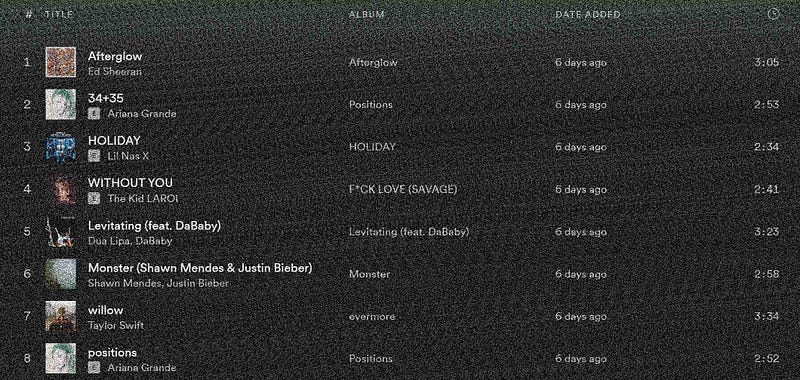
In an effort to stay culturally literate, I took a dive into the “Today’s Top Hits” playlist on Spotify. If I do say so myself, this took a lot of courage.
Here goes …
Ed Sheeran, Afterglow
The “sensitive white boy with acoustic guitar” genre is a risky one. Hey There Delilah, a №1 hit for Plain White T’s in 2007, made many of us go full Bluto.
But this isn’t bad. It doesn’t compare with the Sarah McLachlan album of the same name, but it’s a pleasant listen and a sweet love song.
Ariana Grande, 34+35
If you ever wondered what an 11-year-old thinks about sex, here’s your answer. What? She’s 27? What the hell is wrong with her?
(DM if you want to hear something crude that popped into my head in reference to this song.)
Lil Nas X, HOLIDAY
Hoes, n-word, bitch, bragging about music success, bragging about women all wanting him … BINGO! I HAVE BINGO!
And bullshit.
The Kid LAROI, WITHOUT YOU
What’s with all these CAPITAL LETTERS? OK, let’s check the LYRICS — “fuck all of your reasons,” “can’t make a wife out of a ho” and so on.
Dua Lipa was pretty good on Saturday Night Live. And I don’t hate this. If I could dance, I’d probably dance to it.
Shawn Mendes and Justin Bieber, Monster
The Beeb track Yummy is to music what Manos, the Hands of Fate is to movies, so this isn’t promising.
Spotify includes a “storyline” by Shawn Mendes himself. Let’s see … “A song about the pressures society places on all of us.” Ugh. This is going to be a rough one. “I was 15 when the world put me on a pedestal.” Barf.
Look, kids — if you’re struggling with the mind-altering experience of being a child star, go backpacking through Europe or go to college like Jodie Foster and Claire Danes. Don’t sit around whining on Spotify.
Taylor Swift, willow
I’m the only person in my household who likes Taylor Swift. She’s no Angela Perley, but she has a couple of good songs, including one from this year that sounds a lot like Rachael Yamagata.
In this one, the interwoven acoustic guitar and synth lines sound nice. The lyrics include some callbacks to previous songs, but this isn’t like diving into the fourth episode of The Mandalorian and being lost.
Not as good as Cardigan, but my respect for her keeps growing. Don’t tell my kids.
If you find yourself embarrassed by your enjoyment of the occasional Taylor Swift song, Saturday Night Live has you covered.
I am not listening to another song by Ariana Grande.
I’m all for women taking sexual agency. I’ve listened to Liz Phair and Garbage. But they sound like they know what they’re talking about, and Ariana Grande does not.
For that matter, neither do Cardi B and Megan Thee Stallion in WAP. If you need “a Henny drinker and a weed smoker,” you’re basically saying you need a guy to be stoned to get with you, and that’s the opposite of attractive.
Billie Eilish, Therefore I Am
Bad Guy is a legitimate pop classic, thanks in part to a killer hook with a sharp IV in a minor key.
And she starts out with a Descartes reference here. The “Behind the Lyrics” on Spotify also says she refers to Plato’s “Theory of Forms.” Damn. An 18-year-old (just turned 19) pop singer is better at philosophy than I am.
The song’s a little bland, though. Cut the drum machine and put it in the hands of a legit rock band, and she’d have something.
Pop Smoke, What You Know Bout Love
So his lady takes a naked pic before she leaves every morning, and she drives a Rover instead of a Camry. I guess if the idiocy doesn’t get you, climate change will. Next!
Bad Bunny and Jhay Cortez, Dakiti
Bad Bunny is apparently the top streaming artist of the year. I hadn’t even heard his name until today. Let’s give it a shot …
We’re starting with some cool synths. Then some singing in Spanish. But it’s that same thin Autotuned crap vocal that’s on far too many songs these days.
Cool that a Spanish-language song featuring a couple of guys from Puerto Rico has crossed over, but when you translate it, it’s just the same crap about wine, weed and luxury brands.
24kGoldn (feat. iann dior), Mood
This sucks.
Playboi Carti, Slay3r
“I’m a rockstar, I could’ve joined Slayer” is the funniest lyric I’ve heard so far in this excursion, but it’s the same old boring drum machine. Let’s check out the lyrics … and apparently, this clown thinks it’s cool to be on the PlayStation while a woman is doing stuff to him.
This is worse than I thought. This generation isn’t just making bad music. They’re having bad sex.
HVME, Goosebumps
Autotune … check. Boring beat with synthesized hand claps … check. Next.
Miley Cyrus (feat. Dua Lipa), Prisoner
This could be interesting. As previously mentioned, I have a good impression of Dua Lipa. Miley Cyrus just seems desperate for attention, and it’s been difficult to take her seriously since she twerked in front of Robin Thicke as he sang his borderline-rape anthem Blurred Lines.
It’s a familiar pop trope — this is a terrible relationship, but I just can’t make myself leave. It’s not horrible, but Cyrus’ voice sounds like it’s in a state of decay.
Justin Bieb-
No.
Ritt Momney, Put Your Records On
Gotta root for this one based on the artist’s name. But this one is controversial because it’s a cover of a Corinne Bailey Rae song, and the young white guy missed the Black female perspective in it.
Let’s hear it for unintended consequences. Let’s hope more people jump back and check out Rae’s version, and let’s hope Momney does better in the future.
And let’s see if I can get through the rest of the top 20 …
CJ, Whoopty
It’s short. Barely over two minutes. Good, because this is awful.
Internet Money et al, Lemonade
How long until we get a line about disrespectful sex and the n-word? Second line? All right then. Next.
Tate McRae, you broke me first
She’s not taking back her awful ex. Good for her. Not much to the song.
Conclusion
Have we turned into stereotypical parents? Or are Autotuned vocals, soulless “beats,” airy synths, lazy rapping and misogyny just that bad?
It’s the latter.
But we don’t have to accept that the Spotify most-streamed list is representative of “today’s music,” and even there, we can find a few worthwhile artists. Taylor Swift has a solid catalog of songs now, Billie Eilish is promising, and Dua Lipa is worth checking out. Not really sure why Ed Sheeran broke out of the adult alternative box to become such a huge star, but he’s OK.
The Weeknd didn’t pop up on this list, but he’s terrific. I wouldn’t mind hearing more from Lizzo and Rina Sawayama. The latter is an especially refreshing counterweight to the worst of the Spotify playlist, borrows extensively from hard rock and critiquing the consumer culture the lesser talents extol:
And if you want some more new music that rocks, check out The Pretty Reckless.
Or consider Phoebe Bridgers, who covers several genres in one song and brilliantly dissects her own work:
As for R&B, well, we’re just lucky we grew up with this:
If you know of any modern-day Stevie Wonders, let me know in the comments.
What was the first video played on MTV? And how wonderful was that song?
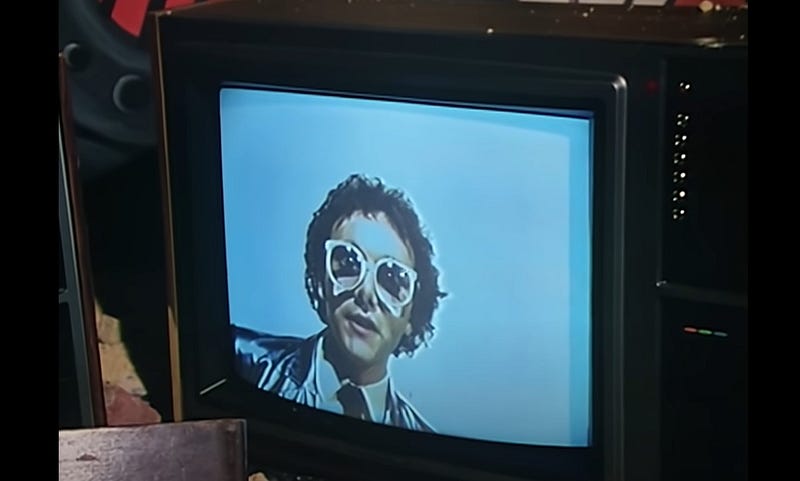
You surely got that trivia question. The first video played on MTV was Video Killed the Radio Star by the Buggles.
The related trivia questions are a little more difficult, depending on where your fandom lies:
What band did primary Buggles Trevor Horn (vocals, bass) and Geoff Downes (keyboards) join next?
What band did Geoff Downes join after that?
Who’s the third guy in the band playing keyboards at the end?
How many versions of this song were released in 1979?
What musical artist did Trevor Horn produce later on?
What band is Geoff Downes in now? (Oct. 23, 2020)
Answers below. But in the meantime, watch and listen …
Forget the trivia for a minute. This is a superbly constructed pop song with a delightful video highlighting the creativity the early video directors used with low budgets.
It’s easy to categorize this as synth-pop. But it’s not. Listen with headphones, and you’ll hear Horn’s melodic bass adding to the cornucopia of hooks in this song. You’ll also hear real drums, unless drum machine technology was much farther advanced in 1979 than any of us realized. There’s even a brief bit of screaming guitar.
But it’s also a textbook in how studio magic can suit the song. Downes’ piano captures the nostalgia of a song that looks both backwards and forwards. Horn’s voice is compressed so that when you see his ghostly image pop up in the video with an old-school microphone, it’s believable. The women singing backup give the choruses a cool vibe that Horn surely couldn’t have provided himself. (I think I have a crush on one of them, but I’m not sure which.)
And you’ll rarely find lyrics that paint a picture as well as these. The first verse reminds me of lying in the upstairs bedroom of my childhood home, trying to angle the antenna on my boombox so I could get clear reception on 96 Rock, the beacon blasting guitar gods across northern Georgia from the big city of Atlanta. From then on, it’s as if we’re traveling with Horn and unearthing the places where all the magic happened.
The way we listen to music is totally different now. You can listen to radio stations from around the world. You can have hundreds of options on SiriusXM — just 25 years after some of us were factoring the presence of an “alternative” radio station into our decisions on where to live, we have about as many varieties of “alternative” stations as we have breakfast cereals.
But there was always something romantic about the radio, especially the farther back you go. I was a shortwave-radio listener, so I delighted in finding windows on the world in the BBC (sporting), Swiss Radio International (charming), Radio Nicaragua (amusing), Radio Tirana Albania (boring), and Radio Moscow (frightening). Radio Tirana Albania was once called “radio’s cure for insomnia” by a shortwave magazine, Radio Moscow brought the USSR’s propaganda arm with an outstretched fist, and Radio Nicaragua alternated anti-American tirades with American music. (“America is terrible! America is coming to kill us! Here’s the latest from Madonna …”)
Closer to home, many a late-night road trip was punctuated by the moment of reaching my destination’s broadcast range. In both cases, I could always picture someone in a studio akin to the one Johnny Fever and Venus Flytrap shared in WKRP in Cincinnati, communicating with a city and the surrounding countryside with music.
So Video Killed the Radio Star is both nostalgic and futuristic. Todd in the Shadows captures that sentiment quite well in his One-Hit Wonderland tribute.
He also touches on some of the trivia questions mentioned above. The answers are:
What band did primary Buggles Trevor Horn (vocals, bass) and Geoff Downes (keyboards) join next?
Yes. It’s not a yes-or-no question. “Yes” is the answer.
Jon Anderson and Rick Wakeman left during a disastrous attempt to record their follow-up to Tormato, which was itself a mediocre follow-up to Going for the One, which deserves a place alongside the Big Three (The Yes Album, Fragile, Close to the Edge) and 90125 as the best the band ever produced.
Downes was an able replacement for Wakeman, a skilled keyboardist who matched Wakeman’s propensity for surrounding himself with far more equipment than he could possibly need and awkwardly stretching between keyboards that were barely within reach if he stood between them. Horn’s voice fit the lone album Yes/Buggles recorded, Drama, but it’s hard to imagine him pulling off Roundabout and Yours Is No Disgrace.
The great documentary Yesyears has an amusing anecdote in which bassist Chris Squire, the one ever-present member of Yes until his untimely passing in 2015, says Horn had a nightmare: They were in a limo on the way to Madison Square Garden when Squire handed him a Walkman and said, “Trevor, listen to this. You’ve never heard it before, but maybe we could play it tonight.”
And wouldn’t you know it, someone put Yesyears on YouTube. Start at the 1:10 mark for Anderson and Wakeman’s departure and stay tuned for the next few minutes.
Except that it skips over the anecdote. That’s weird.
Keep watching if you like, though the retelling of Tony Kaye’s return and the happy vibe of Union aren’t particularly accurate. A few minutes later, you’ll get a partial answer to №4 below.
What band did Geoff Downes join after that?
Asia, along with Yes guitarist Steve Howe. Downes carried on under the Asia name for decades with an even busier revolving door than Yes has had.
Who’s the third guy in the band playing keyboards at the end?
Hans Zimmer.
Yes, that Hans Zimmer. The perennial Oscar nominee for his film scores. The Masterclass teacher. He even wrote a new anthem for Major League Soccer, released this year. Just in time for COVID-19 to scramble the season.
He doesn’t seem to have played on the song, though. Wikipedia has a personnel list taken from a vinyl single release, and Zimmer isn’t mentioned.
The video does feature the actual backup singers, Debi Doss and Linda Jardim. I have no idea whether the guy briefly pictured hitting a drum is actual drummer Paul Robinson — it doesn’t look like him.
How many versions of this song were released in 1979?
Two. Bruce Woolley co-wrote the song with Horn and Downes and started a band called The Camera Club, which included another peripatetic young musician in Thomas Dolby. They recorded the song
There’s no sign of any hard feelings here. Woolley rejoined Horn and Downes for their first live performance in 2004. Not kidding here — the Buggles were a studio creation.
That live performance was part of a Prince’s Trust concert celebrating the music of Trevor Horn. He had done a bit more since leaving Yes and the Buggles. A bit.
What musical artist did Trevor Horn produce later on?
Yes. Squire and drummer Alan White started working with guitarist/vocalist Trevor Rabin, then brought back Anderson and long-exiled keyboardist Tony Kaye. Horn produced one of the most surprising records in rock history, turning Yes into a pop-rock band for the heyday of MTV, propelled by the instantly recognizable Owner of a Lonely Heart.
And then he produced Spandau Ballet. And ABC. And Frankie Goes to Hollywood. And Grace Jones. And Simple Minds, and Paul McCartney, and Rod Stewart, and Seal, and Pet Shop Boys, and … Barry Manilow?
And the Pretenders, and Cher, and … LeAnn Rimes?
And that’s just in the 20th century. Check his AllMusic page and give it a while to load — it also includes “composer” credits for everyone who covered and sampledVideo Killed the Radio Star. Again, allow some time if you want to read that list.
So that Prince’s Trust concert had plenty to choose from. The Buggles kicked things off. Grace Jones did a song. Pet Shop Boys and Seal played. And it all finished with a performance captured in one of my favorite YouTube videos — Frankie Goes to Hollywood.
Look carefully, and you’ll see Steve Howe doing a guitar solo. And you’ll see Trevor Horn.
What band is Geoff Downes in now?
Yes. Again, Yes. And Asia. Those bands toured together in 2019, with members of Yes comprising more than half of the Asia lineup — Yes bassist Billy Sherwood is Asia’s singer/bassist, Downes is on keyboards, and Howe played a bit as well.
So the two guys you see in the one-hit wonder band that was the first video played on MTV are basically the Kevin Bacons of music. Whether it’s a sample, a cover version, something Horn produced or someone with whom Downes played, the Buggles are part of the fabric of music in the last 40 years.
And they did all that after they recording this beautiful song and an unforgettable video.
It was one of the most glorious moments of serendipity in television history.
Country singer Morgan Wallen was uninvited as Saturday Night Live’s musical guest after they discovered Wallen had been partying sans mask. To his credit, Wallen handled the decision gracefully.
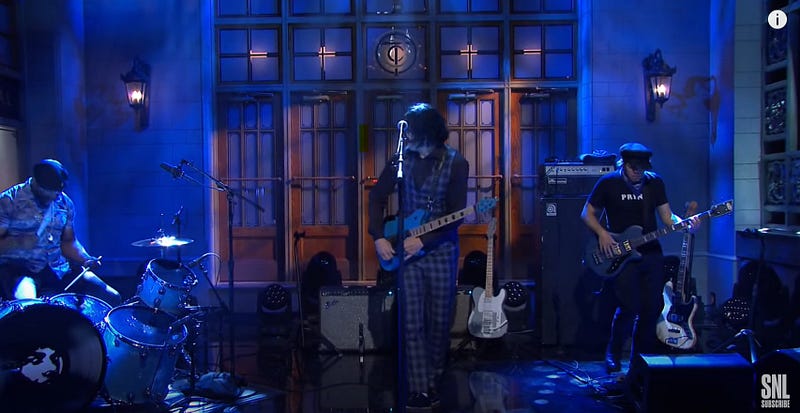
Left with a short-notice vacancy, SNL put called in Jack White, a proven veteran of the Studio 8-H stage.
And he tore … it … up.
Pity Wallen, who wound up being thanked for torpedoing his own performance so that White could take his spot.
His opening medley stitched together a song he did with Beyoncé, a White Stripes song and a gospel blues song by Blind Willie Johnson, who died in 1945. He later performed his solo tune Lazaretto on a custom guitar Eddie Van Halen had helped to design for him, and he tossed in a bit of two-handed tapping as another salute to the rock guitar pioneer who recently passed away.
Guitar World also took a peek at White’s fuzz-heavy pedalboard, giving him a cornucopia of distinctive guitar tones at the touch of a foot.
But the handful of pedals that can be lifted with one hand is nothing compared with the extravagant shows SNL performers have put together in recent years. Last year, Billie Eilish performed on a set that rotated vertically, creating the illusion that she was walking on the ceiling.
Last week, Megan Thee Stallion showed she isn’t just the person who joined Cardi B for the in-your-face sexuality of WAP, with political statements projected on the wall behind her to reinforce the notion of respecting Black women.
There’s nothing wrong with those performances. Megan Thee Stallion made a powerful, timely statement. But White, armed only with a pedalboard, a few lights, a bassist and a drummer with a unique drum kit that faced away from him, more than held his own alongside the multimedia extravaganzas musicians have done on SNL.
In doing so, White proved a basic point.
Rock isn’t dead.
The Billboard charts might say otherwise. But when people want to see a show, there’s nothing quite like the power that some drums and guitars can conjure. (And, in some cases, keyboards.)


 Mostly Modern Media