Saturday Night Live has finally unveiled its hosts and musical guests from a winter break that seems like an eternity. Most of us are probably wondering how they’ll tackle the Capitol insurrection or whether they’ll come up with a pair of Bernie Sanders mittens for Larry David to wear.
But it’s always fun to see who’s coming up next, and this is an intriguing list:
How many of those names do you know? John Krasinski surely the highest Q-rating — yikes, we should probably retire that term — with a career ranging from The Office to A Quiet Place. I also know Dan Levy, though I’m far more familiar with his dad, Eugene, and Phoebe Bridgers is on the list of “best music of the 21st century so far” that I want to finish today.
I’ve heard of the other three, but I don’t know any of their work.
Your answers may differ. You might be a hipster who can name 15 Nathaniel Rateliff songs. Maybe you’re into the intersection of rap and rock, so you know Machine Gun Kelly. Regina King’s list of awards merits its own Wikipedia page.
Naturally, if you profess your unfamiliarity with any of these people on Twitter, prepare to be, as the kids say today because they’re unfamiliar with the history of hate crimes, “dragged.”
We saw the inverse of this generational slap-fighting when Billie Eilish confessed that she hadn’t heard of Van Halen. Fortunately, Wolfgang Van Halen brilliantly set things right:
To an extent, it’s the job of every generation’s artists to bug their parents, as Weird Al Yankovic (more popular five years ago than he was 25 years ago) put it in Smells Like Nirvana. You could, though, make an argument that people wouldn’t still be buying Rumours and Queen’s Greatest Hits if today’s music wasn’t riddled with Autotune, lazy “beats” and misogyny. And no one’s under any obligation to listen to country music — I had no idea who Morgan Wallen was before he lost his SNL spot and was rescheduled for a few weeks later.
In 1980–81, 29 shows averaged more than 15 million viewers, even with less than 80 million TVs in the country. In 2020, that number was down to three, of two of those were football.
As recently as 1999, you could watch nearly everything nominated for a major Emmy with a TV antenna. With basic cable to cover the networks and an HBO subscription, you were pretty well covered. By 2010, you needed a more complete cable package to get AMC and Comedy Central, you’d certainly need HBO, and you could only see everything if you tacked on Showtime.
To see the nominees for best comedy and best drama in 2020, you’d need:
$15/month for HBO Now (Succession, Curb Your Enthusiasm, Insecure)
$13/month for Netflix (Dead to Me, The Kominsky Method, The Crown, Ozark, Stranger Things)
$9/month for Amazon Prime (The Marvelous Mrs. Maisel)
$7/month for Disney Plus (The Mandalorian)
$6/month for Hulu (The Handmaid’s Tale)
$30-$50/month for a good enough cable/streaming package to get FX (What We Do In the Shadows) and AMC (Better Call Saul), not to mention the broadcast channels if you don’t get them another way.
Probably a bit more for another cable tier to get BBC America (Killing Eve) and Pop TV (Schitt’s Creek)
Even with good bundling (I get Hulu through Spotify, and Amazon Prime pays for itself if you use it to pay for shipping), you’re looking at $75-$100 a month just to cover the very best shows.
At least you’re not paying much for music. That means a lot of your favorite musicians don’t have health insurance, but anyway.
So there’s something a bit elitist about insisting that everyone know everything about pop culture. Plenty of people never watched Game of Thrones, so they might recognize Peter Dinklage for “Space Pants” rather than his best-known show. Plenty of people gripe every time SNL brings in an athlete — “Who’s J.J. Watt?”)
Besides, aren’t Millennials and Zoomers supposed to be broke? How are you paying for all this and your $1,000 iPhones with unlimited data?
Those of us with mortgages will happily give any host a chance. And stream some Billie Eilish songs.
All of these words apply to Facebook and Twitter, the two most important social networks we have.
But Facebook is driving people away. Privacy concerns are one factor because Facebook accumulates a lot of data over which many a marketer drools. Older generations have found it’s a wonderful way to keep in touch with all the people we met over the years, only to see their kids and grandkids get frustrated and move on to simpler social networks like Instagram.
To some extent, clever philosophical thinkpieces on bureaucracy and humanity notwithstanding, Facebook’s problems are the Internet’s problems. Bump the purveyors of ignorance and hate off of Facebook, and they’ll just congregate elsewhere.
Like Twitter, which is now in the news because it’s wrestling with the question of whether a sitting president is exempt from policies designed to prevent harassment and disinformation. Twitter is reluctantly dealing with the issue now, while Facebook is similarly reticent.
Zuckerberg to CNBC this morning: "I don't think that Facebook or internet platforms in general should be arbiters of truth I think that's kind of a dangerous line to get down to in terms of deciding what is true and what isn’t."
— Charlie Spiering (@charliespiering) May 28, 2020
Twitter’s openness is both its strength and its undoing. Users are free to make connections and share things that go beyond their circles of friends. They’re also free to engage in misguided public shaming efforts and harass people.
Just ask female journalists, whose horrible treatment online was brought to light in this brilliant, heartbreaking video in which men read tweets face to face with sports reporters Sarah Spain and Julie DiCaro. The men in the video, obviously men of better conscience than the people who wrote the tweets, can barely get through the vile language and sentiments.
Granted, all of these disgusting words could’ve been directed to Spain and DiCaro some other way. Even in the days before email, newspapers used to get interesting letters.
But the public nature of Twitter encourages people to ratchet up the verbal violence. Online trolling offers a vicarious thrill than an email doesn’t generate. The harasser might get the satisfaction of striking a nerve or find kindred hateful spirits.
I can’t speak for Spain, DiCaro or women who bear the brunt of such assaults in ways that men do not. I have, though, been the subject of a couple of campaigns of torches and pitchforks, and they were far nastier on Twitter than they were on email.
When I called out Manchester United for touring the United States without playing Major League Soccer teams, as other big European soccer clubs had done, I got a few hundred emails. The tone changed over the course of each day — the overnight mail from England was witty, while the American Man U fans who wrote later in the day used less refined language. On a message board for Man U fans, I was given credit for engaging with my critics, even if I “failed quite miserably.”
I responded to almost all of the emails, taking it all in good humor. My new virtual penpals were usually impressed that I responded and even a little chagrined upon the realization that a real human being read what they had written in anger.
Those exchanges aren’t the norm on Twitter, as I saw when I made an admittedly flip comment about U.S. women’s national team players demanding “Jordan rules”-style favoritism from refs in the new National Women’s Soccer League in 2013.
I mentioned a book I was writing on women’s soccer, and someone said she would buy it just so she could hit me in the face with it. (Sadly, the tweet is no longer available.)
My favorite was the guy who said he’d kill me twice.
But my “fun” is white male privilege. It’s not fun for Spain or DiCaro. Even in this conversation that ran roughly 20 to 1 against me, a few people harassed Morgan. And it’s not “fun” to see armies of bots and hatemongers spewing garbage.
So Facebook and Twitter have issues. Can we just unplug?
Well … not really. Not without alternatives that don’t exist.
Twitter can be ignored, depending on your job. I’m a journalist, and I need to disseminate my own writing and read a handful of useful sources. If you made a better career choice, you might be able to get by without it.
Facebook is virtually inescapable, particularly if you’re part of any group that needs to communicate. If you think Facebook is clumsy, try email lists.
But let’s dream here. Let’s pretend we have a pile of venture capital to create a robust collection of servers, create relationships and advertise our new meeting place. Let’s pretend we can somehow scale up quickly.
What would we want from our new network?
First, a few things Facebook and Twitter do well:
Instant sharing of links.
Facebook groups, often a means of communication for real-life groups like PTAs and student organizations.
Twitter lists, a means of following reliable sources in particular fields.
On Facebook: Determining which people can see what you’re sharing.
On Facebook: Charitable donations. You can do fundraisers seamlessly, and if you do one for your birthday, your friends will see it.
Direct messaging.
“Sign in with Facebook,” streamlining the process of going to various online stores and sites.
Virtual “yard sales” / marketplaces.
Targeted ads, which have pros (awareness of things we want to know about) and cons (how did Facebook know I was looking for new glasses?).
So we want to keep those. But what can we do better?
More control over what we see and share. Facebook makes it too difficult to make lists and adjust our “news feed.” I moderate a group in which it’s next to impossible to keep track of everything that’s posted. They used to have a nice “smart list” feature in which I could easily share things with friends who live in my town or went to my school, but they took it away for some reason.
Better customization of “Pages” for those of us who are trying to build brands. I have a page for my writing, and I’m prompted to enter my hours of operation.
Give readers easier tools for flagging misinformation, and beef up the staff that checks it out.
And perhaps we can take it into new realms.
Content that lasts: Ally with Medium (no, I’m not just bribing the curators here) to let users turn their pages into blogs. I love the blogs I’ve run because I can go back and look at old content. I’m still getting page views on things I wrote years ago because they pop up on searches. That doesn’t work on Facebook, where everything is in a walled garden — not to the extreme of 1990s AOL and Prodigy, where you literally couldn’t see the content unless you were in the AOL or Prodigy network, but certainly not easy to find by any search, even within Facebook itself. Twitter has an advanced search feature that’s good but not great.
That’ll help individual writers who are just out to reach as wide an audience as possible. But we can go further than that and help solve a bigger problem …
Create universal subscriptions for news sites: We can already sign in to so many sites through Facebook. Suppose we were able to use that sign in to pay a small amount for the content we see?
I so often run into content I can’t read because I’ve used my “three free stories” at the site in question — the LA Times, the San Francisco Chronicle, the Philadelphia Inquirer, etc. I can’t possibly justify subscribing to all of these out-of-town newspapers for the 1–2 stories I want to read each month. I’d be happy to pay a la carte, or better yet, buy packages that let me subscribe to multiple online publications — the old cable TV model that we’re now seeing on YouTube TV, Sling or Hulu.
Speaking of subscription, suppose we gave readers another tool that helps them pick their level of engagement?
Premium payments and privacy: These sites would lose a lot of their functionality if they went behind a paywall, but they’re ideally suited to give premium memberships that let people eliminate some of their concerns.
Users could pay nothing and let the site generate money off their data as social networks currently do. Or they could pay $5/month or so to get greater control over what they share. Maybe even $10/month for an ad-free experience.
Twitter has a narrower focus than Facebook, so it can’t make a lot of the changes here. Getting rid of bots would be the biggest step forward, and any other tool they can use against disinformation would help. Other than that, Twitter is what we make of it. Personally, I’m trimming things down to smaller and smaller lists — on a typical day, I may only check out a list that has 35 people who are vital to my work or real-life friends. My DMs are still open so people can send me news tips or alert me to an interesting conversation. Avoiding the rest of the nonsense on Twitter is basically an exercise in self-discipline.
Facebook could easily do the things suggested here. They can afford the tools (check out the AI being integrated through the work of the Reporters Lab at my alma mater, Duke) to fight misinformation. They can tweak their user interface. They can build upon things they aren’t currently doing.
But they might not do so unless they’re responding to competition. Google Plus was a half-hearted effort, and Google’s “Groups” are anemic in comparison to what Facebook offers.
We might not want to have dozens of social networks because we’d have trouble connecting with the masses as we do. You might have a circle of 20 close friends on 10 different social networks.
All we really need is one solid, well-funded competitor that does much of the good Facebook does while dropping the bad. We’re not going to be able to hold Mark Zuckerberg and company accountable any other way.
Entertainment inevitably has some generation gaps.
Billie Eilish wound up as the poster child for generational barriers when she admitted late last year that she didn’t know Van Halen, starting a controversy brilliantly and kindly resolved by Wolfgang Van Halen.
Eilish never deserved any mockery or scorn in the first place. She was born in 2001. She was born 23 years after Van Halen’s first album. She was born after Van Halen’s Gary Cherone era. Van Halen has released one studio album in her lifetime.
Let’s find something comparable for a Gen Xer born in 1970. We’ll need to find a musical act that debuted in the late 1940s, faded in the 1960s and released one album after 1970. Muddy Waters is close to that timeline, but he released several albums after 1970 and was arguably better appreciated toward the end of his life. Plenty of jazz musicians were big before rock took over in the mid-1950s, but they all keep releasing albums every 15 minutes or so until they pass away.
This is a roundabout way of getting to the just-concluded season of Saturday Night Live, in which Gen Xers often haven’t heard of the musical guests. We also tend to think of Chance the Rapper and Justin Timberlake as great SNL hosts rather than musicians. We don’t get Kyle Mooney’s sketches, and we’re a little hazy on TikTok.
And we’re probably not being hired to write “best of” compilations, so I decided to do one anyway. In chronological order, wrapping up with the wonderful “at home” editions.
(Not including Weekend Update, which has been terrific throughout the Jose-Che tenure.)
Inside the Beltway
Perhaps a bit too painful, as we go back through history to see how many times we’ve written off Trump. Kenan Thompson provides the succinct voice of reason, and Aidy Bryant cracks up after a live-television mishap.
The War in Words: William and Lydia
Mikey Day stars in this recurring parody of historical documentaries with soldiers at the front writing letters home. Phoebe Waller-Bridge is perfect for the role as the exchange of letters grows more exasperating each time.
Mid-Day News
A quick study of racist undertones and an emphatic part of Ego Nwodim’s breakout season. (Inexplicably, her riotous and relatable take as a parent at wit’s end hiding in her closet during quarantine was online-only.)
SoulCycle
Some of the best SNL sketches are the ones that cycle quickly through the cast as they roll out impressions or characters that are great in small doses. They’ve done this basic premise more than once, and it works, especially with these auditions for spin class instructors living up to every hyper stereotype of spin class instructors. Kate McKinnon shines as the one who was kicked out of Scientology, and Ego Nwodim and Alex Moffat provide comic foils for each other as two bickering riders.
E-Sports Reporter
When Chance the Rapper first hosted, he played an MSG sideline reporter who usually did basketball but was pulled in for sub duty on a hockey game, which he did quite uncomfortably. The joke is even better here, with Chance filling in for all of us trying to make sense out of the notion that people will pay to watch other people play video games.
2020 Democratic Debate
Most of the debate sketches were good this season, but Cecily Strong’s terrifying Tulsi Gabbard puts this one ahead of the rest. I’ll also miss Kate McKinnon’s Midwestern grandma Elizabeth Warren and Larry David’s grumpy-yet-amiable Bernie Sanders. It’s always great to see Rachel Dratch, and Woody Harrelson (a few episodes after he hosted) is a welcome addition as Joe Biden.
Chad & JLo
Pete Davidson’s uber-chill slacker Chad is one of the better recurring characters in recent SNL memory, and Jennifer Lopez does a solid job selling a truly twisted love story, a highlight in an episode that spent entirely too much time selling us on the notion that Lopez looks fantastic for her age. Yeah, she does, but how many sketches do we need along those lines?
Sleepover
Adam Driver has become a go-to SNL host, with a deadpan delivery that fits perfectly with this role as a father who really doesn’t want to accuse any of his daughter’s sleepover guests of a misdeed in the bathroom that goes farther and farther into the abyss. (Related: Kate McKinnon is a national treasure.)
Robbie
Kealia Ohai’s husband was a remarkably good host, especially in this puncturing of the sports-underdog trope that was tired when Rudy did it.
(Yes, Ohai’s husband is J.J. Watt.)
John Mulaney Monologue
Mulaney went from SNL writer to failed eponymous sitcom star to one of the best stand-up comics in the country to a must-see SNL host.
On the Couch
Like Justin Timberlake, The Weeknd has a smooth R&B voice that lends itself quite well to music videos that take unexpected turns.
Twitch Stream
I’m barely young enough to know that gamers gain celebrity status on Twitch. Here, the ever-excellent Mikey Day suffers a string of defeats that threatens his status.
Pornhub
We can only wish this was the last word in the “now more than ever” genre of TV ads.
Airbnb Commercial
Star newcomer Chloe Fineman did some of the best “at-home” work. Here, she plays both the earnest Airbnb host and the grating overenthusiastic Swedish guest who is now in indefinite quarantine with her.
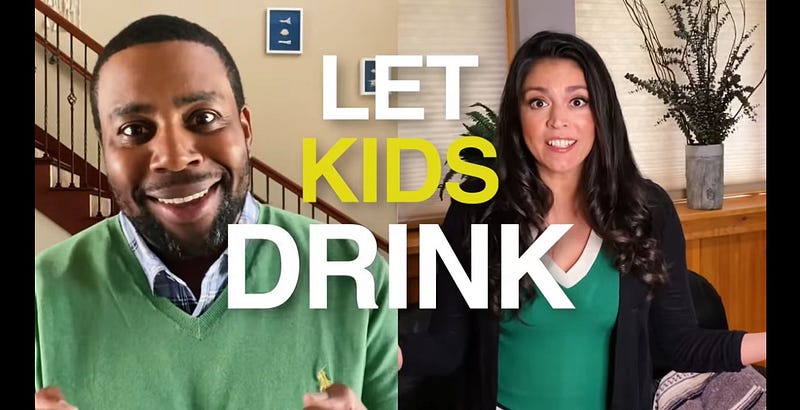
Let Kids Drink
A fitting finale for a season that went into new territory because of historic circumstances. At this point, all parents can relate to this song, which is structured like a charity appeal.
Murder! Guns! Graphic war scenes! A man tenderly running his hand …
Whoa, whoa! We can’t let our kids see that!
Our sensibilities about sex and violence have always been a bit hypocritical. Jamie Lee Curtis taking off her top in Trading Places? That’s an R rating. A film strewn with death? Today, PG-13. In the old days, just PG. Even the original Star Wars had a high death toll, though it was just rebel pilots vaporizing or stormtroopers doing the Wilhelm scream.
Meanwhile, on cable, language restrictions are completely out the window, and some people even have s-e-x. As someone who jumped on the Game of Thrones very late in the show’s run, I started to wonder if part of the appeal was that people got naked. Very naked.
From Saturday Night Live:
Emilia Clarke: Remember when we had sex in Season 6?
To be sure, there’s precious little to mourn in the death of the kind of ogling soft-core wish-fulfillment fantasies that male directors foisted on viewers for nearly a century. But is abstinence really our only option? With young filmmakers being co-opted by the Disney-Marvel complex, and with millennials and Generation Z reportedly having less sex than their predecessors, the new chastity on screen feels like a prudent but not entirely welcome new normal.
And it’s better than having kids learn about sex from porn.
Originally published at https://mostlymodernmedia.wordpress.com on June 10, 2019. That’s my other non-sports blog. It’s sometimes a little more cynical than Before the Apocalypse.
Tough question here. In some cases, people are taking images and giving them new life in new contexts, and everyone wins. In other cases, people are ripping off photographers and artists who deserve to be paid for their work.
Not sure where to draw the line. Not sure we want to let lawyers decide.
Personally, I’m very shy on using photos. That’s why I have a lot of bookmarks for sites at which I can look up images and figure out whether they’re in the public domain or otherwise explicitly available for use. That distinguishes me from about 99% of Internet users.

 Mostly Modern Media