
This is very long, but it can be skimmed at your leisure. Watch for a follow-up post of factoids later this week.
In September, learned people raised the possibility that Kanye West’s candidacy might affect the election.
Turns out that was the least of our concerns.
In 2016, Green Party candidate Jill Stein drew plenty of Democratic ire because if her votes were added to Hillary Clinton’s in a couple of key states (Wisconsin, Michigan, Pennsylvania), we would be in the 12th year of having a Clinton in the White House. In 2000, Green candidate Ralph Nader cost Al Gore the state of Florida (well, a dubious vote count did the damage, but that’s another issue) and therefore the presidency.
https://www.vox.com/policy-and-politics/2016/11/11/13576798/jill-stein-third-party-donald-trump-win
Four years ago, in addition to Stein, we had spacy Libertarian candidate Gary Johnson and anti-Trump conservative Evan McMullin.
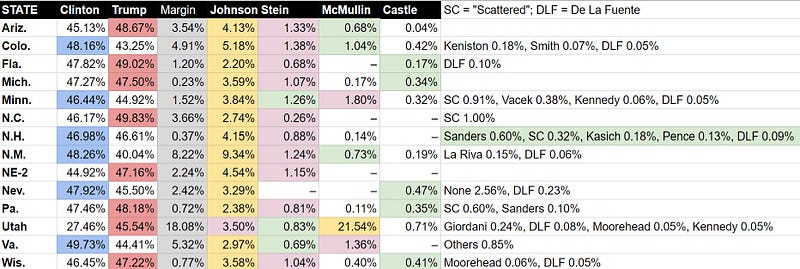
And they were quite effective at keeping two unpopular main-party candidates from picking up majorities. Johnson’s vote percentage beat the winning margin in 10 states and one district. Stein did it in four. McMullin did it in two, including a whopping 21.54% of the vote in his home state of Utah, within striking distance of Clinton’s 27.46%.
In the 13 states and one district that gave the winner less than 50% of the vote, Johnson, Stein, and McMullin weren’t the only spoilers. In Michigan, Clinton would’ve beaten Trump if she had collected all the votes for the Constitution Party’s Darrell Castle. (Not that she had a shot — Castle is a Christian conservative.) And people who wrote in Bernie Sanders over his protests nearly cost Clinton the volatile state of New Hampshire.
(In this chart, the margin between Clinton and Trump is in gray, the 3rd-place finisher in each state is in yellow, 4th place in pink, 5th place in green.)
This time, Green Party candidate Howie Hawkins wasn’t a factor at all and wasn’t even the only Green candidate — in Alaska, the Green representative was the enigmatic former Minnesota governor/pro wrestler Jesse Ventura. The Libertarians nominated Jo Jorgensen, who ran a quiet campaign and also didn’t swing any states.
All told, only two states had a winner with less than 50% of the vote. (When I started writing weeks ago, it was three, but Biden has cracked 50% in Pennsylvania.)
NORTH CAROLINA: Trump 49.93%, Biden 48.59%, Jorgensen 0.88%, Hawkins 0.22%, Others 0.38%
GEORGIA: Biden 49.50%, Trump 49.26%, Jorgensen 1.25%
So if you took the other parties off the ballot, the only potential swing would’ve been in Georgia, and that’s if you assume (not a safe assumption) that the Libertarian vote would’ve gone to the authoritarian Trump.
The 2016 election was a free-for-all between two disliked candidates. “Giant meteor” or sentiment thereof was a popular campaign sign. Wikipedia says (unusually, without a source) that the 1,022,439 write-in votes — not too far from 1% — was a record.
This year, the election featured a likable Democrat in Joe Biden and tens of millions of people determined to dump out an incompetent authoritarian — and, apparently, tens of millions of people who like incompetent authoritarians. And after 2016’s upset, no one was taking anything for granted.
Little wonder the number of serious and semi-serious candidates, including those in primaries, plummeted from 586 in 2016 to 248 in 2020. Ballotpedia’s comprehensive list from the FEC counted 1,780 candidates in 2016, down to 1,212 in 2020, The presence of a feared incumbent meant a much smaller Republican primary field — from 102 (18 “principal”) to 26 (six “principal”) — but the number of people hoping to replace that incumbent in the general election dropped quite a bit.
Is that a bad thing?
Are two parties better than one? Or three?
The two-party system stinks. Our Founding Fathers knew it …
“The alternate domination of one faction over another, sharpened by the spirit of revenge, natural to party dissension, which in different ages and countries has perpetrated the most horrid enormities, is itself a frightful despotism. But this leads at length to a more formal and permanent despotism.” — George Washington
“A division of the republic into two great parties … is to be dreaded as the great political evil.” — John Adams
These quotes lead an article in The Atlantic by Lee Drutman, the author of Breaking the Two-Party Doom Loop, a book title I wish I could borrow.
https://www.vox.com/policy-and-politics/2016/11/11/13576798/jill-stein-third-party-donald-trump-win
And we’re seeing now that The Constitution is even less of a bulwark against partisanship than we thought. If the courts had fewer people of conscience, or if Congress had fewer Democrats, the country might have thrown out a fair election without breaking the law. On top of that, we have the anti-proportional Electoral College. Who wrote this thing?
OK, maybe that’s not fair. As Drutman notes, the Founders were just a little naive. They may have thought their utterances on political parties would be enough to limit their danger, when they should’ve focused writing such limits into the Constitution instead. (Also, they should’ve taken care of that comma splice in the Second Amendment.)
Drutman spelled out his solution in more vivid detail for a piece at Vox. You may have heard of ranked-choice voting, which gives third parties a reasonable shot. As it stands now, a third-party vote means nothing — unless you’re Hillary Clinton.
If you could rank everyone who’s running, then any candidate who doesn’t get 50% would have to impress enough people to be a second or third choice. Drutman is also a fan of proportional elections, in which a state might have five seats or five electoral votes and split them up according to how well each party does — say, two seats for 40%, one for 20%, etc. Beats gerrymandering. (There’s also an entire party set up to support “Approval Voting.”)
The advantage is plain to see. Instead of automatically discounting the “other” side, voters — and maybe even lawmakers — would consider multiple options. Not bad. And such systems would erase the unfair system in which politicians can win an election or electors with less than 50% of the vote.
The sad part is that the third parties as currently constructed are … shall we say, a little cranky?
Third and fourth …
And I’d be a Libertarian, if they weren’t all a bunch of tax-dodging professional whiners. — Bloom County cartoonist Berke Breathed
In 2016, John Oliver took a closer look at Johnson and Stein. The latter is a doctor who cozies up to anti-vaxxers and called for a new 9/11 investigation. Johnson was entertaining, at least. If the networks gave Trump tons of free publicity because he was good TV, they really should’ve done the same with Johnson. I love watching VP candidate William Weld, a former Massachusetts governor, sitting stoically while his running mate babbles.
Oliver also takes note of Joe Exotic (aka Joseph Maldonado), not yet of Tiger King fame and not yet of prison, who was bidding to become our first gay, suitless president. In 2016, he raised more than $15,000 and got 962 votes, mostly in Colorado. He actually raised $1,094 for a 2020 campaign for the Libertarian nomination, perhaps paving the way for former presidents to run from prison.
THE LIBERTARIANS
Johnson’s Libertarian Party is, by a wide margin, the country’s largest third party. It’s also the upholder of the philosophy everyone claims to have but really doesn’t. Conservatives claim they’re “libertarian” when they want to seem like they’re not going to ram their moral values down your throat, but they still want to ram their moral values down your throat. Some Libertarians are anti-abortion, which is simply incoherent. Some liberals claim to be libertarian when they want to appear fiscally conservative.
A lot of people flirt with libertarianism in high school or college. It provides cover for their privilege. The free market cures all, in this view, and people who can’t succeed don’t deserve it. Eventually, like Rush’s Neil Peart (RIP), they outgrow their Ayn Rand phase and realize empathy for other people isn’t a sign of weakness.
The Republican Party is sometimes libertarian-ish. The Tea Party, which overlapped a bit with the libertarians’ small-government ideal, was all the rage a few years ago. Then the GOP turned toward someone as anti-libertarian as any president in history. (And yet the comments section at libertarian magazine Reason includes a whole lotta Trumpism. Go figure.)
But the Libertarians can be amusing. The Atlantic ran a piece in which a progressive panel, a conservative panel and a libertarian panel took a shot at re-writing the Constitution. The libertarian panel considered adding “and we mean it” to every clause, which is a fun idea.
So how has the party done?
Gary Johnson, 2016: Third place in every state except Vermont, where voters put Bernie Sanders third even though he wasn’t running, and Utah and Idaho, where McMullin took third. He had more than 5% in nine states, topped by 9.34% in New Mexico, where he served as governor (as a Republican) from 1995 to 2003. His worst showing: 1.19% in Mississippi.
- National vote: 4,489,341 (3.28%), 3rd place
Jo Jorgensen, 2020: Definitely not the results Johnson got. First, she had to fend off a primary challenge from Dan “Taxation is Theft” Behrman (yes, that’s how his name is registered with the FEC), who raised and spent more than $50 million. That’s more than Kamala Harris. Jorgensen got $3.4 million, far less than some of the candidates below (De La Fuente $15.6m, Kanye $14.4m, Pierce $6.3m).
She still took third place in every state, but the other numbers are less kind. Her best state was South Dakota (2.63%). She only cracked 2% in eight states, and she was under 1% in 11 states.
- National vote: 1,865,620 (1.18%), 3rd place
THE GREENS
Like the Libertarians, the Greens have had some success getting candidates elected at lower levels. Green parties have been more successful in other countries that makes things easier for third parties to move into power and even form ruling coalitions.
As the name implies, they’re environmentalist, and that goes hand in hand with other progressive policies.
Jill Stein, 2016: For all the fuss over her role as the spoiler, Stein didn’t take 3rd place in a single state in 2016. She was 4th in most states, 5th in 11 states, 6th in one, and not on the ballot in three.
And for all the fuss over the Rust Belt, Stein’s best states were Hawaii (2.97%), the West Coast, New England and, oddly enough, Kansas. The Sun Belt was not receptive.
- National vote: 1,457,218 (1.07%),4th place
Howie Hawkins, 2020: 1% in Maine. A plummet to 0.67% in Hawaii. His fund-raising pulled in less than $500,000, even with a clever logo.

- National vote: 404,021 (0.26%), 4th place
In Alaska, Jesse Ventura repped the party with 0.7% of the vote. He also picked up a smattering of write-in votes in California because.
Hawkins also got the nomination of Legal Marijuana Now, Socialist Alternative and Socialist Party USA. Didn’t seem to help.
One oddity: Three of the four people on these tickets in 2020 are from South Carolina — Jorgensen and VP candidate Spike Cohen, and Green VP candidate Angela Walker.
The Wild Wild West
Utah native Evan McMullin is a former CIA agent and GOP Congressional aide who was appalled by the Trump candidacy. He ran in 2016 and endorsed Biden in 2020.
Kanye West is a rapper who liked Trump, then disliked Trump. He’s best known for spoiling Taylor Swift’s acceptance speech.
Evan McMullin, 2016: In addition to his whopping 21.54% in Utah, he was 3rd in Idaho with 6.73%. He was 4th in seven states and 5th in 16 but then dropped off.
- National: 731,991 (0.54%), 5th place
Kanye West, 2020: What do McMullin and West have in common? They fared best in Utah and Idaho. Kanye picked up 0.48% in Utah and 0.36% in Idaho, two of his eight 4th-place finishes. The rest of his 4th-place states, oddly enough, are contiguous Bible Belt states — Oklahoma, Arkansas, Louisiana, Mississippi, Tennessee and Kentucky. But for all his fame and the hype that he might have some impact, he clearly didn’t. Trump won all of those states by at least 16 points. And his national total was less than 10% of McMullin’s. He got nearly as many votes as a vice presidential candidate in California, where the American Independent Party (see below) nominated him without asking.
- National: 70,294 (0.04%), 7th place
Cranky conservatives
CONSTITUTION PARTY
These guys don’t like taxes, climate-change scientists, and immigrants. They like the death penalty but oppose abortion, even if the nominee is otherwise libertarian-leaning. They think Republicans are a bunch of sellouts.
In 2016, nominee Darrell Castle did pretty well. He cracked 1% of the vote in Alaska, South Dakota and, for some reason, Hawaii. He was 4th in South Dakota, though McMullin and Stein weren’t on the ballot there, and 4th in Mississippi, where he finished ahead of Stein.
In Idaho, Scott Copeland was the nominee because the state held its own primary. Copeland’s campaign adviser said Castle was the “insider, establishment” candidate who didn’t bother to campaign in Idaho; Castle said his melanoma diagnosis disrupted his campaign. (He survived melanoma and now has a podcast.) Castle still got 0.64% in the state as an independent; Copeland got 0.34% (2,356 votes).
In 2020, the party nominated Don Blankenship.
Wait a minute. Don’t I know that name?
Yes, Blankenship figures prominently in John Oliver’s classic report on coal. He’s not as prominent as Bob Murray, who predictably sued Oliver and company to inflict some misery even though he had no change of winning. But he spent one year in federal prison in the wake of a fatal mine disaster, and Oliver had fun with footage of a rally he held with Ted Nugent, Hank Williams Jr. and a drooling Sean Hannity. (See the 10-minute mark.)
Being a punchline and a federal convict didn’t stop him from placing fifth in a few states and scratching over 0.3% in some states, but he didn’t even manage a third of what Castle got in 2016.
Constitution numbers:
- 2016, Darrell Castle. National: 202,975 (0.15%, 6th)
- 2020, Don Blankenship. National: 60,062 (0.04%, 8th)
Blankenship, though, wasn’t the only candidate to claim the Constitution Party nomination. See the Independent American and American Independent parties below.
ALSO ON THE RIGHT
Plenty of candidates and parties competed for the “conservative” vote in 2016, but this strain of candidate faded in 2020, perhaps because Trump and his minions demanded fealty.
Let’s start with the perennials:
Richard Duncan (independent: anti-abortion, anti-gun control, pro-bombing): The Ohio native does pretty well in his home state and nowhere else. He peaked in 2016, taking 5th in Ohio, ahead of McMullin and Castle. For some reason, he wasn’t on the Ohio ballot in 2020, nor did he get any write-in votes, and got all of his votes in Vermont.
Update: Duncan says he qualified for the ballot in Ohio but gave his spot to Hawkins, even though their ideologies hardly overlap. Sounds strange, but I was able to confirm it.
- 2008 national: 3,902; Ohio: 3,902 (0.07%, 7th)
- 2012 national: 12,558 (0.01%); Ohio: 12,502 (0.22%, 5th)
- 2016 national: 24,307 (0.02%, 10th); Ohio: 23,235 (0.44%, 5th)
- 2020 national: 213; Vermont: 213 (0.06%, 8th)
Tom Hoefling (America’s Party): This guy tries really hard, and he features in the schism of the American Independent Party (AIP; see below). He was the AIP’s nominee in 2012, when he did pretty well in California. He sought that endorsement again in 2016, but he was 7th in a primary that became moot when the party through its support to Trump. He was also 3rd in the 2016 Constitution Party primary. But he still had the backing of the America’s Party, which isn’t big on taxes or the separation of church and state. His best 2016 result, though, was in Louisiana (1,581, 0.08%, 8th place) as the “Life, Liberty, Constitution” Party candidate. (He did place 6th in a smaller field in Indiana.) He stuck with the “Life, Liberty, Constitution” tag in 2020 and once again got most of his votes in Louisiana while cracking the top 10 in Texas. In most states, he gets fewer votes than he has kids (10). His blog says nothing about his 2020 candidacy but has rants against socialism and abortion, including a swipe at the “pro-abortion incumbent Donald Trump.” Nice to know someone realizes Trump’s “pro-life” posture is lip service.
- 2012 national (AIP / America’s Party): 40,641 (0.03%); California: 38,372, (0.29%, 6th)
- 2016 national (America’s / Life, Liberty, Constitution): 4,779
- 2020 national (Life, Liberty, Constitution): 1,287
Mike Smith (independent: like Trump but anti-wall): Ran in 2016 and picked up nearly all of his votes in Tennessee (7,276, 0.29%, 6th) and Colorado (1,819, 0.07%, 8th).
- 2016 national: 9,338 (0.01%), 13th place
Among the more frightening fringe candidates in 2016 were Art Drew, whose blog includes a screed against “liberal fascism,” and the since-deceased Bob Whitaker, who ran on the slogan “diversity is a code word for white genocide.” They each raised a few thousand dollars but didn’t appear in the vote count.
THE AMERICA’S INDEPENDENT AMERICANS
The American Independent Party is the last third party to pick up electoral votes. Unfortunately, that was in 1968, and the nominee was segregationist George Wallace. In 1972, they nominated John Schmitz, who was kicked out of the John Birch Society for being too extreme. (His daughter is Mary Kay LeTourneau, a teacher infamous for having an affair with a student, then coming out of prison to become pregnant with the same student.)
They returned to garden-variety segregationism with Lester Maddox in 1976, but they had dropped from 9.9m to 1.1m to 170,000. Then they fell apart.
AIP 2.0 was intermingled with the U.S. Taxpayers’ Party, formed by anti-tax activist Howard Phillips. That party evolved into the Constitution Party, because anti-tax people always think they’re defenders of sacred documents.
The marriage between the Constitution and American Independent Party ended in 2008, when former Republican candidate Alan Keyes lost his bid for the Constitution nomination and instead ran under the American Independent (and “America’s Independent”) banner.
Tom Hoefling (see above) took the nomination in 2012. In 2016, the party rejected Hoefling — and everyone else — to throw their weight behind Donald Trump, leaving Hoefling to retreat to the America’s Party.
In 2020, the AIP put forth a ticket, only in California, of Rocky De La Fuente (not conservative — see below) and, for some reason, Kanye West, even though West was also running for president and didn’t want the VP nomination. It’s explained, not quite rationally, in an AIP of California press release.
In addition to the American Independent Party, we have an Independent American Party. Or maybe more than one.

The IAP of Nevada has replaced the AIP as the co-signer on Constitution Party candidates in 2008 (Chuck Baldwin), 2012 (Virgil Goode, a former Virginia congressman who finished fifth overall), 2016 (Castle) and 2020 (Blankenship).
Reverse that in Oregon, where Constitution Party of Oregon candidate Will Christensen placed fifth with 0.25% of the vote in that state but was listed as “Independent American” elsewhere.
In 2016, IAP candidate Rocky Giordani got 2,752 votes — all in his home state of Utah, where he placed 7th (0.24%).
The other candidate claiming the IAP name in 2016 was anti-vaxxer Kyle Kopitke, who departs from conservatism in his stance against the ultra-rich 1% and departs from reality in his talk of Chemtrails, Globalists, and “Our Brave Soldiers are forced to parade in Red High Heel Shoes.” He got all of his 1,096 votes in Colorado (0.04%, 10th place, just ahead of Joe Exotic). There seems to be some dispute as to whether Kopitke is actually associated with the IAP. He ran again in 2020 and got 762 votes (0.02%) in Colorado and 53 in Vermont.
Rocky Reform
The Reform Party has been in a steep decline since Ross Perot ran in 1992 (18.9% nationally) and 1996 (8.4%). Jesse Ventura was elected Minnesota governor in 1998, and Pat Buchanan messed up Florida in 2000. Also in 2000, some frequently bankrupt real estate guy from New York sought their nomination. Wonder whatever happened to him.
Former Green Party spoiler Ralph Nader ran under the Reform banner in 2004 and matched Buchanan’s 0.4% (450,000-ish) of the national vote.
The nominees had little impact in 2008 and 2012, but they’ve had a slight rebound under Rocky De La Fuente in 2016 and 2020.
Well, sort of.
As with the IAP and AIP, the Reform Party now has different factions in different states, some of which nominate a Reform candidate and some of which simply back someone else.
- 2008: Kansas backed Baldwin (Constitution; see above). Mississippi picked Ted Weill, who got 481 votes.
- 2012: Baldwin, not the Constitution nominee this time, got 5,017 votes, again in Kansas. Barbara Washer got the Mississippi nomination and got 1,016. Andre Barnett picked up 956, cracking 0.01% (820 votes) in Florida, where Buchanan was the oddball in 2000.
So in 2016, De La Fuente picked up the nomination of the Reform Party. And the American Delta Party.
In 2020, De La Fuente again won the nomination of the Reform Party. And the Natural Law Party, which believes in solving most of America’s problems with 7,000 “yogic flyers.” And the Alliance Party, which is trying to fuse together a lot of centrist parties. And, as mentioned above, the AIP California faction, which also insisted on nominating Kanye West as vice president.
De La Fuente (full name: Roque De La Fuente Guerra) also has run for Democratic and Republican nominations for various offices.
Here’s the funny thing … he’s not doing too badly.
In 2016, he raised more than $8m and took 5th in Nevada (granted, McMullin and Stein weren’t on the ballot, and he finished behind Castle). Nationally, he was 8th with 33,136 votes (0.02%).
In 2020, he raised more than $15.6m, nearly eight times as much as William Weld raised for his primary challenge against Trump. That paid off with a 5th-place national finish — 88,234 votes (0.06%).
Yes, this guy got more votes than Kanye. Or the Constitution Party. Or most of the socialists, except Gloria La Riva.
Let’s check them next …
Socialist-ish parties
The good news for the socialist movement is that a candidate of theirs finished 3rd in Vermont in the 2016 general election on his way to more than 100,000 votes nationally. The bad news: He’s Bernie Sanders, who had endorsed Hillary Clinton after losing in the Democratic primaries.
In 2020, progressive voters realized getting rid of Trump was a higher priority than a protest vote, and he only got 192 votes.
PERENNIALS
Gloria La Riva (Party for Socialism and Liberation, Liberty Union Party, Peace and Freedom Party): The New Mexican was a presidential or vice presidential candidate for the Workers World Party from 1984 to 2000. The Party for Socialism and Liberation (PSL) split away from Workers World in 2004.
Her breakthrough came, along with other third-party candidates, in 2016. Most of her votes that year were in California.
But while a lot of candidates took a step backwards in 2020, she added to her vote total. Again, more than half came in California, under the Peace and Freedom Party banner, but she also drew well in her home state of New Mexico, Illinois and Florida and placed 6th in eight states.
- 2016 national: 74,401 (0.05%, 7th); California: 66,101 (0.47%, 6th)
- 2020 national: 85,455 (0.05%, 6th); California: 51,037 (0.29%, 6th)
Alyson Kennedy (Socialist Workers Party): Kennedy helped the party take a small step forward in 2016, but 2020 was less kind. She was most successful in Washington in 2016, then in Tennessee — yes, Tennessee — in 2020.
- 2016 national: 12,467 (0.01%, 11th); Washington: 3,583 (0.13%, 6th)
- 2020 national: 6,791 (12th); Tennessee: 2,576 (0.08%, 6th)
Bradford Lyttle (Pacifist Party): Apparently didn’t run in 2020, ending a streak of running in most elections since 1984. He turned 89 just after the 2016 election, in which he picked up 382 votes, all in Colorado.
PARTIES
Bread and Roses Party:
No, Bread and Roses. Candidate Jerome Segal is an interesting guy. He started an academic career in philosophy but shifted to public policy and worked on Capitol Hill for many years. Then he returned to academia, combining the two in Maryland’s Institute for Philosophy and Public Policy. (Kills me as a proud Dukie to credit Maryland with academic innovation, but there should be more efforts to combine those two fields.) He’s also a pancreatic cancer survivor — sadly, a class of people that’s far too small. His platform includes limiting earnings to 20 times the minimum wage. The NBA would certainly be more affordable. His campaign got $44,085, slightly ahead of La Riva.
- 2020 national: 5,949 (14th). Maryland: 5,884 (0.19%, 5th).
Progressive Party of Oregon: One of the more interesting candidates of 2020 was Dario Hunter, the son of an Iranian father and Black mother who converted to Judaism, worked as an environmental lawyer in Israel, was ordained as a rabbi, served on the Youngstown (Ohio) school board, and lost his job as a rabbi for comments about Israel. He’s also gay. He didn’t get the Green Party nomination, but he got a party nomination in Oregon as well as a “Progressive” ballot position in Colorado and a smattering of write-in votes elsewhere, raising $33,396.
- 2020 national: 5,403 (15th). Oregon: 4,988 (0.21%, 5th).
Workers World Party: They haven’t fared well since the PSL broke away. Monica Moorehead, the nominee in 1996 and 2000, ran in 2016 and only got 4,317 votes. She did best in Wisconsin with 1,770 votes (0.06%, 7th) that Hillary Clinton might have wanted. The party hadn’t run its own candidate since 2004. In 2008, it endorsed Green Party candidate and former controversial Georgia congresswoman Cynthia McKinney. They had no candidate in 2020.
Socialist Party USA: Drew 2,691 votes (mostly in Michigan) with Mimi Soltysik in 2016, then endorsed Green candidate Howie Hawkins in 2020. Soltysik and Hawkins had the same running mate — Angela Nicole Walker.
Peace and Freedom Party: It’s hard to imagine more of a contrast in nominees from one election to the next. In 2008, they chose the wonkish Ralph Nader, formerly of the Green, Reform and a few other parties. In 2012, they chose Roseanne Barr. Yes, that Roseanne Barr. In 2016, they threw their name behind La Riva, spurning Lynn Kahn, who had also sought the Green Party. Kahn drew 5,733 votes, mostly in two states: Iowa (2,247, 0.14%, 7th) and Arkansas (3,390, 0.30%, 8th). In 2020, La Riva once again took the nomination.
Socialist Equality Party: Four-time candidate Jerry White drew 475 votes in 2016. Joseph Kishore picked up 350 in 2020.
Progressive Bull Moose Party: I see no sign that they ran a candidate in 2020 or updated their beautiful website since 2018.
Intriguing alternatives
These parties tend to fight for the working class and middle class but are often socially conservative.
American Solidarity Party: Described as “Christian Democratic,” the party is anti-abortion and anti-gay rights, but otherwise quite progressive. They seem to be picking up voters who, unlike a lot of conservatives, have found it’s possible to be fundamentalist without ignoring the overall message of love we’re supposed to take from the Bible. Unlike most third parties, they improved by several multiples from 2016 to 2020.
- 2016, Mike Maturen: National: 6,462 (14th); Texas: 1,401 (0.02%, 7th). Also 7th in Kansas and Georgia.
- 2020, Brian Carroll (not the former MLS player, not Buckethead): National: 38,525 (0.02%, 10th). Illinois: 9,548 (0.16%, 5th), Wisconsin: 5,259 (0.16%, 5th). Also 5th in Indiana, Louisiana, Ohio and Texas.
Perennial candidate Joe “The Average Joe” Schriner also sought the party nomination in 2020. He’s against abortion and gay marriage, but he’s progressive on other issues such as gun control, immigration and race relations. He went on to run in the general election as usual, picking up 13 votes in Indiana after raising nearly $3,500 (roughly half of it from himself). He has been up and down: 82 votes in 2008, 0 in 2012, 79 in 2016.
Veterans Party: In 2016, Chris Keniston drew a few votes for a party that claims to be centrist but takes a hard line on immigration and has a “we don’t deny it, but we deny it” stance on climate change. In 2020, their candidate was “coming soon.”
- 2016 national: 7,211 (0.01% , 13th). Colorado: 5,028 (0.18%, 7th)
Single-issue parties
These folks would take us in very different directions.
Legal Marijuana Now Party: They lost, but they’ve pretty won, haven’t they?
- 2016, Dan Vacek: National: 13,537 (0.01%, 10th). Minnesota: 11,291 (0.38%, 6th).
- 2020: Threw their bongs behind Green Party candidate Howie Hawkins.
Prohibition Party: Good luck with that. 2016 candidate Jim Hedges also competed in the AIP California primary.
- 2016, Jim Hedges: National: 5,617 (16th). Arkansas 4,709 (0.42%, 6th).
- 2020, Phil Collins (not that one): National: 4,856 (16th). Arkansas 2,812 (0.23%, 6th). Nominee Connie Gammon withdrew but still got 1,475 votes in Arkansas.
Nutrition Party: New Jersey restaurateur Rod Silva wants us to be less obese.
- 2016: 751, all in Colorado
Genealogy Know Your Family History Party: Candidate Ricki Sue King didn’t really care about getting any votes, instead contenting herself with being the first Black woman to run for president in Iowa, but she got a few anyway and beat big-spending national candidate Brock Pierce (see below) by two votes.
- 2020: 546, all in Iowa (0.03%, 8th)
Approval Voting Party: The idea, in short, is that voters can vote for as many candidates as they can tolerate. It’s not ranked voting because you don’t actually rank candidates. If you want to read a statistical analysis, check Wikipedia.
- 2016, Frank Atwood: 337, also all in Colorado
- 2020, Blake Huber: 409 — 355 in Colorado, 54 in Vermont
James Jobe ran for the “Justice for Harambe” party, a reference to the gorilla that was shot and killed at the Cincinnati Zoo when a 3-year-old fell into his enclosure. Jobe isn’t in the vote count, but Harambe himself got 15.
On a more positive note, Transhumanist Zoltan Istvan, who once worked for National Geographic and invented volcano boarding, plans to make us all immortal. After picking up 95 votes in 2016, he challenged Donald Trump in the 2020 primaries, prompting the Independent headline “Donald Trump faces presidential challenge from transhumanist cyborg.” (He has a chip in his hand that opens his door, so … I guess he’s a cyborg?)
Random votes
2016
New Hampshire had a lot of votes for candidates who lost in the primaries or ran in the past: Kasich (0.18%), Pence (0.13%), Romney (0.07%), Ryan (0.04%), Jeb Bush, Rubio, Cruz, McCain, Paul (Ron or Rand), Carson, Biden, and Christie.
Rhode Island had votes for many of those politicians along with a few dead ones: Washington, Lincoln, Teddy Roosevelt, Reagan, and recently deceased state lawmaker Robert “Cool Moose” Healey. Also historical: Roger Williams. Various iterations of “none” or “anyone else” also got votes.
God (Almighty) and “Christ,” Jesus got votes, but the Holy Spirit did not. “God Help Us” got five.
Castle, a legitimate candidate from the Constitution Party, trailed Tom Brady (86) and Mickey Mouse (79). The New England Patriots ticket of Brady and Bill Belichick (19 votes, misspelled as “Belicheck”) edged the Disney ticket of Mouse and Donald Duck (18). Mad magazine managed only eight votes for Alfred E. Neuman.
Warren Buffett got five votes, just behind Jimmy Buffett (7).
Pope Francis also got seven, “Me” was tied with “Nutz, Deez” at six, and we had a tie at five between Alice Cooper and Bill Murray.
2020
A few New Hampshire voters again refused to admit that Bernie Sanders (192, 0.02%), Mitt Romney (170) and Tulsi Gabbard (142) weren’t running. Each of them outranked Kanye West (82).
Rhode Island has not released details of its 2,759 write-in candidates as yet, but Vermont carefully catalogued them, capturing a variety of spellings for people like Jenifer Lopez, Barock Obama and A SCJWAMZEMEGGER. Anthony Fauci got at least 10 votes — I lost track of all the different spellings. Phish guitarist Trey Anastasio took two. Among the notables getting one vote: Santa Claus, Dismantle Two Party System, Cheddar (the dog from Brooklyn Nine-Nine?), Chuck Norris, Tina Turner, Joe Rogan, Jesus Christ, Keanu Reeves, Dan Rather, Tony Danza and so on.
Colorful candidates and the 2,000 club
Filing to run for president is rather easy. Even a 19-year-old Canadian can do it. Some of the candidates are serious policy wonks. Some are trying to get a bit of publicity for their economic theories. Some are … out there.
The lists here are (A) any remaining candidates who got 3,000 votes nationally, (B) anyone who raised/gave themselves more than $10,000 for the general election and (C) anyone too interesting to omit.
2020
Brock Pierce, a former child star who now works in cryptocurrency, enlisted Akon to manage a 2020 campaign that raised $6.3 million. His message: technology, single-player health care, technology, universal basic income and technology. In Hawaii, he was listed as the candidate of the American Shopping Party. He was the only third-party candidate other than Jorgensen to make the ballot in Wyoming. Other than that, his support was scattered through the states.
- 2020 national: 49,695 (0.03%, 9th). Wyoming: 2,208 (0.79%, 4th). Idaho 2,808 (0.32%, 5th). New York: 22,587 (0.26%, 5th).
Jade Simmons (Becoming One Nation Party): The classical pianist wants to speak for the “Muted Middle” and reclaim Christianity from “the justifications of the behavior of the current administration by some evangelicals.” She raised $122,675, far more than the Constitution Party did this time around. (And most of the Constitution cash came from Blankenship himself.)
- 2020 national: 6,951 (11th). Oklahoma: 3,654 (0.23%, 5th).
Bill Hammons (Unity Party): The platform is interesting. Not sure the numbers work to get rid of federal income tax and property tax, instead taxing greenhouse-gas emissions, while also balancing the budget, building a spaceport and rebuilding the “Star Wars” defense system. Like the Approval Voting Party, he supports … well, approval voting. The most intriguing ideas: move the capital to Colorado, revoke the president’s power to pardon people (timely, and he also supported Trump’s impeachment), and let 16-year-olds vote. The most muddled thoughts are on gun, where the party says “all sales of new firearms to people who shouldn’t own them (should be) banned while allowing law-abiding gun owners to keep the guns they already have,” but “I support the Second Amendment as it was written over 200 years ago.” Which is …”
Hammons is already running in 2024.
- 2020 national: 6,647 (13th). New Jersey: 3,255 (0.07%, 5th). Colorado: 2,730 (0.08%, 7th).
President R19 Boddie changed his name to “President” because God gave him such confidence he would win. His faith would also lead him to start a seventh military branch, the Praise Force. That was good for 6th place in Texas.
- 2020 national: 3,177 (18th). Texas: 2,012 (0.02%, 6th). Louisiana: 1,125 (0.05%, 7th).
Mark Charles is a Native American activist who wants to update the Constitution to get rid of sexist and racist language. He also shares progressive concerns about gender equity, climate change and wealth inequality.
- 2020 national: 3,022 (19th). Colorado: 2,011 (0.06%, 9th).
H. Brooke Paige ran on behalf of the Grumpy Old Patriots Party, getting 1,175 in Vermont, where he was photographed doing a one-person protest of a COVID shutdown in April. (He was wearing a mask, though. Vermont protesters aren’t stupid.)
Princess Khadijah M. Jacob-Fambro, a carryover from 2016, runs on behalf of the Loyal Trustworthy Compassion Party. If you can figure out what she stands for, please let me know.
- 2016 national: 749 (all Louisiana, 0.04%, 10th).
- 2020 national: 497 (all but two in Colorado)
Kasey Wells and Rachel Wells bid to become the first husband-wife president and VP. Their platform had a lot of progressive plans (universal health care, universal basic income), as well as a web portal through which we could all basically vote on everything. They’d also investigate “Rockefeler (sic) Financial and Family Philanthropies,” “Shutdown Gauntanamo (sic) Bay,” “Ban Artifical (sic) Ingredients” and “Re-open 911 (sic) Investigation” (sick). But if all he has in common with Trump is some erroneous spelling, that would be an improvement. They raised $10,625. 2020 national: 206; Texas: 114.
Jordan “Cancer” Scott takes his nickname from his call sign in Operation Enduring Freedom. He seems to want to replace politics with engineering. 2020 national: 175, all in Colorado
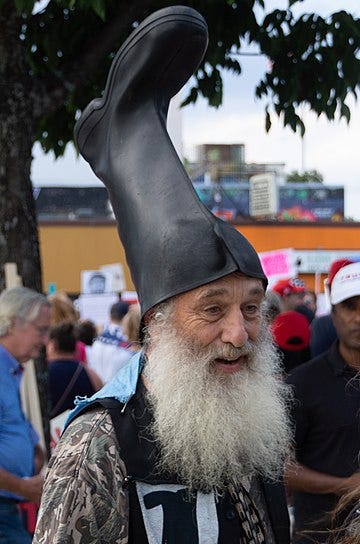
Vermin Love Supreme is a perennial candidate, oscillating between parties’ primaries, who wears a boot on his head. He then gets double-digit support in the general elections (hard to quantify based on some of the write-in quirks). Though his platform of free ponies, time-travel research and a law requiring people to brush their teeth seems to be on the big-government end of the scale, he was third in the 2020 Libertarian Party primary and has been elected to the Libertarian Party judicial committee. Told you libertarians had a sense of humor, even if Ayn Rand didn’t. He raised $74,434.
Valerie McCray, a psychologist who treated PTSD soldiers and prisoners, raised $14,786 for 17 write-in votes in Indiana. She didn’t update her blog in 2020, and her Facebook page has been removed.
John Medeiros (Real Democracy Party) raised $6,104 but suspended his campaign in September, pledging his support to Biden because Trump represents the Confederate States of America. He still got two votes in New York.
Money, but no votes
- Clifton Roberts (Humane Party): $4,490 (none from self). Ready to go vegan?
- Alex Krupkin: $4,100 (all self). His video features a cheeseburger and something that looks like a demonic squirrel with bongos.
https://www.youtube.com/watch?v=2ZWII5xW0u8
- Wanda Diggs: $3,972 (all self)
- Rev. Ronnie Fuller: $1,519 (a little more than half from herself). Like Joe Exotic, there’s no need to be deterred from running just because she’s in prison.
- Marcus Sykes (Populous Party): $1,310. The former weed dealer “will employ over 30 million Americans who use illicit drugs making them federal agents of the white house.” Also, he uses reverse swastikas, but in a good way, and he’s apparently the Antichrist, but in a good way.
- Michael Ott: $995 (nearly all from self, some loaned)
- Horace Taylor: $862. Website is coming soon, but the local paper caught up with him and found he’s a longtime military man who wants to expand health care.
- Consuela Barbetta: $500 (offsets to expenditures)
2016
Laurence Kotlikoff could surely explain his economic overhaul if you give him a couple of hours.
- 2016 national: 3,581. Texas: 1,037 (0.01%, 8th). Louisiana (1,048, 0.05%, 9th)
Clemson professor Peter Skewes of the American Party of South Carolina walked 240 miles to draw attention to the anti-PAC organization in 2016. One interesting focus: family planning to reduce unwanted pregnancies. The party has since joined the Alliance Party’s centrist umbrella.
- 2016 national: 3,250. South Carolina: 3,246 (0.15%, 7th)
Ryan Scott ran under a simple slogan: “If Trump can make a mockery of this election, why not me?” That was enough to beat Hoefling, La Riva and Kennedy in Colorado.
- 2016 national: 754. Colorado: 749 (0.03%)
Ben Hartnell is a teacher who ran in 2016 to teach his kids a civics lesson and to show off his awesome beard. He picked up votes in 10 states. 2016 national: 722. Ohio: 589 (0.01%, 8th)
ALSO IN 2020
We won’t get a full rundown of off-the-wall candidates who got votes until we get FEC data, but we can see who raised money and have not received any votes in the count at The Green Papers:
Frank Scurlock seems rather sincere, though his “All Lives Matter” slogan is tone-deaf, as is his “10% Tax — if God can live with it, so can we” mantra. (Didn’t Bono once say the God he worships isn’t short on cash?) He raised $189,000, though the FEC doesn’t yet say from whom.
Doug Shreffler raised $185,000. His site is now all about plastic surgery.
ALSO IN 2016
Some candidates identified with major parties without picking up the nomination. Cherunda Fox, whose call for reparations for Black people might not sit well with her fellow Republicans, raised $36,412 and got 233 votes. The same year, Democrat Santa Roy A. Clark, perhaps the only candidate who can compete with Ben Hartnell in the beard department, got no money and two votes.
Andrew Basiago got just 83 votes with the $17,000 he raised, but he can always go back in time and try again once the government quits covering up time-travel and teleportation technology. He also supports single-payer health care.
Claire Elliott got 15 votes, which seems like a low number for the woman who sang the song Borderline at age 8 in 1974 (Madonna’s vocals were added later), was the original Gerber Baby (the fact that such a character dates back to the 1920s is apparently irrelevant), and says Ron Goldman’s wife will soon have a book demonstrating that O.J. didn’t do it.
Elliott finished just ahead of Ajay Sood, who got 11 votes after raising $10,347. He then put up a GoFundMe page seeking $500,000.
The Green Papers site also lists The Party of Moderate Progress Within the Bounds of the Law, an initially satirical but later functioning party in pre-WWI Austria-Hungary. Candidate William Griffith raised neither cash nor votes.
James Valentine (or simply “Valentine”) raised $52,600 and got no votes. He’s a former model who writes musicals and has apparently solved all of the country’s problems in one piece of legislation.
J.W. Scroggins got no votes but raised $10,776, which surely helped him drive around in his RV with a bong in his sink while working on astral projections.
The biggest disappointment to me: The Helluva Party, represented by W. Knox Richardson and Richard Karst, got no votes.
Fake news
The real fun, of course, is the list of the other 1,000-plus candidates. Many people on that list don’t actually exist — or maybe the applicant borrowed a celebrity’s name.
(Again, these are all from 2016.)
The latter set up a missed opportunity. Someone registered Marshawn Lynch and gave his party affiliation as Peace and Freedom, not Biscuits and Gravy.
Party affiliation also set up an awkward tension between Emperor Palpatine (Concerned Citizens of Connecticut) and Darth Vader (Independent). And why is Vladimir Putin registered as a communist while Kim Jong Un is an independent? Why is Kermit Frog “other” instead of Green?
Other communists seem unlikely. Dwight Schrute seems more libertarian. And The Antichrist is surely a Republican.
More accurate party affiliations: Tyrion Lannister was running for the House of Lannister, and Tarquin Fintimlinbin Bus Stop Poontang Poontang Ole Biscuit Barrel represented the Silly Party.
Less promising — some Futurama fan registered the misspelling Why Not Zoidburg. Great sentiment, at least.
Most of these parties and candidates appeared in The Green Sheets’ FEC roundups, with the exceptions of Dwight Schrute and Deez Nuts, the latter listed with the comment “AKA Brady Olson, 15 years old, from Wallingford, Iowa.” Mr. Nuts got six votes.
Sadly, no votes for Sydneys Voluptuous Buttocks despite the catchy slogan “After All Every Politician Is An Asshole, So Whats The Difference.” And this blog post is a little sad in hindsight:
But in this time Donald Trump has said that he is running for president and has begun a climb to the top of the Republican party. Can the American people really be that lost that they would prefer a narrow minded illiberal racist bigot to run this country than a free thinking, open minded progressive citizen? The republicans are starting to have their true colors shown and they start gaining popularity? What is wrong with this country?
We can only hope Ms. Buttocks, like a lot of the quadrennial candidates above, tries again in 2024. If not, we’ll always have Kanye.
https://www.vox.com/policy-and-politics/2016/11/11/13576798/jill-stein-third-party-donald-trump-win
Sources
The 2016 results were taken from the FEC’s comprehensive report. The FEC also has current fund-raising data for 2020.
Ballotpedia has a list of all the candidates who filed.
There’s always Wikipedia.
But the go-to site is The Green Papers. Don’t let the mid-90 design fool you — check out their full vote count and a list of candidates by party that sums up financial info and declaration/withdrawal dates by party and candidate, each year.
 Mostly Modern Media