The whole point of this series is to present SNL reviews that are less snarky than all the other reviews by writers who tear at each episode with such venom that we can only wonder when they were turned down for a job at the show. (Or, in some cases, by people who confuse “anti-comedy” with intelligence.)
It’s not that these reviews will be completely deferential. It’s just that a cultural institution that means this much to so many people, particularly those of us in Gen X, that we’re going to treat it with a bit of respect.
So while we’ll mention the things that don’t work, we won’t dwell on them.
With all that in mind, here’s the review of the Oct. 10 episode featuring Bill Burr.
…
…
…
Well, Weekend Update and Jack White were good, right?
The big problem is Burr. Whether his monologue was “offensive” is a red herring. The problem is that his “hey, isn’t political correctness silly?” routine wore thin sometime during the Bush administration.
Some hosts get a chance to show greater range than we would have expected. The best recent example is Adam Driver, who has become one of the most respected film actors today but has surely raised his star power several orders of magnitude by re-creating his Kylo Ren character in Undercover Boss spoofs (53 million YouTube views), impaling a bird as a ruthless oil baron (12 million), investigating what went horribly wrong at his kids’ sleepover (6.8 million), hosting a show on cat videos (5.7 million) or trying not to lose his cool as the host of a kids’ science show (only 3.8 million?).
Burr was Burr. Cranky. Not PC. The only sketch in which it worked was one that asked the question of whether working-class Bostonians would really want a pumpkin-flavored Sam Adams beer.
The show also just seemed a little off from a technical standpoint once again. The cold open gave Maya Rudolph better material than she has usually had for her Kamala Harris impression, and Beck Bennett perfectly captured Mike Pence’s lack of personality, but the attempts to turn Joe Biden and Herman Cain into flies on Pence’s forehead felt labored.
Then the end of the show, for the second straight week, seemed to be missing a sketch or running over time. I don’t see any “Cut for Time” sketches on YouTube, though.
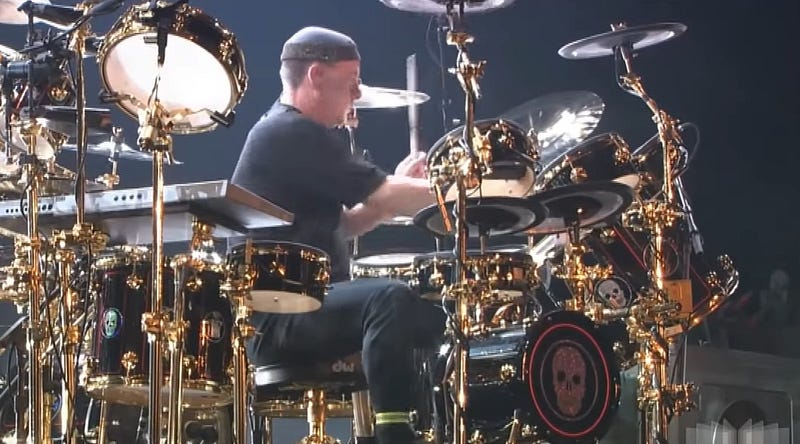
But SNL made the best of a bad situation with its musical guest. Country singer Morgan Wallen’s invitation was rescinded when video emerged of him showing a cavalier attitude toward COVID-19 safety. Enter Jack White, the best musical guest in recent memory, who ripped through two memorable performances with a drummer who didn’t seem at all hindered by having a drum kit that looked like it was set up in the wrong direction.
And Weekend Update made great use of three boundless sources of comedy — Colin Jost, Michael Che and “president and active bioweapon” Donald Trump.
So SNL is a little shaky so far. They might not have figured out how to juggle 20 cast members yet. (Have we seen Melissa Villaseñor at all this season?) They might still be re-acquainting themselves with Studio 8H and adjusting to doing live television during a pandemic.
Entertainment inevitably has some generation gaps.
Billie Eilish wound up as the poster child for generational barriers when she admitted late last year that she didn’t know Van Halen, starting a controversy brilliantly and kindly resolved by Wolfgang Van Halen.
Eilish never deserved any mockery or scorn in the first place. She was born in 2001. She was born 23 years after Van Halen’s first album. She was born after Van Halen’s Gary Cherone era. Van Halen has released one studio album in her lifetime.
Let’s find something comparable for a Gen Xer born in 1970. We’ll need to find a musical act that debuted in the late 1940s, faded in the 1960s and released one album after 1970. Muddy Waters is close to that timeline, but he released several albums after 1970 and was arguably better appreciated toward the end of his life. Plenty of jazz musicians were big before rock took over in the mid-1950s, but they all keep releasing albums every 15 minutes or so until they pass away.
This is a roundabout way of getting to the just-concluded season of Saturday Night Live, in which Gen Xers often haven’t heard of the musical guests. We also tend to think of Chance the Rapper and Justin Timberlake as great SNL hosts rather than musicians. We don’t get Kyle Mooney’s sketches, and we’re a little hazy on TikTok.
And we’re probably not being hired to write “best of” compilations, so I decided to do one anyway. In chronological order, wrapping up with the wonderful “at home” editions.
(Not including Weekend Update, which has been terrific throughout the Jose-Che tenure.)
Inside the Beltway
Perhaps a bit too painful, as we go back through history to see how many times we’ve written off Trump. Kenan Thompson provides the succinct voice of reason, and Aidy Bryant cracks up after a live-television mishap.
The War in Words: William and Lydia
Mikey Day stars in this recurring parody of historical documentaries with soldiers at the front writing letters home. Phoebe Waller-Bridge is perfect for the role as the exchange of letters grows more exasperating each time.
Mid-Day News
A quick study of racist undertones and an emphatic part of Ego Nwodim’s breakout season. (Inexplicably, her riotous and relatable take as a parent at wit’s end hiding in her closet during quarantine was online-only.)
SoulCycle
Some of the best SNL sketches are the ones that cycle quickly through the cast as they roll out impressions or characters that are great in small doses. They’ve done this basic premise more than once, and it works, especially with these auditions for spin class instructors living up to every hyper stereotype of spin class instructors. Kate McKinnon shines as the one who was kicked out of Scientology, and Ego Nwodim and Alex Moffat provide comic foils for each other as two bickering riders.
E-Sports Reporter
When Chance the Rapper first hosted, he played an MSG sideline reporter who usually did basketball but was pulled in for sub duty on a hockey game, which he did quite uncomfortably. The joke is even better here, with Chance filling in for all of us trying to make sense out of the notion that people will pay to watch other people play video games.
2020 Democratic Debate
Most of the debate sketches were good this season, but Cecily Strong’s terrifying Tulsi Gabbard puts this one ahead of the rest. I’ll also miss Kate McKinnon’s Midwestern grandma Elizabeth Warren and Larry David’s grumpy-yet-amiable Bernie Sanders. It’s always great to see Rachel Dratch, and Woody Harrelson (a few episodes after he hosted) is a welcome addition as Joe Biden.
Chad & JLo
Pete Davidson’s uber-chill slacker Chad is one of the better recurring characters in recent SNL memory, and Jennifer Lopez does a solid job selling a truly twisted love story, a highlight in an episode that spent entirely too much time selling us on the notion that Lopez looks fantastic for her age. Yeah, she does, but how many sketches do we need along those lines?
Sleepover
Adam Driver has become a go-to SNL host, with a deadpan delivery that fits perfectly with this role as a father who really doesn’t want to accuse any of his daughter’s sleepover guests of a misdeed in the bathroom that goes farther and farther into the abyss. (Related: Kate McKinnon is a national treasure.)
Robbie
Kealia Ohai’s husband was a remarkably good host, especially in this puncturing of the sports-underdog trope that was tired when Rudy did it.
(Yes, Ohai’s husband is J.J. Watt.)
John Mulaney Monologue
Mulaney went from SNL writer to failed eponymous sitcom star to one of the best stand-up comics in the country to a must-see SNL host.
On the Couch
Like Justin Timberlake, The Weeknd has a smooth R&B voice that lends itself quite well to music videos that take unexpected turns.
Twitch Stream
I’m barely young enough to know that gamers gain celebrity status on Twitch. Here, the ever-excellent Mikey Day suffers a string of defeats that threatens his status.
Pornhub
We can only wish this was the last word in the “now more than ever” genre of TV ads.
Airbnb Commercial
Star newcomer Chloe Fineman did some of the best “at-home” work. Here, she plays both the earnest Airbnb host and the grating overenthusiastic Swedish guest who is now in indefinite quarantine with her.
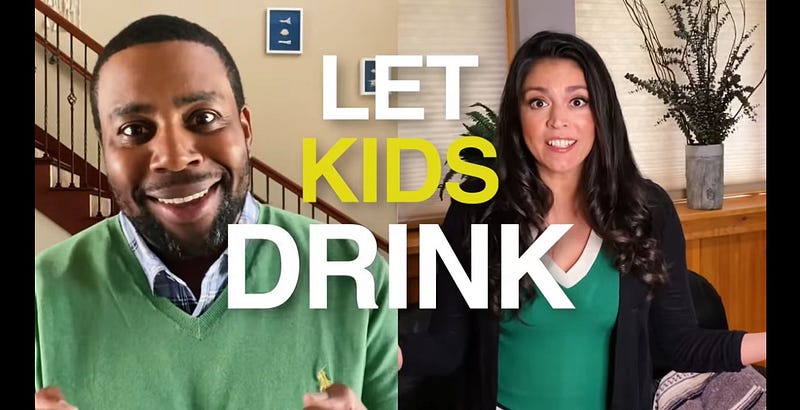
Let Kids Drink
A fitting finale for a season that went into new territory because of historic circumstances. At this point, all parents can relate to this song, which is structured like a charity appeal.
When Rush drummer Neil Peart’s death was announced, three days after it actually happened, social media and mainstream media raced to express shock and to pay tribute. Boomers and Gen Xers broke out their old T-shirts — as I write, a white-haired man across from me is wearing a Peart shirt.
Why? Would we have the same reaction if an accomplished drummer of a similar age passed away? What made Peart so beloved?
It’s not just that he was a virtuoso. The world is full of drummers who have taken the art to another level.
Before Peart, Bill Bruford brought frenetic fundamentals (his legendary part on Heart of the Sunrise is driven by something called a paradiddle-diddle) and a jazz influence to Yes and King Crimson.
Former Frank Zappa and Missing Persons drummer Terry Bozzio is on some sort of quest to place the maximum number of percussion objects within the wingspan of an average-sized human being.
But something set Peart apart. He launched legions of air drummers who could play Peart’s iconic parts on Tom Sawyer and YYZ — if only they had a drum set and world-class stick control. Even a first-rate drummer like Josh Freese joined the air-drumming movement.
RIP Neil Peart. A true artist and a sweet, good guy. And probably the most air drummed drummer of all time. This is my tribute…air drumming one of THE greatest, iconic drum moments in rock history. #neilpeart#rushhttps://t.co/01RW6pYWIl
Well into his 50s and 60s, his drum solos grew even more creative, incorporating electronic drums and samples ranging from African percussion to a full-fledged big band.
In a sense, the music world had already mourned Peart’s loss. He last performed on Aug. 1, 2015, not fully revealing until after the tour that the physical toll drumming took on his body was worse than we imagined. Even if his ailments weren’t so devastating, Peart the perfectionist wouldn’t have accepted playing at anything less than his best. He literally played at the highest level until his body gave out.
But there was more to Peart than what he could do with a pair of sticks, a drum kit whose evolution from cheap starter drums to a high-tech hodgepodge of instruments has been lovingly chronicled online, and his prodigious imagination.
He spoke to and for outcasts
Peart joined Rush for its second album — the only personnel change the band ever had — and quickly took over as their lyricist. He could harness the volumes of books that he read into thoughtful lyrics.
Some of those lyrics didn’t age well. He all but disavowed his Ayn Rand phase, to the point of an unusually blistering comment on Rand Paul when the pseudo-libertarian candidate played Rush songs at his rallies.
But the song that spoke to so many people still does. It’s Subdivisions, from the 1982 album Signals.
Whether studious or stoned, high school outcasts everywhere related to this song, featuring some of Peart’s most direct lyrics. Conform or be cast out.
So Peart let the high school daydreamer know he or she (to be honest, mostly “he”) know that he wasn’t alone.
And the path from Peart’s Ayn Rand phase to Subdivisions wasn’t completely muddled. Peart was drawn not to Rand’s selfishness, aside from the unfortunate dismissal of “begging hands and bleeding hearts” in the early song Anthem, but to the power of the individual.
The young outcasts have grown up to be creators and innovators. But we all still remember what high school was like when we weren’t among the “cool kids.”
Years later, Peart had a viable claim to be one of those “cool kids.” But that wasn’t his nature.
(H)e was so clearly not a rock star, but a bookish, shy chap, who happened to possess extraordinary dexterity on drums. — Michael Hann, The Guardian
Rush fans’ loyalty has been vindicated
For many years, being a Rush fan wasn’t cool. Critics hated the band for many reasons — Geddy Lee’s shrieking voice, the Ayn Rand stuff, and the idea that punk was more authentic than prog.
Over the years, Lee’s shriek and the Rand influence toned down. Punk burned out. And new waves of musicians all cited Rush as an influence that couldn’t be denied.
Rush made the Hall of Fame. Even better, they had the blessing of Jason Segel and Paul Rudd.
In 1997, Peart’s daughter died in a car accident. He then watched his common-law wife pass away — officially due to cancer but attributed by him to “slow suicide by apathy.”
Peart got on his motorcycle and rode for more than a year, like Forrest Gump on wheels, and wrote about the experience in a book called Ghost Rider: Travels on the Healing Road.
In the book, he revealed that he had told bandmates Geddy Lee and Alex Lifeson to “consider me retired.” But Lee and Lifeson always held the door open. Sure enough, Peart eventually came back.
Appropriately, the band’s comeback album opened with One Little Victory, a triumphant song that starts with a sonic salvo from Peart.
He also found a new family, remarrying and having a daughter who is far too young to lose her father. At least she got to see her father play with “Uncle Alex and Uncle Geddy” and will have a memory of seeing them perform while thousands cheered.
Few people knew he was sick
Peart was always active, known for a love of hiking, cross-country skiing and cycling. Aside from the ailments that sent him into retirement, he seemed perfectly fit. If the news had told us Peart had died in a motorcycle or bicycle accident, that would have been less of a shock than hearing the actual cause of death — brain cancer that had battled for more than three years.
It was typical Peart to keep such news private. He wrote of his own reticence to be the center of attention in the song Limelight. By all accounts, he was a stereotypically affable Canadian, but aside from the rare interview, he was limited his public interaction to what he could control — his lyrics, his writing, his drumming.
We didn’t even hear of his death until three days after it happened. He died Jan. 7. The news broke Jan. 10.
So we weren’t prepared. News organizations rolled out remembrances over the weekend because they didn’t have anything ready to go. If the reportedly ailing Eddie Van Halen passes away sometime soon, even though he would also be leaving us too early, the pre-written obituaries, photo galleries and listicles will be unleashed all at once.
Peart’s fellow musicians scrambled to pay tribute. Styx’s Lawrence Gowan threw a solo piano rendition of Limelight into their Jan. 10 show. Others turned to social media, some clearly as stunned and saddened as the rest of us.
Taylor Hawkins of Foo Fighters, the band that inducted Rush into the Hall of Fame, came up with the most succinct take: “Neil Peart had the hands of God. End of story.”
It all seems so unfair. This man who had come back from tragedy to heal himself and give the world another couple of decades of terrific music surely deserved more time to be a happily retired father and enjoy the respect of his peers and friends. Maybe he’d write another book. Maybe he, like Bruford, would become someone who writes about drumming rather than doing it himself.
If there’s any consolation to Peart’s family, including “Uncle Alex and Uncle Geddy,” it’s the knowledge that his work meant so much to so many.
Such accolades never seemed to mean much to him. But maybe they’ll mean something to those around him.
You have a Chevy Malibu with a MacGuffin — much like the briefcase in Pulp Fiction years later — that vaporizes those who look at it.
You have a gang of punks who talk a great game but are basically incompetent and petty.
“Just for that, you’re not in the gang any more!”
“Duke, let’s go do some crimes.” “Yeah! Let’s go get sushi and not pay!”
You have Harry Dean Stanton taking his role of a repo man even more seriously than Cliff Clavin took his role as a mailman.
You have a bunch of strange, loose narrative threads about a televangelist and shadowy government agents.
And it all hinges on a young Emilio Estevez as Otto, who finds a lifeline out of parental abandonment and economic despair by taking a job that pulls him into a world that grows more surreal as the movie proceeds.
It’s hilarious.
But did you know you were watching a commentary on the punk scene, urban decay, religion, capitalism and nuclear war? No?
Watch all 40-plus minutes here:
The video points out some subtleties in the film, especially the setting of a Los Angeles that is very much on the periphery of the glitzy parts. (And yet also not Compton, which isn’t mentioned here. The scenes in Repo Man take place in an L.A. that is simply forgotten, for better or for worse.)
It also has some interesting behind-the-scenes trivia that explains a few of the film’s eccentricities. Some of the narrative threads that don’t go anywhere are the result of studio intervention, especially about the ending. (The person who had to convey that intervention was one of the film’s backers, Michael Nesmith. Yes, that Michael Nesmith. He’s led an interesting life beyond his time as one of the Monkees.)
The debatable part of the video is the theory about the mad scientist J. Frank Parnell and the Chevy Malibu. The video suggests Parnell himself is an alien. At face value, that theory doesn’t hold up because Parnell gives a much more plausible background story:
You ever hear of the neutron bomb? Destroys people — leaves buildings standing. Fits in a suitcase. It’s so small, no one knows it’s there until — BLAMMO. Eyes melt, skin explodes, everybody dead. So immoral, working on the thing can drive you mad.
But the face-value reading doesn’t explain everything. There’s a connection between Parnell and the UFO cultists, one of whom becomes Otto’s sort-of girlfriend. The Malibu is indeed a spacecraft, as we see at the end. (That said, we learn in this video that the ending we see is not the ending director Alex Cox originally intended.)
So maybe Parnell isn’t describing himself when he talks about going mad. Maybe he really is an alien who befriended one of the scientists at one of those scary New Mexico locations. But then why would Parnell succumb to the radiation in what would presumably be his own spacecraft? Maybe they tested the neutron bomb near him, and he initially survived but suffered a lethal does of radiation poisoning?
Anyway, it’s all fun to discuss.
Another possible theory not mentioned here: Is Bud (Harry Dean Stanton) meant to be Jesus? He sacrifices himself at the end, though it’s rather pointless. And when he leaves his hospital bed, the televangelist’s voice is heard exclaiming, “He is risen!” Perhaps that’s not just a throwaway gag. And yes, a religion student has suggested just that.
The video messes up one point here: The relationship between Otto and Leila is anything but stable. Sure, maybe Leila was conflicted when the government agent came in to torture Otto, but there’s little indication that Otto sees her as anything other than a frenemy with benefits, and Leila doesn’t seem to see him as a steady boyfriend, either. It’s only at the end, when Leila is pissed off that Otto is getting called to ride the Malibu to parts unknown, that she throws in the word “relationship.”
That exchange is included in a roll of funny moments from the film:
“What about our relationship?”
“What?”
“Our relationship!”
“Fuck that!”
But it omits Leila’s last line, one of the best in a film with a lot of great ones: “You SHITHEAD! I’m glad I tortured you!”
So yes, it’s silly. But it’s also a wonderful work of art. Like The Young Ones, a British TV show of the same early-80s era, it finds humor in grim reality and adds a dose of the absurd. They also have great music.
By 1980, still in his late 20s, drummer Terry Bozzio had racked up some impressive credits with virtuoso musicians in Frank Zappa’s band and UK (replacing Bill Bruford and playing with John Wetton and Eddie Jobson).
Naturally, he decided to form a pop band with his wife, who was best known for wearing outrageous revealing clothes and adding a few yelps and squeaks to her vocals.
He wasn’t the only adept musician in the band. Guitarist Warren Cuccurullo and bassist Patrick O’Hearn also had Zappa ties. Cuccurullo went on to join Duran Duran, while O’Hearn has done film scores along with New Age and more traditional jazz music.
In Missing Persons, Bozzio, Cuccurullo and company couldn’t just unleash extended solos in 13/8 time or anything like that, and at times, you can almost hear them restraining themselves. But they managed to sneak in quite a few killer riffs that make you want to rewind a bit to see what you just heard.
Their best song, naturally, isn’t their biggest hit. They had a few charting songs, and they’re all solid tracks, but the one that has aged the best is Mental Hopscotch, which has taut interplay between Cuccurullo and keyboardist Chuck Wild over a basic pulsating beat — until Bozzio comes in with an offbeat collection of cymbal sounds to shake things up. Then we get to the chorus, where Bozzio tosses in a few toms and somehow hits the ride bell in the middle.
The video hides all that in the best effects the 80s had to offer.
Check out the band live from that era, and you see Dale Bozzio’s most notable outfit (is that … duct tape?) and Bozzio adding tom fills that would be overkill in most hands but actually fit the song quite well.
He’s also kind of animated.
Dale Bozzio is still touring with various iterations of Missing Persons. Dale and Terry are no longer married, and full-fledged reunions are problematic. But Terry is busy playing solo music on a drum set the size of Manhattan, with several bass drums and banks of toms that are theoretically tuned — drums don’t really have an absolute pitch, but you can make them sound a half-step or whole step apart. He managed to squeeze that kit into a band setting with Korn, but he mostly accompanies himself in what you might call modern classical music for drum set.
You’re probably not going to find this level of mental and physical dexterity in your typical 2010s musical act.
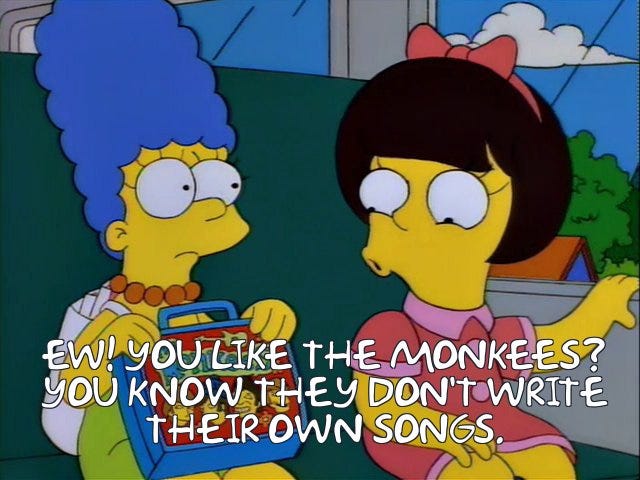
We all know the story: The Monkees were made for TV and didn’t really play their own instruments. Right?
Not quite. And some serious music flowed amid the campy fun of their TV show.
Bloom County at least added a qualifying comment: “For the most part, the Monkees never played their instruments.”
Except when they did.
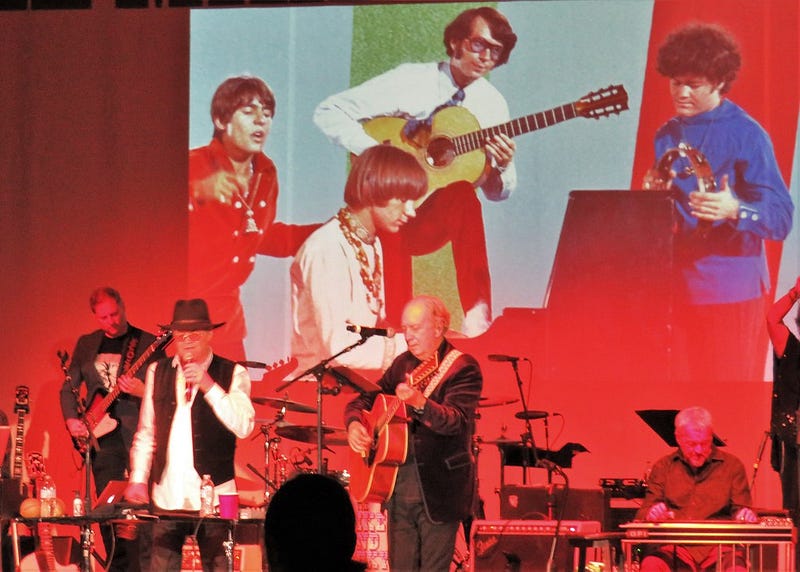
Mike Nesmith in particular fought to make the Monkees evolve from the Prefab Four to a real band. And he won, more or less. The foursome took charge of their own music for the album Headquarters, and a lot of their latter-day projects have Nesmith and Peter Tork — both perfectly capable on various stringed instruments and keyboards — playing their own parts. Micky Dolenz dutifully made his way through drum parts so the band could play live.
They’re better with a few supplemental musicians, but they’re not exactly the only band to do that. If you see Fleetwood Mac live, you’re going to see a battery of backup vocalists and the odd keyboardist or percussionist on stage. Muse has a keyboardist tucked away on stage along with the core trio. Green Day also doesn’t play live as a trio.
Nesmith did an interview with The Bitter Southerner, which refers to him as “the Southern Monkee” and laments his lack of recognition for his pioneering work in country-rock. (He’s better known for his pioneering work in music videos.) In that piece is a perfect and clever summary of the band.
In his book, Nesmith makes a comparison to a different famous puppet: Pinocchio. The Monkees were the fake band that became real. But no matter how much they moved on their own, people always saw the strings.
They certainly didn’t follow the typical rock career path. An effort to duplicate their success, the “New Monkees” created at the height of the Monkees’ MTV resurrection in the 1980s, went nowhere.
On the other hand, the Mickey Mouse Club revival in the 1990s launched the careers of Justin Timberlake, Britney Spears and Christina Aguilera. Maybe we’re due for another one?



 Mostly Modern Media