
What was it like growing up with him?
The question was often asked with a laugh after a particularly funny conversation. Or perhaps with a sympathetic head tilt after some massive argument over taxation, the U.S. military, or maybe the designated hitter.
On the latter, he was particularly inflexible. When I told him I would be rooming with a baseball fan my sophomore year at Duke, he was excited until he heard this roommate preferred the league with the DH. “I wouldn’t know what to say to an American League fan,” he grumbled. Years later, I thought we would have to rescue him from the Atlantic Hotel bar in Berlin, Md., when we were sitting in the midst of a bunch of New Englanders and Princeton alumni. He saw Boston Red Sox highlights on the TV and growled, “Is this minor league baseball?”
It would be too cliched, too simple to say my father had a heart of gold underneath the gruff exterior. He did, of course. But it manifested itself in subtle ways.
Dad showed his love for the world through a sense of responsibility. He dreaded the idea of being a burden on anyone else. He felt his decades of work as a biochemist made the world a better place. And so did his military service — finishing school early to go to Korea, then remaining in the Marine Corps Reserves for 30 years.
And that sense of responsibility included setting high standards for those around him. He insisted upon good manners, sometimes in ways of which Miss Manners might not approve. He felt that people who had advantages in life owed a deeper debt to society than those who didn’t — perhaps not in terms of how much they paid in taxes, but in terms of getting a good education, putting it to good use, and greeting others with class and grace.
When I struggled my first semester at Duke, he wasn’t angry. He simply asked me to remember that grad schools generally don’t look at people with a GPA below 3.0. After my second semester, I improved my cumulative GPA to exactly 3.0. He said that’s nice, but remember that grad schools generally don’t look at people with a GPA below 3.3.
The turning point in my father’s life was the death of my mother. At one time, they had been separated. But they moved back in together, and he never let go of his sense of responsibility for my mother as she dealt with her various ailments. As she slowly passed away, Dad made her as comfortable as possible.
On the day of Mom’s memorial service, Dad took his mind elsewhere with one more classic vetting of a family member’s significant other. My dear cousin Elizabeth was in Athens doing graduate work, and her boyfriend, a fellow Princetonian named Russell, was in town. Russell was a nice young man but had aroused Dad’s suspicion because he was (and still is) what some people would call a “Northerner.” Perhaps even a “Yankee.” Russell survived the inquisition in good humor.
Then Dad underwent a period of reflection. It was a difficult time for him, alone in his house with the dogs and the spiders. He told us he loved his dogs and wished the spiders well. And all the while, he second-guessed his treatment of my mother, wondering what he could’ve done differently.
The next year, in September 1996, Dad and I worked our way to Mom’s hometown — the aforementioned Berlin, Md., where the Hammond family has been a pillar of the community for more than 150 years. The occasion was the wedding of Elizabeth and Russell. After the ceremony, Dad was in tears — a rare occurrence for him — as he thought about how much Mom would have loved the occasion. As it turned out, he did too. When we were supposed to head over to the Hammond house, I found him in the Atlantic Hotel bar, holding court with a group of young Princetonians who were star-struck upon finding themselves in the same room as Elizabeth’s legendary Uncle Leon. They later forgave him for slighting the Red Sox, and we were all happy to see Uncle Leon in such good humor.
Early in 1997, he called me at work. That was a surprise — he was not the one to initiate phone calls. He said, “I have some startling news.” Given his health history and the fact that the last time he called me at work was with bad news about Mom’s condition, I quickly braced myself for the worst. Then he said, “I’m going to marry Meg Gunn.”

Yes, that was startling news. So was the phone call a few weeks later saying the wedding was Sunday, and he’d love it if I could come. I raced down to Athens and learned that I would be the de facto best man in a small ceremony.
A few weeks later, Dad and Miss Meg had a proper wedding reception at home, with a terrific Celtic-influenced band on the porch. I had never seen so many friends in our house. I was instructed to make a quick speech, fulfilling my best-man duties, and introduce the happy couple for their first waltz together. Meg, overflowing with joy, came up afterwards and told me how happy she was to be in my family. Dad came up afterwards with a smile, then growled, “I don’t know how to waltz!”
Dad had changed. He was no longer the leader of a band of Marines. He was a central figure in a large band of friends.
When the Dure family — now including wives or soon-to-be fiancees for Dad’s three sons — went to Sanibel Island for our annual get-together, we awoke on our first morning and gathered in the large living room of the main cottage. We figured Dad would surely stroll into the room any minute and tell us we were wasting precious time on the beach by sitting inside. As time passed, we figured he must have gone for an early walk. As more time passed, we wondered what in the world was going on. We went over to the small cottage in which he and Miss Meg were staying. We found them there, happily perusing the morning papers and lounging in their living room.
What does the story of Dad and Miss Meg say about his lifetime of responsibility? Had he gone soft all of a sudden? Quite the contrary.
When we asked Dad about the sudden transformation in his life that led him to call, date and marry Miss Meg, he had a simple answer. “I decided that being an old curmudgeon on a hill was no way to live!”
And no, it wasn’t. Not for himself, not for his family, and not for those around Athens who cared about him. At age 66, he had learned something essential about life. He realized other ways to fulfill his sense of responsibility.
He taught for more than 40 years. He won teaching awards, though the story he told most often was of the time he pegged a student right between the eyes with a piece of chalk. He demanded attention, but I’m sure the students who signed up for the seminars he taught late in his tenure were willing to give it.
And yet he was always learning. He learned more about biochemistry every day he was in the lab. He learned about foreign cultures, eagerly devouring history books and enjoying his travels — keeping an open mind about the world that the citizenry of the great state of Georgia would do well to emulate. Then in his late years, he learned about relationships. And he learned he didn’t have to drive himself so hard to be the man of great responsibility he always sought to be.
I saw him on what might have been his last day of consciousness. Through a haze, he managed to express two thoughts. He asked Belinda, our wonderful nurse, whether she had money. I don’t think he was asking to borrow any — he wanted to be sure she would be cared for. It seemed like he couldn’t quite figure out who I was, but the last sentence I heard from him was, “Thank you for coming.” To the very end, he was a Southern gentleman.
He held on for nearly two weeks after that. Perhaps, somewhere deep in his mind, he was still exploring and thinking. Perhaps he just wanted to be sure we all had time to process the news. Perhaps he was still holding out hope that the American League would give up the designated hitter.
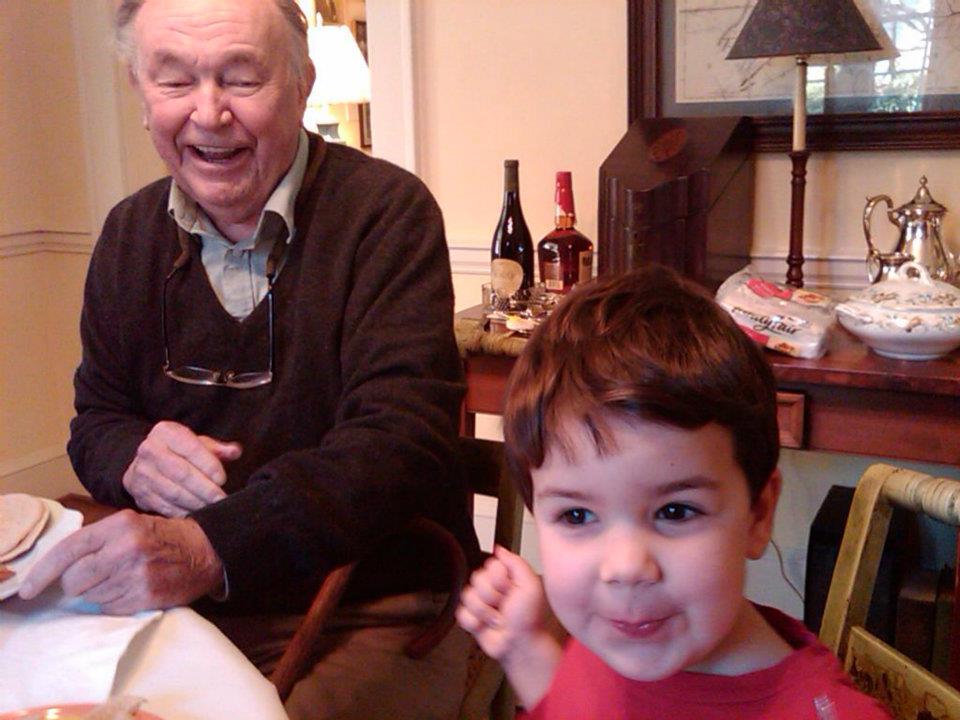
We’re not having a ceremony. As Miss Meg said, “He was way too humble for pomp and ceremony.” We all gathered for his 80th birthday in 2011, and he was almost embarrassed by the simple act of having his kids and a couple of grandkids at dinner. “You didn’t all have to come here,” he said. After a pause that he seemed to consider mischievous: “But I’m glad you did.”
So if you learn one thing from my father’s life, let it be this: Responsibility is a good way to show your love for the world. But responsibility is not static. Responsibility is constant vigilance but also constant education.
And so he taught. And so he learned. And so we learn, and so we ever shall.
Thank you, Dr. Dure. Thank you, Colonel Dure. Thank you, Uncle Leon.
Thank you, Dad.


Leave a Reply